
Speco Technologies AP500HA vs Speco Technologies APCR640L: Specification Comparison
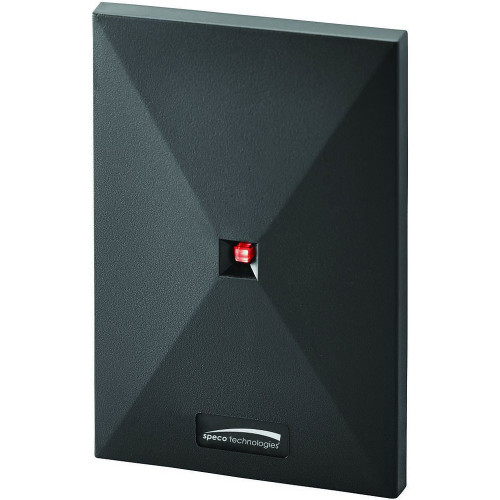
Both the Speco Technologies AP500HA and APCR640L are single-unit wall-mount access control proximity readers designed for panel integration via Wiegand output, making them genuine cross-shop candidates for installers specifying door-level credential hardware. The comparison centers on three decision axes: credential technology and read range, physical installation and environmental ratings, and output protocol and power requirements. The AP500HA is a traditional 125 kHz-only reader; the APCR640L adds Bluetooth Low Energy mobile credentials alongside 125 kHz proximity, targeting sites that want or anticipate mobile-first access.
In This Guide
- Which reader supports the credential types and read range your deployment requires?
- How do the two readers compare on weatherproofing, form factor, and mounting?
- Which unit integrates more flexibly with access control panels, and what are the power demands?
- Which should you choose: the AP500HA or the APCR640L?
- Side-by-Side Specs
- FAQ
Which reader supports the credential types and read range your deployment requires?
The AP500HA reads 125 kHz proximity cards (HID and AWID formats) at up to 8 inches. No mobile or multi-technology credential support is specified.
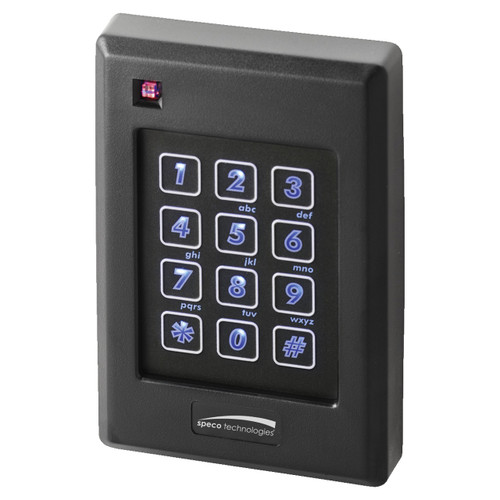
The APCR640L reads the same 125 kHz proximity cards at up to 4 inches but adds Bluetooth Low Energy (BLE) mobile credentials with a stated read range of up to 15 feet in mobile mode. It also incorporates an integrated keypad, which is not listed for the AP500HA.
For deployments limited to legacy 125 kHz card stock, the AP500HA's 8-inch card read range exceeds the APCR640L's 4-inch card range. For sites adopting or planning smartphone-based credentials, the APCR640L's 15-foot BLE range is a distinct functional advantage not available on the AP500HA.
How do the two readers compare on weatherproofing, form factor, and mounting?
Both units carry an IP67 weatherproof rating and are listed for outdoor use. Both include a beeper and LED indicators and ship with a black snap-on cover.
The APCR640L provides explicit physical dimensions (3 inches wide × 4.6 inches high × 0.75 inches deep) and is specified as a single-gang wall-mount form factor, simplifying rough-in planning. Physical dimensions for the AP500HA are not provided in the available specifications.
The APCR640L is additionally described as tamper-resistant, a spec not stated for the AP500HA. Operating temperature ranges are nearly identical: AP500HA at −40°F to 149°F; APCR640L at −31°F to 150°F. The AP500HA carries ETL listing and NDAA Section 889 Part B compliance; the APCR640L's certifications are not specified in the provided data.
Which unit integrates more flexibly with access control panels, and what are the power demands?
The AP500HA outputs Wiegand ABA Track II only, drawing 30 mA at 12 VDC from a 5–16 VDC supply. This is compatible with virtually any legacy Wiegand-capable access panel.
The APCR640L outputs either Wiegand 26-bit or OSDP8, switchable per installation. OSDP (Open Supervised Device Protocol) enables encrypted, bidirectional communication and device supervision on panels that support it—functionality not available on the AP500HA. Peak current draw is 90 mA at +8 to +14 VDC, three times the AP500HA's stated draw, which may require wire-gauge or power-supply review on longer cable runs.
The AP500HA's lower current draw is advantageous in multi-reader or distance-sensitive wiring scenarios. The APCR640L's OSDP8 option adds a meaningful security and diagnostics layer for modern panel platforms, at the cost of higher current consumption.
Which should you choose: the AP500HA or the APCR640L?
Our take: The AP500HA is the stronger choice when a project is limited to legacy 125 kHz card credentials, demands minimal current draw (30 mA vs. 90 mA peak), requires NDAA Section 889 Part B compliance, or specifies ETL listing—none of which are confirmed for the APCR640L in the available data. The APCR640L is the stronger choice when mobile BLE credentials are required (up to 15 ft range vs. no BLE on the AP500HA), when an OSDP-capable panel is in play for encrypted supervision, or when a standard single-gang form factor with known dimensions (3" × 4.6" × 0.75") simplifies installation planning. The 4-inch card read range on the APCR640L is notably shorter than the AP500HA's 8 inches for proximity-only use. Platform fit is the deciding factor: legacy Wiegand-only panels favor the AP500HA; modern OSDP or mobile-credential deployments favor the APCR640L.
Side-by-Side Comparison
Spec-for-spec, from manufacturer data.
| Specification | Speco Technologies AP500HA | Speco Technologies APCR640L |
|---|---|---|
| Credential Technology | 125 kHz Proximity (HID/AWID) | 125 kHz Proximity + Bluetooth Low Energy (BLE) |
| Card Read Range | 8 inches | 4 inches |
| Mobile Read Range | — | Up to 15 ft (BLE) |
| Output Protocol | Wiegand ABA Track II | Wiegand 26-bit or OSDP8 |
| Integrated Keypad | — | Yes |
| Power Supply Range | 5–16 VDC | +8 to +14 VDC |
| Current Draw | 30 mA @ 12 VDC | 90 mA peak |
| IP Rating | IP67 | IP67 |
| Tamper Resistant | — | Yes |
| Operating Temperature | −40°F to 149°F | −31°F to 150°F |
| Environment Rating | Outdoor | Outdoor (indoor covered also noted) |
| Form Factor | — | Single-gang wall mount, 3" W × 4.6" H × 0.75" D |
| Housing Color | White (black snap-on cover included) | White (black snap-on cover included) |
| Audio / LED Feedback | Beeper and LED indicators | Beeper and LED indicators |
| Certifications | ETL, NDAA Section 889 Part B, FCC, CE | Not specified in available data |
| Warranty | 2-year | 2-year |
Frequently Asked Questions
Which should you choose: the AP500HA or the APCR640L?
The AP500HA is the stronger choice when a project is limited to legacy 125 kHz card credentials, demands minimal current draw (30 mA vs. 90 mA peak), requires NDAA Section 889 Part B compliance, or specifies ETL listing—none of which are confirmed for the APCR640L in the available data. The APCR640L is the stronger choice when mobile BLE credentials are required (up to 15 ft range vs. no BLE on the AP500HA), when an OSDP-capable panel is in play for encrypted supervision, or when a standard single-gang form factor with known dimensions (3" × 4.6" × 0.75") simplifies installation planning. The 4-inch card read range on the APCR640L is notably shorter than the AP500HA's 8 inches for proximity-only use. Platform fit is the deciding factor: legacy Wiegand-only panels favor the AP500HA; modern OSDP or mobile-credential deployments favor the APCR640L.
Can either reader work with smartphone-based credentials?
Only the APCR640L supports smartphone credentials, using Bluetooth Low Energy (BLE) with a stated mobile read range of up to 15 feet. The AP500HA reads 125 kHz proximity cards only (HID and AWID); no BLE or mobile credential capability is specified for it.
Is the AP500HA or APCR640L better for installations that need NDAA compliance?
The AP500HA is explicitly listed as NDAA Section 889 Part B compliant. NDAA compliance is not stated in the available specifications for the APCR640L. If NDAA compliance is a project requirement, the AP500HA is the documented choice; verify APCR640L status directly with Speco Technologies before specifying it for federal or government-adjacent projects.
Will either reader connect to an OSDP-capable access control panel?
Yes—the APCR640L supports either Wiegand 26-bit or OSDP8 output, making it compatible with modern OSDP-capable panels for encrypted, bidirectional communication. The AP500HA outputs Wiegand ABA Track II only; OSDP is not listed as a supported interface, so it is limited to panels with a Wiegand input.
More Access Control Reader Comparisons
- HID 5365EGP00 vs Comelit 909020116
- HID 5365EGP00 vs Speco Technologies AP500HA
- HID 5365EGP00 vs Comelit 909020113
- HID 5365EGP00 vs HID 20NKS-00-000000
- HID 5365EGP00 vs HID 40NKS-00-000000
- Comelit 909020116 vs Speco Technologies AP500HA
Access Control Reader Buying Guides
Get a Second Opinion on Your Camera Choice
Share your site layout, coverage goals, and budget. Our team will validate the camera selection, flag anything we would change, and recommend products that match the use case.