
Janam XT3-STKJBMNW00 vs Zebra MC3330XR: Specification Comparison
Both the Janam XT3-STKJBMNW00 and the Zebra MC333U-GJ4EG4US-1SKT (MC3330XR kit) are Android-based rugged RFID handheld mobile computers targeting warehouse, retail, and field-mobility deployments where UHF/HF RFID reading and barcode scanning are required simultaneously. Buyers in logistics, inventory control, and asset tracking frequently cross-shop these two devices based on form factor, OS version, scan capability, and ruggedization. This comparison evaluates the three most decision-relevant dimensions: RFID and scanning capability, ruggedness and physical design, and OS/wireless platform.
In This Guide
- How do the RFID, NFC, and barcode scanning capabilities compare?
- How do ruggedness ratings, form factor, and physical design differ?
- What OS version, wireless standards, and enterprise management platform does each support?
- Which should you choose: the XT3-STKJBMNW00 or the MC3330XR?
- Side-by-Side Specs
- FAQ
How do the RFID, NFC, and barcode scanning capabilities compare?
The Janam XT3-STKJBMNW00 specifies NFC support with ISO14443 Type A/B, ISO15693, MIFARE 1k/4k/Plus/UltraLight/DESFire, and Sony FeliCa — covering NFC Forum Tags 1–5. Its 2D imager reads 1D symbologies (Code 128, Code 39, UPC, EAN) and 2D symbologies (QR Code, Data Matrix, PDF417). The spec also lists RFID as a feature alongside the NFC engine, though the specific RFID frequency band (HF vs. UHF) and read range are not detailed in the provided specifications.
The Zebra MC3330XR is described in its product name and Features field as a 'UHF RFID GUN,' explicitly positioning it as a UHF RFID reader. Its barcode engine is listed as 1D/2D Imager with Short Range classification. However, the specific UHF frequency, read range, NFC support, and detailed symbology list are not provided in the available specifications for Product B.
For buyers whose primary need is long-range UHF RFID inventory sweeping, the Zebra's explicit UHF designation is a meaningful differentiator. For HF/NFC contactless card and tag reading (access control, loyalty, smart labels), the Janam's detailed NFC protocol stack is the only spec-confirmed option between the two.
How do ruggedness ratings, form factor, and physical design differ?
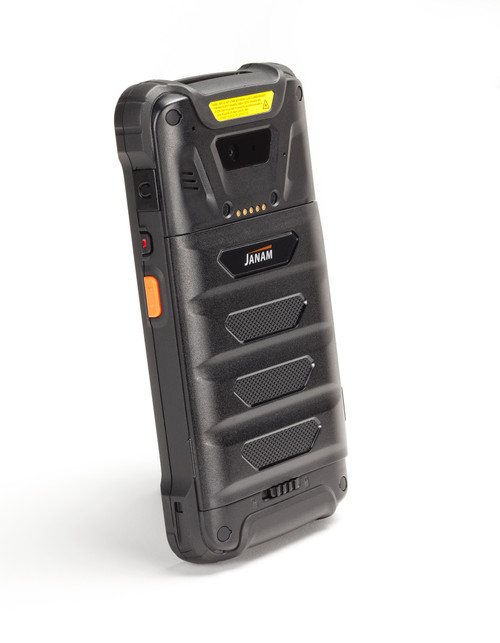
The Janam XT3-STKJBMNW00 carries an IP67 rating (dust-tight and immersion-resistant to 1 meter) and a verified drop specification of 1.5m (5 ft) to concrete on all sides. It uses a slab/candybar form factor with a 5-inch HD (1280×720) IPS display rated at 500 nits for daylight readability, protected by Corning Gorilla Glass. The device weighs 9.5 oz / 272 g with battery and measures 156mm × 82mm × 21mm. It includes 9 programmable external buttons and supports an optional 5800mAh extended battery in addition to the standard 2900mAh pack.
The Zebra MC3330XR uses a pistol-grip form factor, which is ergonomically suited for sustained trigger-pull scanning in warehouse aisles. Its display is rated for indoor use. The durability is listed as 'Rugged' and the battery is described as 'Extended Battery,' but no IP rating, specific drop specification, display size, nit rating, or weight is provided in the available specifications.
The form-factor difference is operationally significant: the Janam's slab design suits mixed-use mobility (voice, app navigation, occasional scan), while the Zebra's pistol grip is optimized for high-volume, repetitive scan-and-move workflows. Buyers cannot make a direct IP or drop comparison for the Zebra from the provided data.
What OS version, wireless standards, and enterprise management platform does each support?
The Janam XT3-STKJBMNW00 runs Android 11 with Google Mobile Services (GMS) and is Android Enterprise Recommended (AER), confirming compliance with Google's enterprise management requirements. Wireless connectivity covers 802.11a/b/g/n/ac with amendment support for d/h/i/k/r/v (fast roaming, band steering, voice-grade QoS), plus Bluetooth 5.0 BLE. An optional WWAN radio is available via a single micro SIM slot. The processor is a 2.2 GHz Qualcomm Snapdragon octa-core; RAM/storage is 4GB/64GB (3GB/32GB optional). Interfaces include USB-C and Pogo Pin for charging/data.
The Zebra MC3330XR lists Android with GMS as its OS but does not specify the Android version in the provided specifications. Connectivity is listed as Bluetooth and Wi-Fi (802.11) without specifying which 802.11 amendments are supported. Flash memory is 32GB; RAM is not specified. The device carries a 47-key alpha-numeric physical keypad, which the Janam does not match (9 programmable buttons vs. full alpha-numeric). WWAN capability, processor, and specific MDM platform compatibility are not stated in the available specifications.
The Janam's Android 11 AER status, specific Wi-Fi amendment list (including 802.11k/r/v for seamless roaming), and Bluetooth 5.0 BLE are all spec-confirmed. The Zebra's Android version, Wi-Fi amendment support, and RAM remain unconfirmed from the provided data, limiting a complete apples-to-apples platform comparison.
Which should you choose: the XT3-STKJBMNW00 or the MC3330XR?
Our take: The XT3-STKJBMNW00 is the stronger choice when the deployment requires a confirmed Android 11 AER platform, detailed NFC protocol support, IP67-rated ruggedization, and a verified 1.5m drop spec in a slab form factor. Concrete spec deltas favor the Janam on OS currency (Android 11 vs. unspecified Android version for the Zebra), wireless rigor (802.11a/b/g/n/ac/d/h/i/k/r/v with roaming amendments vs. generic '802.11' for the Zebra), and NFC depth (ISO14443/ISO15693/MIFARE/FeliCa stack vs. no NFC detail provided for the Zebra). The Zebra MC3330XR's explicit UHF RFID designation and pistol-grip form factor make it the operationally superior choice for high-volume warehouse RFID inventory scanning where trigger-pull ergonomics and long-range UHF reads are the primary workflow driver. Platform-conscious IT teams standardized on Zebra's MDM ecosystem should also weigh vendor consistency before cross-shopping.
Side-by-Side Comparison
Spec-for-spec, from manufacturer data.
| Specification | Janam XT3-STKJBMNW00 | Zebra MC3330XR |
|---|---|---|
| Operating System | Android 11 (GMS / AER) | Android with GMS (version not specified) |
| Form Factor | Slab / Candybar | Pistol Grip |
| RFID Type | RFID + NFC (frequency not specified) | UHF RFID (explicit) |
| NFC Protocols | ISO14443 A/B, ISO15693, MIFARE, FeliCa, NFC Forum 1–5 | — |
| Barcode Engine | 1D/2D Imager | 1D/2D Imager |
| 1D Symbologies | Code 128, Code 39, UPC, EAN | Supported (details not specified) |
| 2D Symbologies | QR Code, Data Matrix, PDF417 | Supported (details not specified) |
| Wi-Fi Standards | 802.11a/b/g/n/ac/d/h/i/k/r/v | 802.11 (amendments not specified) |
| Bluetooth | Bluetooth 5.0 BLE | Bluetooth (version not specified) |
| IP Rating | IP67 | — |
| Drop Rating | 1.5m (5 ft) to concrete | — |
| Processor | 2.2 GHz Qualcomm Snapdragon octa-core | — |
| RAM / Storage | 4GB / 64GB (3GB / 32GB optional) | — / 32GB Flash |
| Display | 5" HD (1280×720) IPS, 500 nits, Gorilla Glass | Indoor display (size/nits not specified) |
| Battery | 2900mAh Li-ion (5800mAh optional) | Extended Battery (capacity not specified) |
| Keypad | 9 programmable external buttons | 47-key alpha-numeric |
| WWAN | Optional (1× micro SIM) | — |
| Weight | 9.5 oz / 272 g (with battery) | — |
Frequently Asked Questions
Which should you choose: the XT3-STKJBMNW00 or the MC3330XR?
The XT3-STKJBMNW00 is the stronger choice when the deployment requires a confirmed Android 11 AER platform, detailed NFC protocol support, IP67-rated ruggedization, and a verified 1.5m drop spec in a slab form factor. Concrete spec deltas favor the Janam on OS currency (Android 11 vs. unspecified Android version for the Zebra), wireless rigor (802.11a/b/g/n/ac/d/h/i/k/r/v with roaming amendments vs. generic '802.11' for the Zebra), and NFC depth (ISO14443/ISO15693/MIFARE/FeliCa stack vs. no NFC detail provided for the Zebra). The Zebra MC3330XR's explicit UHF RFID designation and pistol-grip form factor make it the operationally superior choice for high-volume warehouse RFID inventory scanning where trigger-pull ergonomics and long-range UHF reads are the primary workflow driver. Platform-conscious IT teams standardized on Zebra's MDM ecosystem should also weigh vendor consistency before cross-shopping.
Which device is better for warehouse UHF RFID inventory sweeps?
Based on the provided specifications, the Zebra MC3330XR is explicitly described as a 'UHF RFID GUN' with a pistol-grip form factor optimized for high-volume trigger-pull scanning — making it the spec-indicated choice for UHF RFID warehouse workflows. The Janam XT3-STKJBMNW00 lists RFID and NFC capability but does not specify UHF frequency or read range in the provided data.
Does the Janam XT3-STKJBMNW00 support enterprise MDM deployment out of the box?
Yes. The XT3-STKJBMNW00 is listed as Android Enterprise Recommended (AER) and ships with Android 11 GMS, confirming it meets Google's validated requirements for enterprise MDM enrollment and management. The Zebra MC3330XR lists Android with GMS but does not specify Android version or AER status in the provided specifications.
Which device has a better-documented ruggedness rating?
The Janam XT3-STKJBMNW00 has spec-confirmed IP67 dust and water resistance and a stated 1.5m (5 ft) drop-to-concrete rating. The Zebra MC3330XR is described as 'Rugged' in its specifications, but no IP rating or specific drop height is provided in the available data, so a direct numerical comparison cannot be made.
More Mobile Computer Comparisons
- Janam XT40-ATHKRMGW00 vs Zebra MC3390XR
- Janam XT40-ATHKRMGW00 vs Zebra MC3330XR
- Janam XT40-ATHKRMGW00 vs Janam XT3-STHGBMGW01
- Janam XT40-ATHKRMGW00 vs Janam XT3-STHJBMGW00
- Janam XT3-STHGBMGW01 vs Zebra MC3390XR
- Janam XT3-STHGBMGW01 vs Zebra MC3330XR
Mobile Computer Buying Guides
Get a Second Opinion on Your Camera Choice
Share your site layout, coverage goals, and budget. Our team will validate the camera selection, flag anything we would change, and recommend products that match the use case.