
Janam XR2-ATHKYMGWU0 vs Zebra MC3330XR: Specification Comparison
Both the Janam XR2-ATHKYMGWU0 and the Zebra MC333U-GJ4EG4US-1SKT (MC3330XR kit) are rugged Android UHF RFID handheld computers targeting warehouse, retail, and field inventory operations. The Janam is a bar-style form factor with integrated cellular, while the Zebra ships as a pistol-grip gun kit. This comparison evaluates RFID and scanning capability, ruggedness and physical design, and connectivity and OS platform — the three axes most relevant to buyers choosing between these two purpose-built RFID mobile computers.
In This Guide
- How do RFID read performance and barcode scanning capabilities compare?
- Which device offers stronger ruggedness ratings and how do form factor differences affect field use?
- How do wireless connectivity, cellular support, OS version, and platform longevity compare?
- Which should you choose: the XR2-ATHKYMGWU0 or the MC3330XR?
- Side-by-Side Specs
- FAQ
How do RFID read performance and barcode scanning capabilities compare?
The XR2-ATHKYMGWU0 specifies a UHF RFID scan rate of 1,300+ tags/sec and uses a Honeywell N5703 1D/2D imager supporting GS1-128, Code 39, Code 128, QR, and Data Matrix symbologies. The RFID coverage is noted as North America frequency band.
The MC333U-GJ4EG4US-1SKT lists UHF RFID reader capability and a 1D/2D imager, but its provided specs do not state a tag read rate, specific scan engine model, or supported symbology list. Its scanner range is described as Short Range; no equivalent detail is disclosed for the Janam's RFID read range.
On the barcode side, both support 1D and 2D codes. The Janam provides engine model and explicit symbology enumeration; the Zebra's spec sheet as provided does not. Buyers requiring a published minimum tag throughput figure have that number only for the Janam.
Which device offers stronger ruggedness ratings and how do form factor differences affect field use?
The XR2-ATHKYMGWU0 carries an IP67 sealing rating and a 1.2 m (4 ft) drop specification to concrete. It uses a bar/slab form factor weighing 678 g (23.9 oz) with dimensions of 143.3 × 169 × 90.5 mm. The display is 5.7 in. (720 × 1440) with Corning Gorilla Glass.
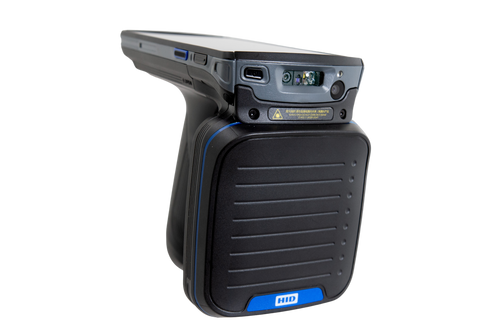
The MC333U-GJ4EG4US-1SKT is described as 'Rugged' and ships in a pistol-grip form factor with an indoor-rated display and a 47-key alpha-numeric keypad. However, the provided specifications do not include an IP rating, a drop-test height, weight, or physical dimensions.
The pistol-grip layout of the Zebra is typically preferred for sustained trigger-pull scanning or RFID sweeping of shelves, reducing hand fatigue versus a brick-style device. The Janam's brick form factor with its larger display may suit workers who alternate between RFID reads and data entry. Ruggedness can only be quantified for the Janam from the data provided.
How do wireless connectivity, cellular support, OS version, and platform longevity compare?
The XR2-ATHKYMGWU0 runs Android 13 AOSP with a stated upgrade path to Android 15. It includes Bluetooth 5.1, 802.11a/b/g/n Wi-Fi across channels 1–13 and 34–165, and a dual-SIM GSM/LTE radio covering FDD-LTE bands B1–B5/B7/B8/B12 and TD-LTE B34/B38/B39/B40/B41. Storage is 4 GB RAM / 64 GB internal plus a microSD slot up to 512 GB. The processor is a 2.45 GHz Qualcomm octa-core. GPS includes A-GPS, BeiDou, GLONASS, and Galileo.
The MC333U-GJ4EG4US-1SKT runs Android with GMS (Google Mobile Services), which provides access to the Google Play ecosystem and enterprise mobility management tools certified against GMS. Flash storage is listed as 32 GB. Connectivity is Bluetooth and Wi-Fi 802.11, but specific 802.11 bands, Bluetooth version, LTE support, RAM, processor, and GPS capability are not stated in the provided specifications.
The Janam's AOSP build omits GMS; enterprise app deployment requires sideloading or a non-Play MDM channel. The Zebra's GMS build supports standard Android Enterprise enrollment and Play-managed apps. Cellular connectivity is present on the Janam and not specified for the Zebra, which is relevant for deployments outside Wi-Fi coverage.
Which should you choose: the XR2-ATHKYMGWU0 or the MC3330XR?
Our take: The XR2-ATHKYMGWU0 is the stronger choice when cellular connectivity, a published RFID throughput figure, and a larger OS upgrade runway are primary requirements. It specifies 1,300+ tags/sec UHF read rate, dual-SIM LTE with multi-band coverage, and an Android 13 AOSP platform upgradable to Android 15 — none of which are confirmed in the MC3330XR's provided specs. The Janam also documents IP67 sealing and a 1.2 m drop rating; comparable ruggedness figures are absent for the Zebra. Conversely, the MC333U-GJ4EG4US-1SKT's pistol-grip form factor reduces operator fatigue during extended RFID sweeps, and its Android with GMS build simplifies Play-based enterprise app management and standard Android Enterprise MDM enrollment. Buyers running GMS-dependent EMM platforms or requiring the ergonomic benefit of a trigger-grip should evaluate the Zebra, recognizing that key ruggedness and performance specs would need to be sourced from Zebra's full datasheet before finalizing the decision.
Side-by-Side Comparison
Spec-for-spec, from manufacturer data.
| Specification | Janam XR2-ATHKYMGWU0 | Zebra MC3330XR |
|---|---|---|
| Form Factor | Bar / Slab (brick) | Pistol Grip |
| Operating System | Android 13 AOSP; upgradable to Android 15 | Android with GMS |
| UHF RFID | Yes — North America | Yes |
| RFID Read Rate | 1,300+ tags/sec | — |
| Scan Engine | Honeywell N5703 1D/2D imager | 1D/2D imager (engine not specified) |
| Barcode Symbologies | GS1-128; Code 39; Code 128; QR; Data Matrix | — |
| IP Rating | IP67 | — |
| Drop Rating | 1.2 m (4 ft) to concrete | — |
| Processor | 2.45 GHz Qualcomm octa-core | — |
| RAM | 4 GB | — |
| Internal Storage | 64 GB | 32 GB |
| Expandable Storage | microSD up to 512 GB | — |
| Battery | 9,000 mAh 3.7 V Li-ion | Extended Battery (capacity not specified) |
| Wi-Fi | 802.11a/b/g/n | 802.11 (bands not specified) |
| Bluetooth | Bluetooth 5.1 | Bluetooth (version not specified) |
| Cellular / LTE | Dual-SIM GSM/LTE (FDD + TD-LTE multi-band) | — |
| GPS | A-GPS, BeiDou, GLONASS, Galileo | — |
| Display | 5.7 in. 720×1440 Corning Gorilla Glass | Indoor display (size/resolution not specified) |
| Keypad | — | 47-key alpha-numeric |
| Weight | 678 g (23.9 oz) | — |
| RoHS Compliance | Directive 2011/65/EU; Amendment 2015/863; REACH SVHC 1907/2006 | — |
Frequently Asked Questions
Which should you choose: the XR2-ATHKYMGWU0 or the MC3330XR?
The XR2-ATHKYMGWU0 is the stronger choice when cellular connectivity, a published RFID throughput figure, and a larger OS upgrade runway are primary requirements. It specifies 1,300+ tags/sec UHF read rate, dual-SIM LTE with multi-band coverage, and an Android 13 AOSP platform upgradable to Android 15 — none of which are confirmed in the MC3330XR's provided specs. The Janam also documents IP67 sealing and a 1.2 m drop rating; comparable ruggedness figures are absent for the Zebra. Conversely, the MC333U-GJ4EG4US-1SKT's pistol-grip form factor reduces operator fatigue during extended RFID sweeps, and its Android with GMS build simplifies Play-based enterprise app management and standard Android Enterprise MDM enrollment. Buyers running GMS-dependent EMM platforms or requiring the ergonomic benefit of a trigger-grip should evaluate the Zebra, recognizing that key ruggedness and performance specs would need to be sourced from Zebra's full datasheet before finalizing the decision.
Does either device support cellular LTE for use outside warehouse Wi-Fi coverage?
Yes, the Janam XR2-ATHKYMGWU0 includes a dual-SIM GSM/LTE radio covering multiple FDD-LTE and TD-LTE bands and is explicitly specified for cellular use. The MC333U-GJ4EG4US-1SKT's provided specifications list only Bluetooth and Wi-Fi 802.11; no LTE capability is stated for it in the available data.
Which device is better suited to a GMS-based MDM or enterprise mobility management platform?
The MC333U-GJ4EG4US-1SKT runs Android with GMS, meaning it supports Google Play-managed apps and standard Android Enterprise (zero-touch, managed profiles) enrollment. The XR2-ATHKYMGWU0 runs Android 13 AOSP without GMS, so app distribution and MDM must be handled through non-Play channels such as sideloading or an AOSP-compatible EMM. If your MDM relies on GMS APIs or Play deployment, the Zebra is the compatible choice.
Is the Janam XR2-ATHKYMGWU0 or the Zebra MC3330XR better for high-volume RFID tag reading?
The XR2-ATHKYMGWU0 publishes a UHF RFID read rate of 1,300+ tags/sec. The MC333U-GJ4EG4US-1SKT's provided specifications do not state a tag read rate, so a direct numerical comparison cannot be made from the available data. Buyers requiring a guaranteed minimum throughput figure should request the full Zebra datasheet to obtain that specification before making a decision.
More Mobile Computer Comparisons
- Janam XT40-ATHKRMGW00 vs Zebra MC3390XR
- Janam XT40-ATHKRMGW00 vs Zebra MC3330XR
- Janam XT40-ATHKRMGW00 vs Janam XT3-STHGBMGW01
- Janam XT40-ATHKRMGW00 vs Janam XT3-STHJBMGW00
- Janam XT3-STHGBMGW01 vs Zebra MC3390XR
- Janam XT3-STHGBMGW01 vs Zebra MC3330XR
Mobile Computer Buying Guides
Get a Second Opinion on Your Camera Choice
Share your site layout, coverage goals, and budget. Our team will validate the camera selection, flag anything we would change, and recommend products that match the use case.