
i-PRO X35402-F2L vs i-PRO X35402-F2LM: Specification Comparison
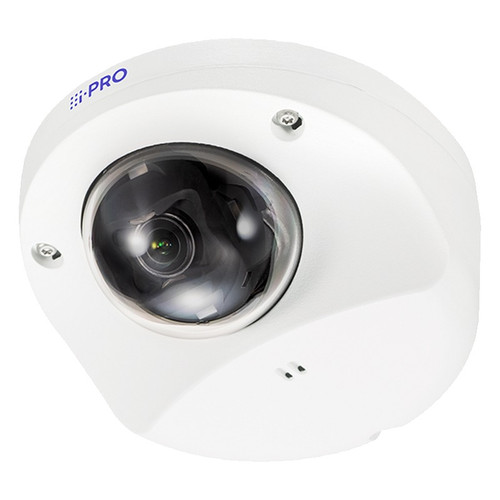
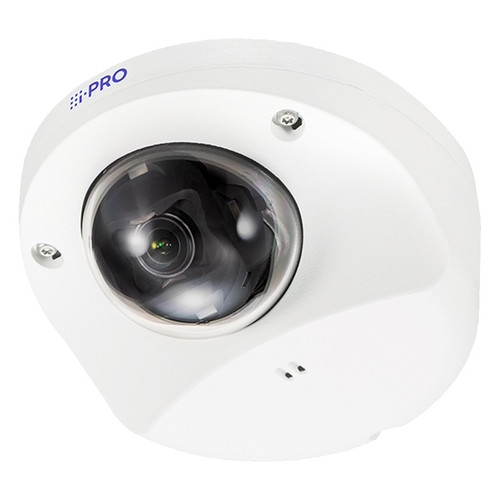
Both the i-PRO WV-X35402-F2L and WV-X35402-F2LM are 4MP compact dome IP cameras sharing the same 1/2.8-type CMOS sensor, 2.4mm fixed lens, IK10/IP66-rated housing, and PoE power budget. They target transit and railway deployments, making them a genuine cross-shop pair. The key differentiators lie in their network connector type, railway certification depth, ICR control granularity, smart-coding implementation detail, and IPv6 protocol breadth — details that matter in hardened vehicle and trackside installations.
In This Guide
How do the imaging specs compare?
Both cameras deliver 4MP resolution at 25/30fps across identical 16:9 modes (2560×1440, 1920×1080, 1280×720) and 4:3 modes (2048×1536, 1280×960). The shared 1/2.8-type CMOS sensor produces a 5.12mm × 3.84mm scanning area on each model, with a 2.4mm F2.1 fixed lens providing 121° horizontal field of view and a minimum color illumination of 0.07 lx. Both achieve 132dB dynamic range with Super Dynamic level 31 enabled, and IR LED range is specified at 14m on both units.
One measurable low-light distinction exists: the F2LM specification explicitly lists 0 lx (with IR) for B&W minimum illumination, while the F2L lists 0.06 lx B&W without a stated 0-lx IR floor. The F2LM also documents ICR state as Off/On(IR Off)/On(IR On)/Auto — a four-state control — whereas the F2L lists Off/On/Auto, a three-state control. DORI distances are identical across both: Detect 29.0m, Observe 11.6m, Recognize 5.8m, Identify 2.9m. Both use the Ambarella CV25M SoC. Smart Coding is implemented on both, with the F2L specifying Variable GOP 1–16s plus Fixed GOP 60s option, and the F2LM specifying Variable GOP 1–60s with frame-rate control — a wider GOP range on the F2LM per the supplied specs.
What about installation and environment?
Both cameras share identical mechanical dimensions (109mm W × 53mm H × 119mm D) and mass (approx. 475g), with the same aluminum die-cast white / PC resin clear finish and tamper-resistant enclosure. Environmental ratings are matched: IP66 (IEC 60529), Type 4X (UL50E), NEMA 4X, IK10 (IEC 62262), and wind resistance up to 40 m/s. Operating temperature range is −40°C to +60°C on both, though the F2LM spec adds a −20°C power-on qualification not stated in the F2L spec.
The single most installation-critical physical difference is the network connector: the F2L uses an RJ45 connector, while the F2LM uses an M12 connector. M12 is the standard hardened connector for rolling stock and trackside cabinets where vibration, moisture ingress, and connector retention are concerns — RJ45 is not rated for those environments. Both are PoE-powered at 8.6W maximum. Railway/vehicle certifications also diverge: the F2L covers EN50155, JIS E 5006, IEC62236, and EN50121; the F2LM adds IEC61373 (mechanical shock and vibration for railway equipment) and EN45545 (railway fire protection) to that same base set. Both units carry identical safety marks (UL62368-1, CSA C22.2 No.62368-1, CE, IEC62368-1) and EMC marks (FCC Part15 ClassA, ICES-003 ClassA, EN55032 ClassA, EN55035).
Which fits your VMS and analytics better?
Both cameras are ONVIF Profile G/M/S/T compliant, support up to 14 simultaneous users, and offer H.265/H.264 with constant and variable bitrate, unicast and multicast, plus JPEG at 10 quality steps. FIPS 140-2 Level 3 secure element is present on both. Edge storage on both supports microSDXC up to 512GB; the F2LM spec enumerates capacity tiers (2GB–512GB across SD/SDHC/SDXC) more explicitly. The F2L alarm actions include Email, HTTP, TCP notifications, and SD card recording; the F2LM alarm actions list Email, HTTP, and TCP notification — SD card recording is not explicitly listed in the F2LM alarm actions field as supplied.
AI analytics on the F2L are enumerated as AI motion, face, people, vehicle, mask, and occupancy detection. The F2LM spec states '7 detection types' without individually naming them in the provided data. Both include AI Sound Classification (Gunshot, Yell, Vehicle horn, Glass break), VMD (4 areas), SCD (1 area), and audio detection. The F2L IPv6 protocol stack is fully enumerated (including SSL/TLS, SMTP, DNS, NTP, SNMPv1/v2/v3, DHCPv6, RTP, MLD, ICMP, ARP, IEEE 802.1X, DiffServ, LLDP, FTP, SFTP, MQTT); the F2LM IPv6 stack as supplied lists only IPv6, TCP/IP, UDP/IP, HTTP, HTTPS, SNMPv3 — a shorter list that may reflect incomplete spec documentation rather than a feature gap. Both models list 9 GUI languages; the F2L enumerates them (English, Italian, French, German, Spanish, Portuguese, Russian, Chinese, Japanese).
Which should you choose: the X35402-F2L or the X35402-F2LM?
Our take: The WV-X35402-F2LM is the stronger choice when the deployment is rolling stock, trackside, or any vibration-and-moisture-exposed environment requiring a hardened connector and full railway certification. Its M12 network connector replaces the F2L's RJ45 with a connector designed for connector retention and ingress resistance under vibration. Its railway certification set adds IEC61373 (mechanical shock/vibration) and EN45545 (fire protection) to the four standards the F2L already carries — two certifications that are procurement requirements on most rail contracts. It also documents 0 lx B&W minimum illumination with IR active, a floor the F2L spec does not explicitly state. The WV-X35402-F2L is the appropriate choice where a standard RJ45 infrastructure is already in place, connector tooling is not railway-hardened, and the additional two rail certifications are not contractually required — it offers the same 4MP/132dB/IK10/IP66 imaging and environmental performance at that level.
Side-by-Side Comparison
Spec-for-spec, from manufacturer data.
| Specification | i-PRO X35402-F2L | i-PRO X35402-F2LM |
|---|---|---|
| Resolution | 4MP (2560×1440 max) | 4MP (2560×1440 max) |
| Image Sensor | Approx. 1/2.8-type CMOS | Approx. 1/2.8-type CMOS |
| Lens / Focal Length | 2.4mm fixed, F2.1, 121° HFOV | 2.4mm fixed, F2.1, 121° HFOV |
| Min Illumination (Color) | 0.07 lx | 0.07 lx |
| Min Illumination (B&W) | 0.06 lx | 0.06 lx; 0 lx (with IR) |
| IR Range | 14m max (46ft) | 14m max (46ft) |
| Dynamic Range (WDR) | 132 dB max | 132 dB max |
| Max Frame Rate | 25/30fps | 25/30fps |
| Video Compression | H.265, H.264, JPEG | H.265, H.264, JPEG |
| Network Connector | RJ45 | M12 |
| IP / Dust Rating | IP66, NEMA 4X, Type 4X | IP66, NEMA 4X, Type 4X |
| Impact Rating | IK10 (IEC 62262) | IK10 (IEC 62262) |
| Operating Temperature | -40°C to +60°C | -40°C to +60°C (-20°C power-on) |
| Power Input / Max Consumption | PoE (IEEE 802.3af), 8.6W max | PoE, 8.6W max |
| Railway Certifications | EN50155, JIS E 5006, IEC62236, EN50121 | EN50155, JIS E 5006, IEC62236, EN50121, IEC61373, EN45545 |
| Edge Storage | Up to 512GB microSDXC | Up to 512GB microSDXC |
| ONVIF Profiles | G / M / S / T | G / M / S / T |
| Audio | Yes (G.726, G.711); AI Sound Classification | Yes (G.726, G.711); AI Sound Classification |
| Dimensions | 109 × 53 × 119 mm | 109 × 53 × 119 mm |
| Weight | Approx. 475g (1.05 lbs) | Approx. 475g (1.05 lbs) |
| Warranty | 5-Year | 5-Year |
Frequently Asked Questions
Which should you choose: the X35402-F2L or the X35402-F2LM?
The WV-X35402-F2LM is the stronger choice when the deployment is rolling stock, trackside, or any vibration-and-moisture-exposed environment requiring a hardened connector and full railway certification. Its M12 network connector replaces the F2L's RJ45 with a connector designed for connector retention and ingress resistance under vibration. Its railway certification set adds IEC61373 (mechanical shock/vibration) and EN45545 (fire protection) to the four standards the F2L already carries — two certifications that are procurement requirements on most rail contracts. It also documents 0 lx B&W minimum illumination with IR active, a floor the F2L spec does not explicitly state. The WV-X35402-F2L is the appropriate choice where a standard RJ45 infrastructure is already in place, connector tooling is not railway-hardened, and the additional two rail certifications are not contractually required — it offers the same 4MP/132dB/IK10/IP66 imaging and environmental performance at that level.
Is the WV-X35402-F2L or WV-X35402-F2LM better for low-light performance?
Per the supplied specifications, the WV-X35402-F2LM explicitly states 0 lx B&W minimum illumination when IR is active, while the WV-X35402-F2L lists 0.06 lx B&W without a stated 0-lx IR floor. Both share the same 0.07 lx color minimum illumination and 14m IR LED range. If absolute darkness capability is a procurement criterion, the F2LM spec provides the clearer statement; confirm with i-PRO if the F2L carries the same 0-lx IR floor before ruling it out.
Can I use a standard RJ45 patch cable with the WV-X35402-F2LM?
No. Per the supplied specifications, the WV-X35402-F2LM uses an M12 connector for its 10BASE-T/100BASE-TX network interface. The WV-X35402-F2L uses a standard RJ45 connector. M12 requires a compatible M12-to-RJ45 adapter cable or an M12-terminated PoE switch port. Factor in M12 cabling and any required adapters when budgeting the F2LM installation.
Do both cameras carry the same railway certifications?
No. Both carry EN50155, JIS E 5006, IEC62236, and EN50121. The WV-X35402-F2LM additionally lists IEC61373 (shock and vibration for railway equipment) and EN45545 (railway fire protection), which the WV-X35402-F2L does not include per the provided specifications. If your project specification mandates IEC61373 or EN45545 compliance, the F2LM is the compliant option.
Get a Second Opinion on Your Camera Choice
Share your site layout, coverage goals, and budget. Our team will validate the camera selection, flag anything we would change, and recommend products that match the use case.