
i-PRO NX400/27000T3 vs Vivotek NR9682-V3: Specification Comparison
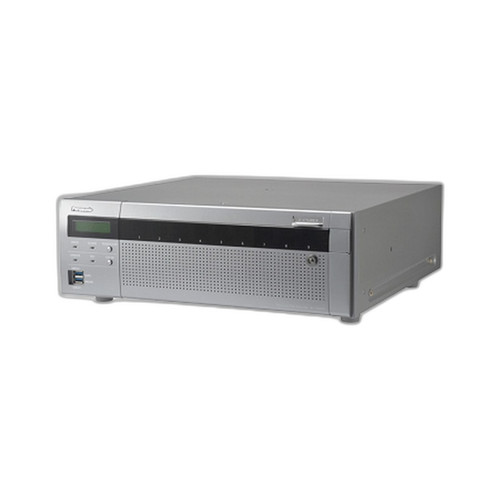
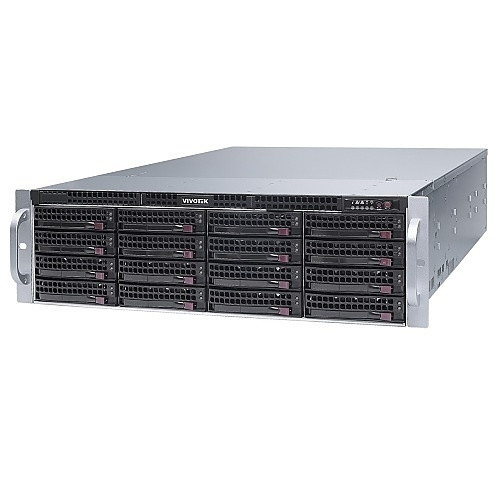
Both the i-PRO WJ-NX400/27000T3 and the Vivotek NR9682-V3 are 64-channel network video recorders targeting large-scale surveillance deployments. The i-PRO unit ships with 27TB of pre-installed storage in an embedded rack-mount form, while the Vivotek arrives as a 16-bay, drive-purchaser-separate platform running embedded Windows 10. This comparison evaluates the three dimensions that most directly influence purchasing decisions for enterprise NVRs: recording capacity and throughput, storage architecture and RAID flexibility, and display output plus integration breadth.
In This Guide
- Which NVR delivers more recording headroom — in channels, resolution, and sustained throughput?
- How do the two NVRs compare on storage capacity, bay count, RAID levels, and drive flexibility?
- Which unit offers broader display output, camera compatibility, and management integration?
- Which should you choose: the NX400/27000T3 or the NR9682-V3?
- Side-by-Side Specs
- FAQ
Which NVR delivers more recording headroom — in channels, resolution, and sustained throughput?
Both units support 64 channels natively and record at 4K resolution with a maximum of 60 fps per camera. Beyond that baseline, the specs diverge meaningfully. The Vivotek NR9682-V3 is licensed to expand to 192 channels with additional software licenses, while the i-PRO WJ-NX400/27000T3 specifications do not list any channel-expansion path beyond 64. On throughput, the NR9682-V3 specifies a recording throughput of 512 Mbps and a remote-client video throughput of 650 Mbps; the WJ-NX400/27000T3 specifications list a speed figure of 3 Mbps, which is not described as aggregate recording throughput — no aggregate throughput figure is provided for the i-PRO unit.
Decoding capability also differs. The NR9682-V3 specifies decoding up to 7680x2560 resolution (via DisplayPort) and H.264 decoding at 1920x1080 at 360 fps / H.265 at 1920x1080 at 180 fps. The WJ-NX400/27000T3 specifications do not state a decoding resolution ceiling or aggregate decoding fps figure. For installations prioritising maximum sustained throughput and future channel growth, the NR9682-V3 presents a broader published specification. For installations capped at 64 channels where pre-installed storage is preferred, the WJ-NX400/27000T3 ships ready to record without separate drive procurement.
How do the two NVRs compare on storage capacity, bay count, RAID levels, and drive flexibility?
The i-PRO WJ-NX400/27000T3 ships with 27TB of pre-installed HDD storage configured across nine 3TB drives. It supports RAID 0, 1, 5, 6, and 10. No hot-swap drive capability is mentioned in the provided specifications. Local microSD storage is also listed as available on the unit.
The Vivotek NR9682-V3 ships without drives — HDDs are purchased separately — but provides 16 hot-swappable drive bays. It supports RAID 0, 1, 5, 6, 10, 50, and 60, adding RAID 50 and RAID 60 levels not listed for the i-PRO unit. Maximum raw capacity depends on the drives installed and is referred to the Vivotek HDD compatibility list rather than a fixed figure. The NR9682-V3 also supports iSCSI network storage expansion and NAS backup (SMB/CIFS), and carries a 128 GB mSATA system drive. Buyers needing immediate out-of-box recording will favour the pre-loaded i-PRO; buyers requiring higher bay count, hot-swap serviceability, or RAID 50/60 will favour the Vivotek.
Which unit offers broader display output, camera compatibility, and management integration?
The i-PRO WJ-NX400/27000T3 provides HDMI output and is listed as compatible with ONVIF Profile S cameras and i-PRO IP cameras natively. It supports PTZ control including pan, tilt, zoom, focus, brightness, and up to 256 preset positions. Alarm I/O is specified at 1–32 alarm inputs and 1–4 alarm reset inputs. Audio codecs include G.711 and G.726 ADPCM 32 kbps with a −10 dBv RCA output. VMS integration beyond standalone operation is not listed in the provided specifications.
The Vivotek NR9682-V3 provides four simultaneous display outputs — HDMI (4096x2160), DisplayPort (7680x4320), DVI, and VGA — supporting dual-monitor configurations. Camera integration covers ONVIF Profile S; third-party I/O boxes (ADAM-6000, CYT-133SC, ioLogik E1210/E1211/E1212) are explicitly listed. Analytics include LPR, VCA counting, smart search I and II, and deep search. The unit integrates with Vivotek's Shepherd and VSS Pro software platforms and the iViewer mobile app. Audio format support extends to G.711, G.726, AMR, and MPEG-2 AAC-LC, with 2-way audio and 7.1 HD surround output listed. User management supports up to 4096 users with Windows Active Directory integration. UPS integration and cybersecurity management are also specified.
Which should you choose: the NX400/27000T3 or the NR9682-V3?
Our take: The NR9682-V3 is the stronger choice when maximum throughput, storage scalability, and display-output breadth are the primary requirements. The Vivotek specifies 512 Mbps recording throughput against an unstated aggregate figure for the i-PRO; it adds RAID 50 and RAID 60 levels the WJ-NX400/27000T3 does not list; and it supplies four simultaneous display outputs (HDMI, DisplayPort 8K, DVI, VGA) versus the i-PRO's single HDMI. Its 16 hot-swappable bays with redundant 100–240 V AC power supply also suit mission-critical, always-on environments where drive replacement without downtime matters. The WJ-NX400/27000T3 is the stronger choice for integrators deploying a self-contained, immediately operational 64-channel system: 27TB of pre-installed storage eliminates a separate drive-procurement step and qualification risk. Choose the NX400/27000T3 for fixed 64-channel i-PRO-centric deployments needing day-one readiness; choose the NR9682-V3 for large, expansion-oriented, multi-vendor ONVIF environments demanding high throughput and storage flexibility.
Side-by-Side Comparison
Spec-for-spec, from manufacturer data.
| Specification | i-PRO NX400/27000T3 | Vivotek NR9682-V3 |
|---|---|---|
| Product Type | 64-Channel Embedded NVR (Rack-Mount) | 64-Channel NVR (Rack-Mount, Windows 10) |
| Max Camera Channels (Native) | 64 | 64 (expandable to 192 with license) |
| Recording Resolution | 4K (3840×2160) | Up to 12MP |
| Max Frame Rate per Camera | 60 fps | 60 fps |
| Recording Throughput | Not specified (3 Mbps listed; context unclear) | 512 Mbps |
| Video Compression | H.265, H.264, JPEG | H.265, H.264, MJPEG, MPEG4 |
| Pre-installed Storage | 27TB (9 × 3TB HDD) | None (HDDs purchased separately) |
| Storage Bays | Not specified | 16 hot-swappable |
| RAID Support | RAID 0, 1, 5, 6, 10 | RAID 0, 1, 5, 6, 10, 50, 60 |
| Display Outputs | HDMI x1 | HDMI x1, DisplayPort x1, DVI x1, VGA x1 |
| Max Decode Resolution | Not specified | 7680×2560 |
| Network Ports | Not specified | Dual 2.5 Gigabit LAN |
| ONVIF | Profile S | Profile S |
| Alarm Inputs | 1–32 | Via I/O Box integration (ADAM-6000, etc.) |
| Redundant Power Supply | Not specified | Supported (100–240V AC) |
| Dimensions (H × W × D mm) | 132 × 430 × 400 | 132 × 437 × 647 |
| Operating Temperature | Not specified | 5°C – 35°C (41°F – 95°F) |
Frequently Asked Questions
Which should you choose: the NX400/27000T3 or the NR9682-V3?
The NR9682-V3 is the stronger choice when maximum throughput, storage scalability, and display-output breadth are the primary requirements. The Vivotek specifies 512 Mbps recording throughput against an unstated aggregate figure for the i-PRO; it adds RAID 50 and RAID 60 levels the WJ-NX400/27000T3 does not list; and it supplies four simultaneous display outputs (HDMI, DisplayPort 8K, DVI, VGA) versus the i-PRO's single HDMI. Its 16 hot-swappable bays with redundant 100–240 V AC power supply also suit mission-critical, always-on environments where drive replacement without downtime matters. The WJ-NX400/27000T3 is the stronger choice for integrators deploying a self-contained, immediately operational 64-channel system: 27TB of pre-installed storage eliminates a separate drive-procurement step and qualification risk. Choose the NX400/27000T3 for fixed 64-channel i-PRO-centric deployments needing day-one readiness; choose the NR9682-V3 for large, expansion-oriented, multi-vendor ONVIF environments demanding high throughput and storage flexibility.
Is the i-PRO WJ-NX400/27000T3 or the Vivotek NR9682-V3 better for larger deployments that may grow beyond 64 channels?
The Vivotek NR9682-V3 is the better fit for growth scenarios. Its specifications state it is expandable to 192 channels with additional licensing. The i-PRO WJ-NX400/27000T3 specifications do not list any channel-expansion capability beyond 64 channels.
Which NVR is easier to maintain in a 24/7 environment where drives may need to be swapped without taking the system offline?
The Vivotek NR9682-V3 lists 16 hot-swappable drive trays and a redundant 100–240 V AC power supply, both of which are specifically designed for continuous-operation environments. The i-PRO WJ-NX400/27000T3 specifications do not mention hot-swap drive capability or redundant power supply.
Does either NVR work with third-party cameras from brands other than the manufacturer's own line?
Both units list ONVIF Profile S compatibility, which enables integration with third-party ONVIF-conformant cameras. The i-PRO WJ-NX400/27000T3 additionally lists native compatibility with i-PRO IP cameras. The Vivotek NR9682-V3 also supports integration with specific third-party I/O devices (ADAM-6000, CYT-133SC, ioLogik E1210/E1211/E1212) and the Vivotek VSS Pro and Shepherd software platforms. Neither specification excludes third-party ONVIF cameras.
Get a Second Opinion on Your Camera Choice
Share your site layout, coverage goals, and budget. Our team will validate the camera selection, flag anything we would change, and recommend products that match the use case.