
Honeywell CW45-X0N-BND10XG vs Zebra TC2205-0G1250SS-US: Specification Comparison
Both the Honeywell CW45-X0N-BND10XG and the Zebra TC2205-0G1250SS-US are Android-based wearable mobile computers targeting warehouse and logistics environments where hands-free or reduced-handling operation is a priority. The Honeywell is a wrist-mounted mobile computer with dual cameras and full Wi-Fi 6 connectivity, while the Zebra TC22 is a wearable scanner with integrated RFID capability and a larger 6-inch display. Buyers evaluating either unit are typically choosing between scanning-centric wearable platforms for inventory, fulfillment, or field mobility workflows.
In This Guide
- Which device offers more processing power and a better display for demanding warehouse applications?
- Which device better supports barcode scanning, RFID, and image capture requirements?
- Which device is better equipped for all-shift operation and harsh operating environments?
- Which should you choose: the CW45-X0N-BND10XG or the TC2205-0G1250SS-US?
- Side-by-Side Specs
- FAQ
Which device offers more processing power and a better display for demanding warehouse applications?
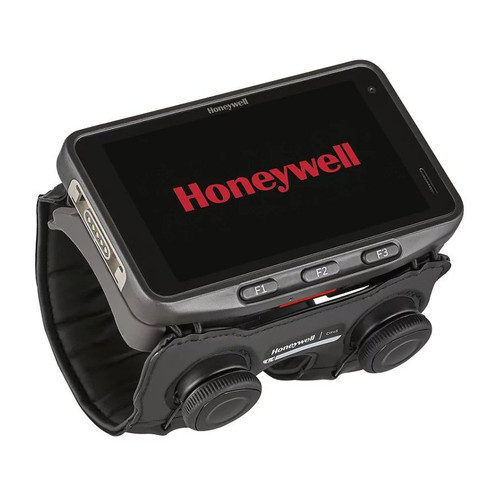
The Honeywell CW45-X0N-BND10XG is equipped with a Qualcomm QCS4290 octa-core processor running at 2.0 GHz paired with 6 GB of RAM. Its 4.7-inch HD display is protected by Corning Gorilla Glass 5, offering durability alongside readability. The wrist-worn form factor and 263 g weight with standard battery make it ergonomically suited for sustained use.
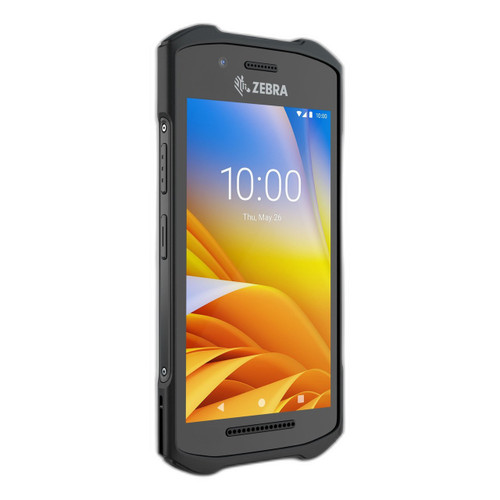
The Zebra TC2205-0G1250SS-US uses a Qualcomm Snapdragon 660 octa-core at 1.8 GHz with 4 GB of RAM (per spec data attributed to this unit, though the spec block contains mixed TC26 references that introduce some ambiguity). Its display is specified as 6.0 inches, giving it a significant screen-size advantage for UI-heavy applications, form entry, or supervisor-level tasks, despite the lower clock speed and less RAM.
On raw compute metrics the Honeywell leads: 2.0 GHz vs. 1.8 GHz clock speed and 6 GB vs. 4 GB RAM. Buyers prioritizing display real estate for complex workflows will favor the Zebra's 6-inch screen; those prioritizing processing headroom for multi-app or computer-vision pipelines will favor the Honeywell.
Which device better supports barcode scanning, RFID, and image capture requirements?
The Honeywell CW45-X0N-BND10XG provides two cameras — an 8 MP front-facing and a 13 MP side-facing — for barcode scanning and image capture. No dedicated scan engine type (1D/2D imager vs. laser) is specified beyond the camera hardware. NFC is included. RFID capability is not listed in the provided specifications.
The Zebra TC2205-0G1250SS-US specifies an integrated 1D/2D scan engine supporting Code 128, Code 39, UPC, EAN, QR Code, Data Matrix, and PDF417 symbologies. Critically, RFID scanning is listed as a core capability, making it the only unit in this comparison with confirmed RFID support. NFC is not specified for the Zebra.
For deployments where RFID tag reading is a workflow requirement — common in retail replenishment, asset tracking, and receiving — the Zebra TC2205-0G1250SS-US is the only specified option. For image-capture-heavy tasks such as damage documentation or OCR, the Honeywell's 13 MP side camera provides a clear hardware advantage. The Zebra's explicit 1D/2D symbology list also provides stronger procurement certainty for barcode-centric specs.
Which device is better equipped for all-shift operation and harsh operating environments?
The Honeywell CW45-X0N-BND10XG supports Wi-Fi 6 (802.11 a/b/g/n/ac/ax) and Bluetooth 5.1 BLE — the most current wireless standards in this comparison. Its 6800 mAh Li-Ion battery is specified as hot-swappable and designed for all-shift operation. The IP65/IP67 dual rating confirms protection against dust ingress and temporary immersion. Operating temperature is rated at -20 to 50 °C; storage temperature at -30 to 70 °C.
The Zebra TC2205-0G1250SS-US specifies Wi-Fi 802.11 a/b/g/n (Wi-Fi 5/Wi-Fi 4; no ax/Wi-Fi 6 listed) and Bluetooth 5.0 BLE. Its battery is rated at 3100 mAh — less than half the Honeywell's capacity. No IP ingress protection rating is provided in the supplied specifications. Storage temperature is listed at -30 to 70 °C, but an operating temperature range is not specified in the provided data.
The Honeywell holds a substantial advantage in wireless generation (Wi-Fi 6 vs. Wi-Fi 4/5), battery capacity (6800 mAh vs. 3100 mAh), and confirmed environmental sealing (IP65/IP67 vs. not specified). Buyers operating in wet, dusty, or refrigerated environments, or requiring all-shift battery life without opportunity charging, should weight these gaps heavily.
Which should you choose: the CW45-X0N-BND10XG or the TC2205-0G1250SS-US?
Our take: The CW45-X0N-BND10XG is the stronger choice when wireless throughput, battery endurance, and environmental ruggedness are the primary selection criteria. It leads on three concrete spec dimensions: Wi-Fi 6 (802.11ax) versus the Zebra's 802.11 a/b/g/n, a 6800 mAh battery versus 3100 mAh — more than double the capacity — and confirmed IP65/IP67 sealing versus no IP rating specified for the Zebra. The TC2205-0G1250SS-US counters with two differentiators not present in the Honeywell's specs: integrated RFID scanning and a larger 6-inch display. For RFID-dependent workflows such as retail receiving, asset management, or supply-chain track-and-trace, the Zebra is the only specified option here. Buyers running barcode-only, image-capture, or compute-intensive warehouse applications in demanding environments will find the Honeywell's spec sheet more complete and more favorable.
Side-by-Side Comparison
Spec-for-spec, from manufacturer data.
| Specification | Honeywell CW45-X0N-BND10XG | Zebra TC2205-0G1250SS-US |
|---|---|---|
| Product Type | Wearable Mobile Computer | Wearable RFID Scanner |
| Processor | Qualcomm QCS4290 Octa-Core 2.0 GHz | Qualcomm Snapdragon 660 Octa-Core 1.8 GHz |
| RAM | 6 GB | 4 GB |
| Storage | 64 GB Flash + microSD | 64 GB |
| Operating System | Android (non-GMS) | Android |
| Display Size | 4.7 in HD (Gorilla Glass 5) | 6.0 in color HD (1280×720) |
| Wi-Fi | Wi-Fi 6 (802.11 a/b/g/n/ac/ax) | 802.11 a/b/g/n |
| Bluetooth | 5.1 BLE | 5.0 BLE |
| NFC | Yes | — |
| RFID | — | Yes |
| Scan Engine | — | 1D/2D (imager) |
| Camera | 8 MP front + 13 MP side | — |
| Battery Capacity | 6800 mAh Li-Ion (hot-swap) | 3100 mAh |
| IP Rating | IP65/IP67 | — |
| Operating Temp. | -20 to 50 °C (-4 to 122 °F) | — |
| Weight | 263 g (9.3 oz) with battery | 236 g (8.32 oz) with battery |
Frequently Asked Questions
Which should you choose: the CW45-X0N-BND10XG or the TC2205-0G1250SS-US?
The CW45-X0N-BND10XG is the stronger choice when wireless throughput, battery endurance, and environmental ruggedness are the primary selection criteria. It leads on three concrete spec dimensions: Wi-Fi 6 (802.11ax) versus the Zebra's 802.11 a/b/g/n, a 6800 mAh battery versus 3100 mAh — more than double the capacity — and confirmed IP65/IP67 sealing versus no IP rating specified for the Zebra. The TC2205-0G1250SS-US counters with two differentiators not present in the Honeywell's specs: integrated RFID scanning and a larger 6-inch display. For RFID-dependent workflows such as retail receiving, asset management, or supply-chain track-and-trace, the Zebra is the only specified option here. Buyers running barcode-only, image-capture, or compute-intensive warehouse applications in demanding environments will find the Honeywell's spec sheet more complete and more favorable.
Does either the CW45-X0N-BND10XG or TC2205-0G1250SS-US support RFID scanning?
Only the Zebra TC2205-0G1250SS-US lists RFID scanning as a specified capability. The Honeywell CW45-X0N-BND10XG does not include RFID in its provided specifications; it offers NFC, which is a distinct, short-range standard not equivalent to warehouse RFID.
Which device has a longer battery life for full-shift warehouse use?
Based on specified battery capacity, the Honeywell CW45-X0N-BND10XG has a significant advantage at 6800 mAh versus the Zebra TC2205-0G1250SS-US at 3100 mAh. The Honeywell spec also explicitly notes hot-swap capability and all-shift operation. No comparable battery endurance claim is provided in the Zebra's specifications.
Is the CW45-X0N-BND10XG or TC2205-0G1250SS-US better suited for environments with Wi-Fi 6 infrastructure?
The Honeywell CW45-X0N-BND10XG supports Wi-Fi 6 (802.11ax) and will take advantage of Wi-Fi 6 access points for higher throughput and reduced latency in dense RF environments. The Zebra TC2205-0G1250SS-US is specified at 802.11 a/b/g/n only, which does not include Wi-Fi 5 (ac) or Wi-Fi 6 (ax), limiting its compatibility with next-generation wireless infrastructure.
More Mobile Computer Comparisons
- Honeywell CW45-X0N-AND10XG vs Unitech HT730-LJ6122BG
- Honeywell CW45-X0N-AND10XG vs Unitech HT730-LJ6142BG
- Honeywell CW45-X0N-AND10XG vs Unitech HT330-QA62TM3G-Z3
- Honeywell CW45-X0N-AND10XG vs Zebra TC2205-0G1250SS-US
- Honeywell CW45-X0N-AND10XG vs Honeywell CW45-X0N-AND10SG
- Honeywell CW45-X0N-AND10XG vs Honeywell CW45-X0N-BND10XG
Mobile Computer Buying Guides
Get a Second Opinion on Your Camera Choice
Share your site layout, coverage goals, and budget. Our team will validate the camera selection, flag anything we would change, and recommend products that match the use case.