
Honeywell CW45-5CB-UVN-0 vs Unitech HT330-QA62TM3G-Z3: Specification Comparison
Both the Honeywell CW45-5CB-UVN-0 and the Unitech HT330-QA62TM3G-Z3 are wearable mobile devices designed for hands-free warehouse, logistics, and industrial operations. The CW45 is a full wearable mobile computer with an onboard processor, OS, Wi-Fi, and display, while the HT330 is a wearable Bluetooth scanner that pairs to a host device. Despite the wearable form factor overlap, these occupy meaningfully different device tiers—one is a standalone computer, the other a peripheral scanner—so buyers should evaluate whether they need an independent compute platform or a companion scanning accessory.
In This Guide
- Which device delivers the compute power and wireless connectivity needed for standalone mobile workflows?
- How do the two devices compare on ruggedization ratings and battery endurance for multi-shift industrial use?
- Which wearable form factor and input configuration better fits the intended picking, scanning, and operational workflow?
- Which should you choose: the CW45-5CB-UVN-0 or the HT330-QA62TM3G-Z3?
- Side-by-Side Specs
- FAQ
Which device delivers the compute power and wireless connectivity needed for standalone mobile workflows?
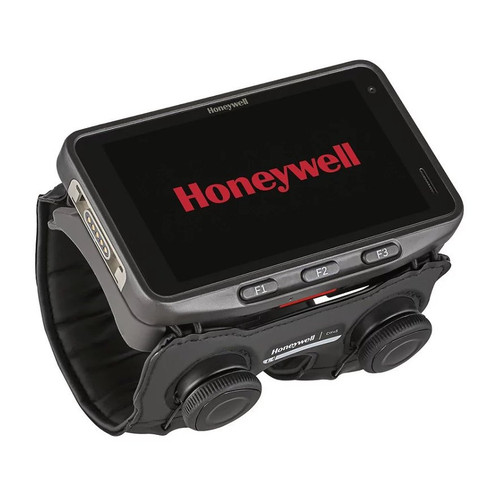
The Honeywell CW45-5CB-UVN-0 is a fully self-contained mobile computer built around a Qualcomm QCS4290 Octa-Core 2.0 GHz processor running Android. It carries its own Wi-Fi 6 (802.11 a/b/g/n/ac/ax) radio and Bluetooth 5.2, enabling it to connect directly to enterprise networks, WMS platforms, and cloud services without relying on a paired host device. Its 4.7-inch HD (1280 × 720) display and onboard OS make it a true endpoint in any mobile computing deployment.
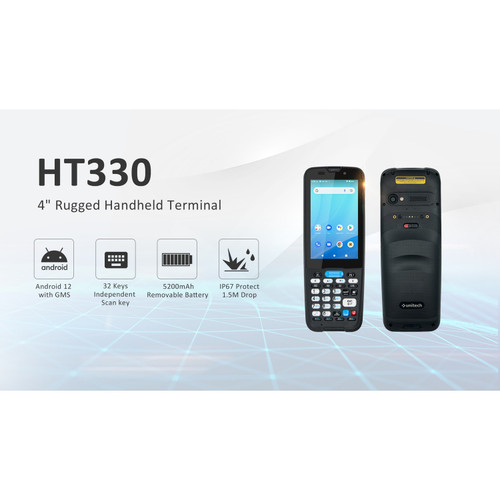
The Unitech HT330-QA62TM3G-Z3 specs list an Android 12 OS, 3 GB RAM, 32 GB internal flash, a 4-inch touchscreen, and a 32-key physical keypad, suggesting it functions as a wearable handheld terminal rather than a pure peripheral. Its primary wireless link is Bluetooth 5.0, supplemented by 2.4 GHz + 5 GHz Wi-Fi and GPS per its listed wireless spec. However, its product-type designation as a 'Wearable Bluetooth Scanner' and its pairing-to-host positioning should be weighed against the fuller standalone computer classification of the CW45. Buyers must confirm with Unitech whether the HT330 supports direct enterprise Wi-Fi authentication independently.
For deployments requiring a single, network-connected wearable endpoint with Wi-Fi 6 throughput advantages in dense RF environments, the CW45 provides documented, higher-generation wireless capability.
How do the two devices compare on ruggedization ratings and battery endurance for multi-shift industrial use?
Both devices share an IP67 rating for dust and water ingress protection. The HT330 adds a documented 1.5 m drop specification to concrete, a common benchmark for warehouse ruggedness. The CW45 specs list IP65/IP67 dual certification but do not specify a drop height in the provided data—buyers requiring a documented drop spec should request Honeywell's MIL-STD or drop-test certification separately.
On battery, the devices diverge substantially. The CW45 offers 3,400 mAh standard or 6,800 mAh extended Li-Ion packs described as swappable, providing deployment flexibility for varying shift lengths. The HT330 ships with a 5,200 mAh Li-Ion removable battery and lists a 20-hour operating runtime—a concrete endurance figure absent from the CW45's provided specs. For operations running extended or double shifts where runtime predictability matters, the HT330's documented 20-hour figure and larger fixed capacity are directly comparable data points; the CW45's swappable battery architecture offers a different mitigation strategy (hot-swap rather than extended single-charge runtime).
Both are removable-battery designs, preserving the ability to carry charged spares—an important consideration for depot-free field operations.
Which wearable form factor and input configuration better fits the intended picking, scanning, and operational workflow?
The Honeywell CW45 weighs 263 g (9.3 oz / 0.58 lb) and is positioned as a wearable mobile computer with a 4.7-inch HD display. Its specs note day/night visibility and outdoor readiness, along with an associated keypad accessory (CW45-KPD), indicating it supports physical key input in addition to touchscreen. Its night-vision capability and wearable form factor are cited as purpose-built for hands-free warehouse work.
The Unitech HT330 is described as a wearable handheld terminal with a 4-inch touchscreen and a 32-key physical keypad built in. The strap or belt-attached wearable configuration supports hands-free pick-pack operations. Its scanner type is listed as 'Wearable handheld,' and GPS is included in its wireless specification—potentially useful for yard management or outdoor logistics where location context is needed alongside scanning.
The CW45's larger 4.7-inch display and Wi-Fi 6 radio favor intensive screen-based workflows (receiving, putaway, complex WMS UIs) while the HT330's integrated 32-key keypad and GPS suit scan-heavy, location-aware field tasks. Weight for the HT330 is not specified in the provided data.
Which should you choose: the CW45-5CB-UVN-0 or the HT330-QA62TM3G-Z3?
Our take: The CW45-5CB-UVN-0 is the stronger choice when deploying a fully autonomous wearable endpoint on an enterprise Wi-Fi network with demanding screen-based workflows. It delivers Wi-Fi 6 (802.11 ax) versus the HT330's Bluetooth 5.0 primary link, a larger 4.7-inch HD display versus the HT330's 4-inch screen, and a swappable battery architecture (3,400 or 6,800 mAh) that allows hot-swap continuity rather than depending on a single charge. The HT330-QA62TM3G-Z3 is the stronger candidate when a documented 20-hour runtime, an integrated 32-key physical keypad, a specified 1.5 m drop rating to concrete, and built-in GPS are non-negotiable requirements—particularly for scan-intensive, location-aware, or extended-shift workflows where raw battery endurance is the primary risk. Platform alignment matters: the CW45 suits Honeywell-ecosystem WMS and voice-picking deployments; the HT330 suits environments pairing wearables with Android-based host terminals or requiring GPS-tagged scan events.
Side-by-Side Comparison
Spec-for-spec, from manufacturer data.
| Specification | Honeywell CW45-5CB-UVN-0 | Unitech HT330-QA62TM3G-Z3 |
|---|---|---|
| Product Type | Wearable Mobile Computer | Wearable Bluetooth Scanner / Handheld Terminal |
| Operating System | Android | Android 12 |
| Processor | Qualcomm QCS4290 Octa-Core 2.0 GHz | — |
| RAM | — | 3 GB |
| Storage | — | 32 GB internal flash |
| Display Size | 4.7-inch HD (1280 × 720) | 4-inch touchscreen |
| Keypad | Optional (CW45-KPD accessory) | 32-key physical keypad (built-in) |
| Wi-Fi Standard | Wi-Fi 6 (802.11 a/b/g/n/ac/ax) | 2.4 GHz + 5 GHz (standard not specified) |
| Bluetooth Version | 5.2 | 5.0 |
| GPS | — | Yes |
| IP Rating | IP65 / IP67 | IP67 |
| Drop Specification | — | 1.5 m to concrete |
| Battery Capacity | 3,400 mAh or 6,800 mAh Li-Ion (swappable) | 5,200 mAh Li-Ion (removable) |
| Documented Runtime | — | 20 hours |
| Weight | 263 g (9.3 oz) | — |
| Warranty | 1-year | Manufacturer Warranty (duration not specified) |
Frequently Asked Questions
Which should you choose: the CW45-5CB-UVN-0 or the HT330-QA62TM3G-Z3?
The CW45-5CB-UVN-0 is the stronger choice when deploying a fully autonomous wearable endpoint on an enterprise Wi-Fi network with demanding screen-based workflows. It delivers Wi-Fi 6 (802.11 ax) versus the HT330's Bluetooth 5.0 primary link, a larger 4.7-inch HD display versus the HT330's 4-inch screen, and a swappable battery architecture (3,400 or 6,800 mAh) that allows hot-swap continuity rather than depending on a single charge. The HT330-QA62TM3G-Z3 is the stronger candidate when a documented 20-hour runtime, an integrated 32-key physical keypad, a specified 1.5 m drop rating to concrete, and built-in GPS are non-negotiable requirements—particularly for scan-intensive, location-aware, or extended-shift workflows where raw battery endurance is the primary risk. Platform alignment matters: the CW45 suits Honeywell-ecosystem WMS and voice-picking deployments; the HT330 suits environments pairing wearables with Android-based host terminals or requiring GPS-tagged scan events.
Is the CW45-5CB-UVN-0 or HT330-QA62TM3G-Z3 better for a full double-shift without a battery swap?
Based on provided specs, only the HT330 carries a documented operating runtime—20 hours—making it the verifiable choice for extended shifts on a single charge. The CW45 does not list a runtime figure in the provided specifications; however, it offers a swappable battery option (up to 6,800 mAh) as an alternative endurance strategy. Buyers should request Honeywell's published runtime data before ruling it out for double-shift use.
Can the HT330-QA62TM3G-Z3 work as a standalone device, or does it require pairing to another phone or computer?
The HT330's provided specs include Android 12, 3 GB RAM, 32 GB storage, Wi-Fi (2.4 GHz + 5 GHz), and GPS alongside its Bluetooth 5.0 radio, which suggests potential standalone capability. However, its product-type designation as a 'Wearable Bluetooth Scanner' and its pairing-to-host marketing positioning introduce ambiguity. Buyers should confirm directly with Unitech whether it supports independent enterprise Wi-Fi authentication and full standalone app execution before deploying it as a primary wearable computer.
Which device is better suited for outdoor or yard management operations?
The HT330 lists GPS in its wireless specification, making it the documented choice for location-aware outdoor workflows such as yard management or trailer tracking. The CW45 is noted as outdoor-ready and carries IP65/IP67 sealing, but GPS is not listed in its provided specifications. For pure outdoor environmental durability both are IP67-rated; for GPS-dependent use cases the HT330 has the spec advantage.
More Mobile Computer Comparisons
- Honeywell CW45-X0N-AND10XG vs Unitech HT730-LJ6122BG
- Honeywell CW45-X0N-AND10XG vs Unitech HT730-LJ6142BG
- Honeywell CW45-X0N-AND10XG vs Unitech HT330-QA62TM3G-Z3
- Honeywell CW45-X0N-AND10XG vs Zebra TC2205-0G1250SS-US
- Honeywell CW45-X0N-AND10XG vs Honeywell CW45-X0N-AND10SG
- Honeywell CW45-X0N-AND10XG vs Honeywell CW45-X0N-BND10XG
Mobile Computer Buying Guides
Get a Second Opinion on Your Camera Choice
Share your site layout, coverage goals, and budget. Our team will validate the camera selection, flag anything we would change, and recommend products that match the use case.