
Hanwha XRN-6420RB2 vs i-PRO NX400/27000T3: Specification Comparison
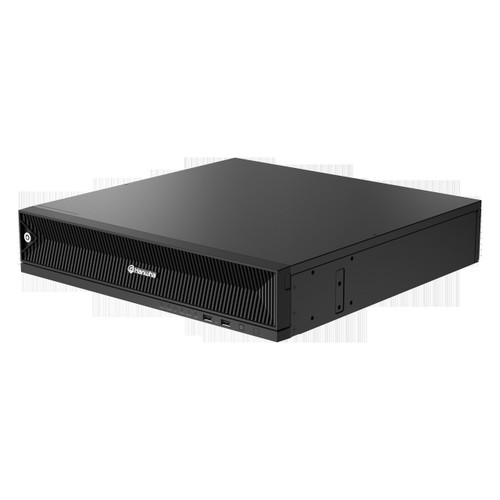
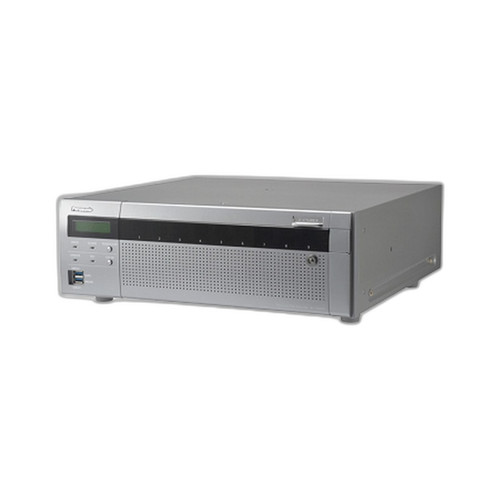
Both the Hanwha XRN-6420RB2-48TB and the i-PRO WJ-NX400/27000T3 are rack-mount, 64-channel NVRs aimed at enterprise and large-scale IP surveillance deployments. The comparison covers recording capacity and bandwidth, storage architecture and data protection, and integration and cybersecurity posture — the three axes most likely to drive a purchasing decision at this tier. Neither unit ships with PoE switching built in; both rely on external IP cameras delivered over the network.
In This Guide
- Which NVR delivers higher resolution recording and sufficient bandwidth for dense 64-channel deployments?
- How do the two units compare on pre-installed storage capacity, expandability, and data-protection redundancy?
- Which unit offers stronger ecosystem integration, VMS compatibility, and cybersecurity controls for IT-governed environments?
- Which should you choose: the XRN-6420RB2 or the NX400/27000T3?
- Side-by-Side Specs
- FAQ
Which NVR delivers higher resolution recording and sufficient bandwidth for dense 64-channel deployments?
The Hanwha XRN-6420RB2 supports a maximum per-camera resolution of 32 MP and records up to 8.3 MP across 4 channels at 30 fps, 1080p across 16 channels at 30 fps, or CIF across all 64 channels at 30 fps. Its aggregate recording bandwidth is specified at 520 Mbps in distributed mode, backed by an Intel 12th-generation processor. Maximum frame rate at the highest resolution (32 MP) is listed as 15 fps under H.265.
The i-PRO WJ-NX400/27000T3 specifies a maximum resolution of 4K (3840×2160, 8 MP) per camera and a maximum of 60 fps per camera channel. Its aggregate throughput is listed in the provided specs at 3 Mbps — a figure that appears to be a per-stream or placeholder value rather than a system-wide aggregate, as no total system bandwidth figure is provided in the supplied specification data. Buyers should request the full i-PRO system bandwidth spec sheet before finalizing a design.
On stated resolution ceiling, the Hanwha unit reaches 32 MP versus the i-PRO's 8 MP (4K). The i-PRO specifies 60 fps per camera at 4K; the Hanwha specifies 15 fps at its maximum 32 MP resolution and 30 fps at lower resolutions. If per-channel frame rate at 4K is the priority, the i-PRO's stated 60 fps figure is the higher number in the supplied specs.
How do the two units compare on pre-installed storage capacity, expandability, and data-protection redundancy?
The Hanwha XRN-6420RB2-48TB ships with 48 TB pre-configured across 8 SATA HDD bays and supports expansion to a stated maximum of 80 TB. It includes RAID 5 and RAID 6 support plus an N+1 automatic failover mechanism. The NVR also specifies a microSD local storage option is not mentioned; local storage details beyond the HDD bays are not provided in the supplied specs.
The i-PRO WJ-NX400/27000T3 ships with 27 TB pre-installed (nine 3 TB drives) and supports RAID modes 0, 1, 5, 6, and 10 — a broader RAID menu than the Hanwha, which lists only RAID 5/6. The i-PRO also specifies a microSD local storage slot. Maximum expandable capacity beyond the 27 TB pre-installed figure is not stated in the provided specification data.
At out-of-box capacity, the Hanwha ships with 48 TB versus the i-PRO's 27 TB — a 21 TB difference. The Hanwha's documented expansion ceiling is 80 TB; the i-PRO's expansion ceiling is not specified in the provided data. The i-PRO offers RAID 10 as an additional mode not listed for the Hanwha; both support RAID 5 and RAID 6.
Which unit offers stronger ecosystem integration, VMS compatibility, and cybersecurity controls for IT-governed environments?
The Hanwha XRN-6420RB2 specifies ONVIF compliance, SUNAPI support, Wisenet Viewer, and Wisenet mobile app compatibility. On cybersecurity, it lists TPM 2.0, signed firmware, and NDAA compliance. The operating system is Embedded Linux. Analytics onboard include Defocus Detection, Audio Detection, Dynamic Event, and User Event. Two-way audio is supported with G.711, G.726, and AAC codecs at 16 kHz and 48 kHz.
The i-PRO WJ-NX400/27000T3 specifies ONVIF Profile S compliance and notes preferred compatibility with i-PRO IP cameras. VMS integration is described as standalone (non-VMS) or ONVIF Profile S; no third-party VMS partnerships or proprietary SDK are cited in the provided specs. Alarm I/O is detailed: 32 alarm inputs, 4 alarm outputs, and 4 alarm reset inputs — none of which are specified for the Hanwha in the provided data. Audio output is listed as −10 dBv RCA. Cybersecurity certifications, TPM, or NDAA compliance status are not stated in the provided i-PRO spec data.
The Hanwha unit provides documented cybersecurity controls (TPM 2.0, signed firmware, NDAA compliance) and a broader stated VMS/SDK ecosystem (SUNAPI, Wisenet). The i-PRO unit lists more granular alarm I/O (32 inputs / 4 outputs) but cybersecurity posture details and NDAA status are absent from the supplied specification data.
Which should you choose: the XRN-6420RB2 or the NX400/27000T3?
Our take: The XRN-6420RB2 is the stronger choice when maximum resolution ceiling, pre-installed storage capacity, and documented cybersecurity compliance are the primary decision drivers. It records at up to 32 MP versus the i-PRO's 4K (8 MP) ceiling, ships with 48 TB versus 27 TB pre-installed, and explicitly documents TPM 2.0, signed firmware, and NDAA compliance — none of which appear in the supplied i-PRO spec data. The i-PRO WJ-NX400/27000T3 is worth shortlisting when per-channel frame rate at 4K matters (60 fps stated versus the Hanwha's 15 fps at peak resolution), when RAID 10 is a site requirement, or when the deployment is predominantly i-PRO camera-native and the 32-alarm-input I/O count is required. Buyers standardizing on Hanwha Wisenet cameras will benefit from the SUNAPI integration and mobile app ecosystem; mixed-vendor or i-PRO-camera sites should evaluate the NX400's ONVIF Profile S posture against actual camera compatibility matrices before committing.
Side-by-Side Comparison
Spec-for-spec, from manufacturer data.
| Specification | Hanwha XRN-6420RB2 | i-PRO NX400/27000T3 |
|---|---|---|
| Product Type | 64-Channel Rack-Mount NVR | 64-Channel Rack-Mount NVR |
| Max Camera Channels | 64 | 64 |
| Max Resolution (per camera) | 32 MP | 4K / 8 MP (3840×2160) |
| Max Frame Rate at Peak Res. | 15 fps @ 32 MP (H.265) | 60 fps @ 4K |
| Aggregate Recording Bandwidth | 520 Mbps (distributed mode) | Not specified in provided data |
| Video Compression | H.265, H.264, MJPEG | H.265, H.264, JPEG |
| Pre-Installed Storage | 48 TB | 27 TB (3 TB × 9) |
| Max Expandable Storage | 80 TB | Not specified in provided data |
| HDD Bays | 8 SATA | 9 (implied by 3 TB × 9) |
| RAID Support | RAID 5, RAID 6 + N+1 failover | RAID 0, 1, 5, 6, 10 |
| Local Storage (microSD) | — | Yes |
| ONVIF | Yes (SUNAPI, ONVIF) | Yes (ONVIF Profile S) |
| Alarm I/O | — | 32 inputs / 4 outputs / 4 reset inputs |
| Cybersecurity | TPM 2.0, signed firmware | Not specified in provided data |
| NDAA Compliance | Yes | Not specified in provided data |
| Processor | Intel 12th Generation | Not specified in provided data |
| Operating System | Embedded Linux | Not specified in provided data |
| Operating Temperature | 0°C to +40°C | Not specified in provided data |
| Power Supply | Not specified in provided data | 12V DC |
| Warranty | 5 years | Not specified in provided data |
Frequently Asked Questions
Which should you choose: the XRN-6420RB2 or the NX400/27000T3?
The XRN-6420RB2 is the stronger choice when maximum resolution ceiling, pre-installed storage capacity, and documented cybersecurity compliance are the primary decision drivers. It records at up to 32 MP versus the i-PRO's 4K (8 MP) ceiling, ships with 48 TB versus 27 TB pre-installed, and explicitly documents TPM 2.0, signed firmware, and NDAA compliance — none of which appear in the supplied i-PRO spec data. The i-PRO WJ-NX400/27000T3 is worth shortlisting when per-channel frame rate at 4K matters (60 fps stated versus the Hanwha's 15 fps at peak resolution), when RAID 10 is a site requirement, or when the deployment is predominantly i-PRO camera-native and the 32-alarm-input I/O count is required. Buyers standardizing on Hanwha Wisenet cameras will benefit from the SUNAPI integration and mobile app ecosystem; mixed-vendor or i-PRO-camera sites should evaluate the NX400's ONVIF Profile S posture against actual camera compatibility matrices before committing.
Is the XRN-6420RB2 or the WJ-NX400/27000T3 better for larger deployments that need high-resolution forensic detail?
Based on the provided specifications, the XRN-6420RB2 supports a higher maximum resolution ceiling — up to 32 MP per camera — compared to the WJ-NX400/27000T3's stated maximum of 4K (8 MP). For deployments requiring forensic-grade resolution from high-megapixel cameras, the Hanwha unit's spec advantage is significant. However, the i-PRO specifies 60 fps per channel at 4K; if smooth motion at standard 4K is the goal rather than extreme still-frame resolution, both platforms are worth evaluating against camera line-up compatibility.
Which NVR gives me more storage out of the box, and can either be expanded later?
The XRN-6420RB2 ships with 48 TB pre-configured across 8 SATA bays and is documented as expandable to 80 TB maximum. The WJ-NX400/27000T3 ships with 27 TB pre-installed (nine 3 TB drives); its maximum expandable capacity is not stated in the provided specification data. For out-of-box storage depth, the Hanwha unit ships with 21 TB more than the i-PRO unit. Buyers requiring expansion beyond the Hanwha's documented 80 TB ceiling should verify with the manufacturer.
Does either NVR meet federal NDAA compliance requirements for government or critical-infrastructure projects?
The XRN-6420RB2 is explicitly listed as NDAA-compliant in the provided specifications, and it also documents TPM 2.0 and signed firmware as cybersecurity controls. The WJ-NX400/27000T3 specification data provided does not state NDAA compliance status, TPM, or signed firmware. Buyers with NDAA requirements should confirm the i-PRO unit's compliance status directly with i-PRO before specifying it on a government or critical-infrastructure project.
Get a Second Opinion on Your Camera Choice
Share your site layout, coverage goals, and budget. Our team will validate the camera selection, flag anything we would change, and recommend products that match the use case.