
Hanwha XRN-6420RB2-32TB vs Vivotek NR9682-V3: Specification Comparison
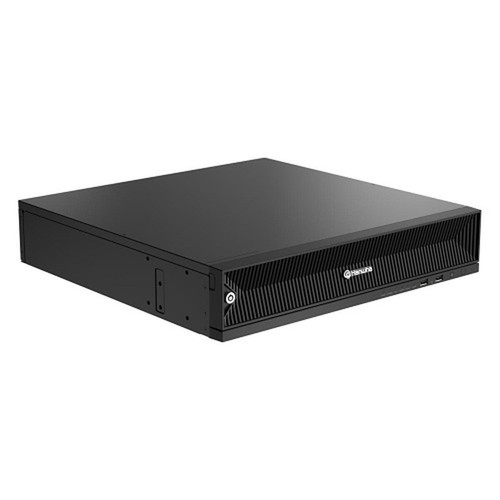
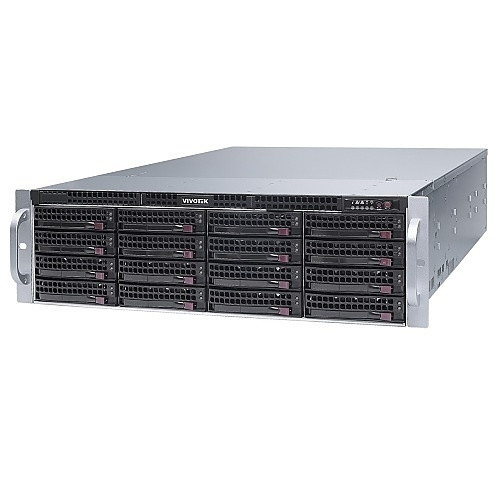
Both the Hanwha XRN-6420RB2-32TB and the Vivotek NR9682-V3 are rack-mount, 64-channel enterprise NVRs designed for large-scale IP camera deployments. The Hanwha ships with 32TB of factory-installed storage on an Intel 12th-gen platform running embedded Linux, while the Vivotek offers 16 hot-swappable drive bays (drives sold separately) on an Intel Core i7 platform running embedded Windows 10. Both support H.265, ONVIF, two-way audio, and RAID, making them genuine cross-shop candidates for integrators specifying a 64-channel head-end.
In This Guide
- How do channel capacity, recording throughput, and storage expandability compare?
- What are the display output options, RAID configurations, and physical storage differences?
- How do operating platform, integration ecosystem, and operating environment differ?
- Which should you choose: the XRN-6420RB2-32TB or the NR9682-V3?
- Side-by-Side Specs
- FAQ
How do channel capacity, recording throughput, and storage expandability compare?
Both units support 64 native recording channels, but they diverge sharply on storage architecture. The Hanwha XRN-6420RB2-32TB ships with 32TB pre-installed across eight internal SATA bays, expandable to 80TB internally. The Vivotek NR9682-V3 provides 16 hot-swappable drive bays with no drives included; maximum raw capacity is not specified in the provided specs and requires reference to Vivotek's supported HDD list.
On throughput, the Hanwha is rated at 520 Mbps sustained in both RAID and normal operating modes. The Vivotek records at 512 Mbps and adds a separate 650 Mbps video throughput figure for remote clients — a distinction the Hanwha spec does not make explicitly. The Vivotek also supports channel expansion via license to 192 channels; the Hanwha spec does not document a licensed channel-expansion path.
Maximum recorded resolution is 32MP on the Hanwha versus 12MP on the Vivotek per their respective spec sheets. The Hanwha simultaneously records all 64 channels at 32MP; the Vivotek's decoding ceiling is 7680×2560 (approximately 20MP), and its listed max resolution spec is 12MP.
What are the display output options, RAID configurations, and physical storage differences?
The Vivotek NR9682-V3 provides four discrete video outputs: HDMI (4096×2160), DisplayPort (7680×4320 / 8K), DVI, and VGA, with dual-monitor support documented. The Hanwha XRN-6420RB2-32TB has dual HDMI outputs — one at 4K/30Hz and one at Full HD/60Hz — with no DisplayPort, DVI, or VGA outputs listed in the provided specs.
RAID support on the Vivotek spans RAID 0, 1, 5, 6, 10, 50, and 60. The Hanwha spec confirms RAID support but does not enumerate which RAID levels are available in the provided documentation. The Vivotek's 16 hot-swappable bays facilitate drive replacement without system downtime; the Hanwha's eight SATA bays are not described as hot-swappable in the provided specs.
The Vivotek includes a 128GB mSATA OS drive and 8GB RAM. The Hanwha spec does not list a discrete OS drive or RAM figure. The Vivotek also supports iSCSI, NAS (SMB/CIFS) backup schedules, and USB 3.2 backup ports; the Hanwha spec does not document iSCSI or NAS backup capability.
How do operating platform, integration ecosystem, and operating environment differ?
The Hanwha XRN-6420RB2-32TB runs embedded Linux on an Intel 12th-Generation processor. Network connectivity is via three RJ-45 Gigabit Ethernet ports (LAN/WAN). Operating temperature is 0°C to 40°C. Weight without HDDs is 8.8 kg. Analytics include defocus, audio, dynamic event, and user event. The unit carries a 5-year warranty.
The Vivotek NR9682-V3 runs embedded Windows 10 on an Intel Core i7 processor. It provides dual 2.5 Gigabit LAN ports — higher per-port bandwidth than the Hanwha's Gigabit ports, though the Hanwha provides three ports versus Vivotek's two. Operating temperature is 5°C to 35°C, a narrower range than the Hanwha's 0°C to 40°C floor. Weight without HDDs is 33 kg — substantially heavier. The Vivotek carries a 3-year warranty.
The Vivotek's integration scope is more extensively documented: ONVIF Profile S, ADAM-6000/ioLogik I/O box support, Windows Active Directory with up to 4,096 users, LPR, VCA counting, POS integration (ARCH), UPS integration, failover, and compatibility with VSS Pro and iViewer mobile app. The Hanwha spec confirms ONVIF but does not detail AD integration, user count limits, or third-party software compatibility beyond what is listed. Both support two-way audio. The Vivotek also lists redundant power supply with 80 Plus Platinum certification and a maximum draw of 920W; the Hanwha spec does not list power consumption or redundant PSU.
Which should you choose: the XRN-6420RB2-32TB or the NR9682-V3?
Our take: The XRN-6420RB2-32TB is the stronger choice when maximum recorded resolution and ready-to-deploy storage are the primary requirements. It records all 64 channels simultaneously at 32MP versus the NR9682-V3's 12MP maximum, ships with 32TB pre-installed versus no drives included on the Vivotek, and sustains 520 Mbps versus 512 Mbps. Its 5-year warranty versus the Vivotek's 3-year term also reduces long-term support cost. Conversely, the NR9682-V3 is the stronger choice for large enterprise environments requiring platform flexibility: its 16 hot-swappable bays, seven RAID levels (0/1/5/6/10/50/60), 8K DisplayPort output, dual 2.5 Gbps LAN, Windows 10 OS with AD/4,096-user management, failover, LPR, POS integration, redundant platinum-rated PSU, and licensed 192-channel expansion address enterprise IT and physical-security convergence use cases the Hanwha spec does not document support for.
Side-by-Side Comparison
Spec-for-spec, from manufacturer data.
| Specification | Hanwha XRN-6420RB2-32TB | Vivotek NR9682-V3 |
|---|---|---|
| Product Type | NVR | NVR |
| Native Recording Channels | 64 | 64 |
| Licensed Channel Expansion | — | Up to 192 (with license) |
| Max Recorded Resolution | 32MP | 12MP |
| Recording Throughput | 520 Mbps | 512 Mbps |
| Remote Client Video Throughput | — | 650 Mbps |
| Storage (Included) | 32TB factory-installed | None (HDD sold separately) |
| Internal Drive Bays | 8 SATA bays (up to 80TB) | 16 hot-swappable bays |
| RAID Levels | RAID supported (levels not specified in spec) | RAID 0, 1, 5, 6, 10, 50, 60 |
| Video Outputs | Dual HDMI (4K@30Hz + FHD@60Hz) | HDMI (4K), DisplayPort (8K), DVI, VGA |
| Network Ports | 3x RJ-45 Gigabit Ethernet | 2x 2.5 Gigabit LAN |
| Operating System | Embedded Linux | Embedded Windows 10 |
| Processor | Intel 12th-Generation | Intel Core i7 |
| Operating Temperature | 0°C to 40°C | 5°C to 35°C |
| Weight (without HDD) | 8.8 kg | 33 kg |
| Warranty | 5-Year | 3-Year |
| Redundant Power Supply | — | Supported (80 Plus Platinum, max 920W) |
| Active Directory Integration | — | Supported (up to 4,096 users) |
| ONVIF | Yes | Yes (Profile S) |
| Two-Way Audio | Yes | Yes |
| Video Compression | H.265, H.264, MJPEG | H.265, H.264, MPEG4, MJPEG |
Frequently Asked Questions
Which should you choose: the XRN-6420RB2-32TB or the NR9682-V3?
The XRN-6420RB2-32TB is the stronger choice when maximum recorded resolution and ready-to-deploy storage are the primary requirements. It records all 64 channels simultaneously at 32MP versus the NR9682-V3's 12MP maximum, ships with 32TB pre-installed versus no drives included on the Vivotek, and sustains 520 Mbps versus 512 Mbps. Its 5-year warranty versus the Vivotek's 3-year term also reduces long-term support cost. Conversely, the NR9682-V3 is the stronger choice for large enterprise environments requiring platform flexibility: its 16 hot-swappable bays, seven RAID levels (0/1/5/6/10/50/60), 8K DisplayPort output, dual 2.5 Gbps LAN, Windows 10 OS with AD/4,096-user management, failover, LPR, POS integration, redundant platinum-rated PSU, and licensed 192-channel expansion address enterprise IT and physical-security convergence use cases the Hanwha spec does not document support for.
Is the XRN-6420RB2-32TB or NR9682-V3 better for large deployments that may need to grow beyond 64 channels?
Based on the provided specs, the Vivotek NR9682-V3 documents a licensed expansion path to 192 channels. The Hanwha XRN-6420RB2-32TB spec does not describe a channel-expansion option beyond the native 64. If future scalability beyond 64 channels is a requirement, the NR9682-V3 has a documented path; the Hanwha does not.
Which NVR is ready to record out of the box without additional storage purchases?
The Hanwha XRN-6420RB2-32TB ships with 32TB factory-installed across its eight SATA bays and is ready to record immediately. The Vivotek NR9682-V3 spec states 'HDD is purchased separately,' so drives must be procured and installed before recording is possible. Buyers needing a turnkey deployment will find the Hanwha requires no additional storage spend at the listed configuration.
Does either NVR support integration with third-party access control or enterprise IT systems like Active Directory?
The Vivotek NR9682-V3 explicitly documents Windows Active Directory integration supporting up to 4,096 users, plus POS integration (ARCH), UPS integration, and compatibility with external I/O devices (ADAM-6000, ioLogik E1210/E1211/E1212). The Hanwha XRN-6420RB2-32TB spec does not detail Active Directory support, user account limits, or named third-party IT integrations beyond ONVIF. Integrators requiring AD-based user management or enterprise IT convergence should evaluate the Vivotek's documented feature set against their specific requirements.
Get a Second Opinion on Your Camera Choice
Share your site layout, coverage goals, and budget. Our team will validate the camera selection, flag anything we would change, and recommend products that match the use case.