
Hanwha XRN-6420DB4 vs i-PRO NX400/27000T3: Specification Comparison
Both the Hanwha XRN-6420DB4 and the i-PRO WJ-NX400/27000T3 are enterprise-class 64-channel rack-mount NVRs targeting mid-to-large physical security deployments. They compete directly on channel count, storage architecture, RAID redundancy, and multi-standard IP camera compatibility. This comparison evaluates recording bandwidth and resolution throughput, storage capacity and redundancy architecture, and protocol/integration breadth — the three axes most relevant to a systems integrator specifying a 64-channel NVR for a commercial or institutional site.
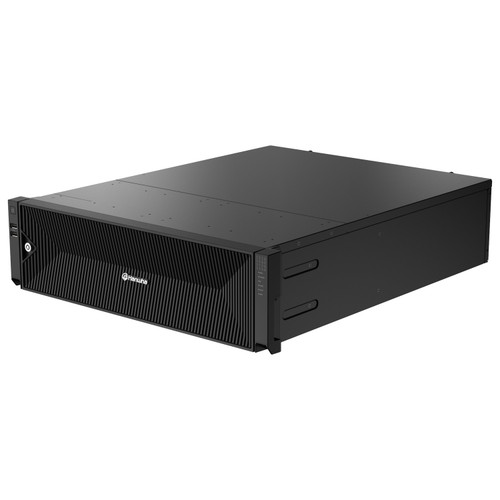
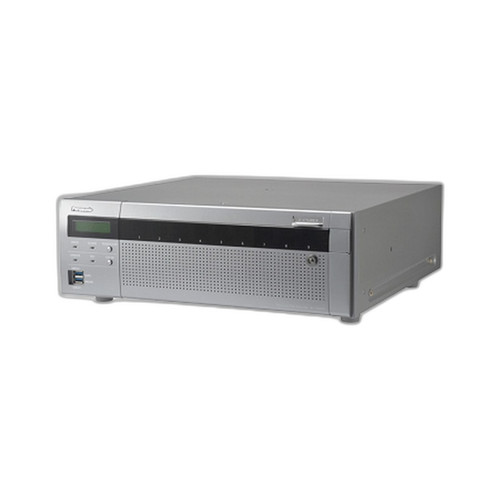
In This Guide
- Which NVR delivers higher recording bandwidth and resolution throughput across 64 channels?
- How do the two NVRs compare on raw storage capacity, drive bay count, and RAID redundancy options?
- Which NVR offers broader protocol support, remote management capabilities, and third-party camera integration?
- Which should you choose: the XRN-6420DB4 or the NX400/27000T3?
- Side-by-Side Specs
- FAQ
Which NVR delivers higher recording bandwidth and resolution throughput across 64 channels?
The Hanwha XRN-6420DB4 specifies a maximum recording bandwidth of 520 Mbps, with simultaneous 64-channel playback supported at up to 200 Mbps. It supports camera streams up to 32MP at 15 fps (H.265 only) and 12MP at 30 fps (H.265 only), stepping down to 1080p at 16 channels simultaneously at 30 fps, and D1 at all 64 channels at 30 fps. Local display output reaches 4K at 30 Hz on the primary HDMI port plus 1080p at 60 Hz on a second HDMI port.
The i-PRO WJ-NX400/27000T3 specifies a maximum resolution of 4K (3840×2160 / 8 MP) and a per-camera maximum of 60 fps. However, the provided specifications do not state an aggregate recording bandwidth figure in Mbps, and they do not break out multi-channel simultaneous recording resolution tiers (e.g., how many channels at 4K simultaneously). The 'Speed: 3 Mbps' field appears to describe a single-stream bitrate reference rather than aggregate throughput, and cannot be compared directly to the Hanwha's 520 Mbps aggregate figure.
On the basis of documented specs, the XRN-6420DB4 provides a fully specified multi-resolution, multi-channel throughput matrix. The WJ-NX400/27000T3's aggregate bandwidth is not specified in the provided data, making a direct throughput comparison incomplete on that dimension.
How do the two NVRs compare on raw storage capacity, drive bay count, and RAID redundancy options?
The Hanwha XRN-6420DB4 ships with 16 SATA HDD bays supporting drives up to 10TB each, yielding a maximum internal capacity of 160TB. It supports RAID 5 and RAID 6 configurations (array size: 8 HDDs × 2 arrays) as well as a non-RAID mode and iSCSI external storage expansion. Hot-swap drive replacement is supported. The unit does not ship with pre-installed drives; storage must be added by the integrator.
The i-PRO WJ-NX400/27000T3 ships with 27TB of pre-installed storage configured as 3TB × 9 drives. It supports RAID 0, 1, 5, 6, and 10 — a broader RAID option set than the Hanwha, which omits RAID 0, 1, and 10. The i-PRO unit also lists local microSD storage as an auxiliary option. Maximum internal expandable capacity beyond the 27TB pre-installed configuration is not stated in the provided specifications. iSCSI or external expansion support is not mentioned.
The Hanwha offers a higher documented maximum internal capacity ceiling (160TB vs. 27TB pre-installed with no stated expansion ceiling for the i-PRO) and hot-swap, but the i-PRO ships ready-to-record and supports a wider RAID level selection including RAID 10.
Which NVR offers broader protocol support, remote management capabilities, and third-party camera integration?
The Hanwha XRN-6420DB4 supports SUNAPI (Hanwha's native API) and ONVIF. It accommodates up to 4 simultaneous users (1 local, 3 remote), with remote live view supporting up to 10 unicast connections and search up to 3 concurrent users. It includes N+1 failover, ARB (Auto Recovery Backup), and CMS integration. PTZ control supports up to 300 presets. Mobile clients for iOS and Android are specified. Protocol support includes RTP, RTSP, HTTP, and CGI via SUNAPI. Object attribute analytics are noted as compatible with Hanwha AI cameras specifically.
The i-PRO WJ-NX400/27000T3 specifies ONVIF Profile S compatibility and native compatibility with i-PRO IP cameras. PTZ control covers pan, tilt, zoom, focus, brightness, and up to 256 preset positions. Alarm I/O is explicitly specified: 1–32 alarm inputs and 1–4 alarm reset inputs with alarm output — a level of alarm I/O detail not provided in the Hanwha's spec sheet. Audio output is specified as −10 dBv RCA. The number of simultaneous remote users, failover capability, ARB, and mobile app support are not stated in the provided specifications.
The Hanwha spec sheet provides more detail on remote access concurrency, failover, and mobile management. The i-PRO spec sheet provides more explicit alarm I/O counts. Both support ONVIF, but SUNAPI gives the Hanwha a deeper integration path within the Hanwha/Samsung camera ecosystem, while the i-PRO's broader ONVIF Profile S documentation supports third-party camera integration at the protocol level.
Which should you choose: the XRN-6420DB4 or the NX400/27000T3?
Our take: The XRN-6420DB4 is the stronger choice when maximum internal storage scalability, documented aggregate recording throughput, and deep Hanwha ecosystem integration are the primary requirements. It delivers a specified 520 Mbps aggregate recording bandwidth versus no stated aggregate figure for the WJ-NX400/27000T3, supports up to 160TB across 16 hot-swap SATA bays versus the i-PRO's 27TB pre-installed (with no stated expansion ceiling), and adds N+1 failover and ARB not listed in the i-PRO specs. The WJ-NX400/27000T3 is the stronger choice when a plug-and-play pre-loaded storage configuration, a broader RAID option set (adding RAID 0, 1, and 10 absent from the Hanwha), explicit 32-point alarm I/O, and native i-PRO camera compatibility on a 12V DC power architecture are the priority. Integrators specifying a Hanwha camera site should favor the XRN-6420DB4; those standardizing on i-PRO cameras or requiring RAID 10 should evaluate the WJ-NX400/27000T3.
Side-by-Side Comparison
Spec-for-spec, from manufacturer data.
| Specification | Hanwha XRN-6420DB4 | i-PRO NX400/27000T3 |
|---|---|---|
| Product Class | 64-Channel NVR | 64-Channel NVR |
| Max Camera Channels | 64 | 64 |
| Recording Bandwidth (Aggregate) | 520 Mbps | — |
| Playback Bandwidth (Aggregate) | 200 Mbps (64CH simultaneous) | — |
| Max Supported Resolution | 32MP @ 15fps (H.265 only) | 4K / 8MP @ 60fps per camera |
| Local Display Output | Dual HDMI: 4K@30Hz + 1080p@60Hz | HDMI (resolution not specified) |
| Video Compression | H.265, H.264, MJPEG | H.265, H.264, JPEG |
| HDD Bays | 16 × SATA (hot-swap) | 9 (pre-installed 3TBx9) |
| Max Internal Storage | 160TB (10TB per drive max) | 27TB pre-installed; max not stated |
| External Storage | iSCSI | — |
| RAID Support | RAID 5, 6 | RAID 0, 1, 5, 6, 10 |
| N+1 Failover / ARB | Yes / Yes | — / — |
| Alarm Inputs / Outputs | — | 1–32 inputs / 1 output / 1–4 reset |
| Max Simultaneous Users | 4 (1 local + 3 remote) | — |
| PTZ Presets | 300 | 256 |
| Power Input | 100–240 VAC, dual SMPS | 12V DC |
| Operating Temperature | 0°C to +40°C | — |
| Protocols | SUNAPI, ONVIF, RTP, RTSP, HTTP, CGI | ONVIF Profile S |
| Mobile App | iOS, Android | — |
| Dimensions (WxHxD mm) | 440 × 132 × 571 | 430 × 132 × 400 |
| Weight | 15.1 kg (HDDs not included) | — |
Frequently Asked Questions
Which should you choose: the XRN-6420DB4 or the NX400/27000T3?
The XRN-6420DB4 is the stronger choice when maximum internal storage scalability, documented aggregate recording throughput, and deep Hanwha ecosystem integration are the primary requirements. It delivers a specified 520 Mbps aggregate recording bandwidth versus no stated aggregate figure for the WJ-NX400/27000T3, supports up to 160TB across 16 hot-swap SATA bays versus the i-PRO's 27TB pre-installed (with no stated expansion ceiling), and adds N+1 failover and ARB not listed in the i-PRO specs. The WJ-NX400/27000T3 is the stronger choice when a plug-and-play pre-loaded storage configuration, a broader RAID option set (adding RAID 0, 1, and 10 absent from the Hanwha), explicit 32-point alarm I/O, and native i-PRO camera compatibility on a 12V DC power architecture are the priority. Integrators specifying a Hanwha camera site should favor the XRN-6420DB4; those standardizing on i-PRO cameras or requiring RAID 10 should evaluate the WJ-NX400/27000T3.
Is the XRN-6420DB4 or the WJ-NX400/27000T3 better for larger deployments requiring long video retention?
Based on the provided specifications, the XRN-6420DB4 supports a documented maximum internal capacity of 160TB across 16 hot-swap SATA bays (up to 10TB per drive) plus iSCSI external expansion, making it the better-specified option for high-retention large-scale deployments. The WJ-NX400/27000T3 ships with 27TB pre-installed across 9 drives; its maximum expandable capacity is not stated in the provided specifications, so a ceiling comparison beyond 27TB cannot be made from the available data.
Can both NVRs work with third-party ONVIF cameras, or are they locked to their own brand?
Both NVRs list ONVIF support. The XRN-6420DB4 specifies ONVIF alongside Hanwha's native SUNAPI protocol and notes that AI object attribute analytics are compatible with Hanwha AI cameras specifically, implying some advanced analytics features are brand-gated. The WJ-NX400/27000T3 specifies ONVIF Profile S and lists compatibility with i-PRO IP cameras. Neither specification document explicitly defines the scope of ONVIF feature parity versus native-brand feature parity for non-native cameras.
Which NVR has stronger built-in redundancy and failover protection?
The XRN-6420DB4 specifies N+1 failover, ARB (Auto Recovery Backup), RAID 5/6 with dual-array support, hot-swap drives, and dual SMPS (redundant power supplies). The WJ-NX400/27000T3 specifies RAID 0, 1, 5, 6, and 10 — a broader RAID level set — but failover, ARB, hot-swap capability, and power supply redundancy are not stated in the provided specifications for the i-PRO unit.
Get a Second Opinion on Your Camera Choice
Share your site layout, coverage goals, and budget. Our team will validate the camera selection, flag anything we would change, and recommend products that match the use case.