
Hanwha XNV-9082R vs i-PRO U85402-V2L1: Specification Comparison
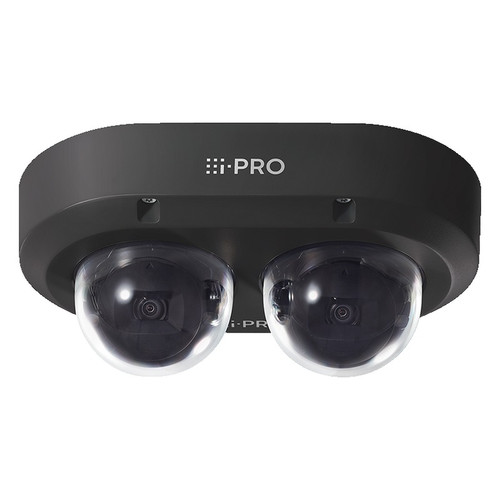
Both the Hanwha XNV-9082R and the i-PRO WV-U85402-V2L1 are outdoor vandal-rated IP dome cameras positioned for perimeter and general surveillance applications. The comparison involves an 8MP single-sensor fixed dome against a dual-sensor 4MP-per-channel unit, both with motorized varifocal lenses, 40m IR, IK10 impact resistance, and IP67 ratings. Buyers evaluating these two models are typically weighing single-channel pixel density against dual-sensor simultaneous coverage, and Hanwha's broader on-camera analytics platform against i-PRO's FIPS 140-2 Level 3 security posture.
In This Guide
How do the imaging specs compare?
The XNV-9082R uses a single 1/2.8" progressive CMOS sensor delivering 3840×2160 (8MP) at 30fps, with a 2.8–8.4mm 3x motorized varifocal lens reaching a maximum horizontal field of view of 114° and a minimum aperture of F1.2 at wide end. Its WDR is rated at 120dB (Hanwha extremeWDR), and minimum illumination is 0.05 Lux color with 0 Lux IR capability. IR range is 40m via WiseIR. DORI detection at wide is 49.9m and at tele 211.0m. The WV-U85402-V2L1 deploys two 1/2.7" CMOS sensors simultaneously, each outputting up to 2688×1520 (4MP per channel) at 30fps. Its motorized varifocal covers 2.9–7.3mm (2.5x optical zoom) with a horizontal FOV of 43–100°. WDR is rated at 108dB maximum (Super Dynamic on, level 31), and minimum illumination is specified at 0.12 Lux (B&W, 50 IRE). IR range is also 40m. DORI detection at wide is 45.1m and at tele 136.5m.
The XNV-9082R delivers higher single-channel resolution (8MP vs 4MP per sensor), lower minimum illumination (0.05 Lux color vs 0.12 Lux B&W), greater WDR headroom (120dB vs 108dB), and a longer tele DORI detection range (211.0m vs 136.5m). The WV-U85402-V2L1's architectural advantage is simultaneous dual-angle capture from two independent sensors without requiring a second camera or PTZ sweep, which the XNV-9082R cannot replicate. The i-PRO unit also supports up to 10.5x digital zoom (at 640×360 resolution) as an extra zoom mode; the XNV-9082R does not list an equivalent digital zoom figure in its provided specifications.
What about installation and environment?
Both cameras share IP66/IP67, NEMA 4X, and IK10 ratings, making them equivalently rated for dust ingress, water jets, salt-spray environments, and physical impact. The XNV-9082R additionally carries IP6K9K certification (high-pressure, high-temperature washdown per ISO 20653) and an IK10+ designation, which exceeds standard IK10. The WV-U85402-V2L1 adds a wind resistance specification of up to 40 m/s (~89 mph) and an anti-condensation Temish element, neither of which is listed in the XNV-9082R's provided specifications. Operating temperature ranges are nearly identical: XNV-9082R is rated –50°C to +60°C; WV-U85402-V2L1 is rated –40°C to +60°C, giving the Hanwha a 10°C advantage at the cold extreme.
Power requirements diverge meaningfully. The XNV-9082R draws up to 12.95W and is powered by PoE IEEE 802.3af (Class 3), 12VDC, or 24VAC. The WV-U85402-V2L1 requires PoE+ (IEEE 802.3at, Class 4) at 18.9W due to its dual-sensor architecture; installers must confirm that their switch or injector supports 802.3at before deployment. The XNV-9082R weighs 1,900g and measures ø180×125mm; the WV-U85402-V2L1 weighs approximately 1,800g at 250×150×105mm (attachment plate). The XNV-9082R lists a broader set of compatible conduit knockouts and gang-box adapters (19.1mm/M25, single/double/4" octagon/4" square) and a dedicated hanging mount (SBP-187HMW); comparable mounting accessories are not enumerated in the i-PRO's provided specifications.
Which fits your VMS and analytics better?
Both cameras declare ONVIF Profile S/G/T compliance and support H.265, H.264, and MJPEG compression with CBR/VBR bitrate control. The XNV-9082R supports up to 10 simultaneous streaming profiles (3 virtual channels) and unicast up to 20 users; the WV-U85402-V2L1 supports 24 simultaneous users. Protocol coverage is broadly comparable, with both listing MQTT, SNMPv1/v2/v3, IEEE 802.1X, HTTPS/SSL/TLS, and LLDP. The WV-U85402-V2L1 specifies FIPS 140-2 Level 3 compliance—a federal/government-grade cryptographic standard not claimed in the XNV-9082R's provided specifications. The XNV-9082R lists Wisenet SUNAPI and the Wisenet open platform for third-party integration beyond ONVIF; no equivalent SDK/API is listed for the i-PRO unit in the provided specifications.
On analytics, the XNV-9082R carries a substantially broader on-camera AI suite: defocus detection, directional detection, digital auto tracking, appear/disappear, enter/exit, loitering, tampering, fog detection, virtual line, face/upper body detection, and business intelligence functions including people counting, queue management, and heatmap—all edge-executed. The WV-U85402-V2L1 lists VMD (4 areas), Scene Change Detection (1 area), and audio detection; its AI Analytics and AI Sound Classification fields are explicitly marked as '—' (not supported) in the provided specifications. Both support on-board microSD/SDXC storage up to 512GB. Audio I/O is available on both: the XNV-9082R uses a selectable mic/line-in and line-out; the WV-U85402-V2L1 provides 3.5mm stereo mini jack input and 3.5mm mono jack output, with half-duplex and full-duplex transmission modes listed.
Which should you choose: the XNV-9082R or the U85402-V2L1?
Our take: The XNV-9082R is the stronger choice when maximum single-channel resolution, richer edge analytics, and sub-zero cold-weather operation are the primary requirements. It delivers 8MP (3840×2160) versus 4MP per sensor on the WV-U85402-V2L1, a 120dB WDR rating versus 108dB, a cold-end operating temperature of –50°C versus –40°C, and a tele DORI detection range of 211.0m versus 136.5m—all from a standard PoE 802.3af (Class 3, 12.95W) budget. Its on-camera analytics catalog—people counting, heatmap, loitering, face/upper body detection—has no equivalent in the i-PRO's provided specifications. The WV-U85402-V2L1 is the better fit when simultaneous dual-angle coverage from a single mounting point is operationally required, when FIPS 140-2 Level 3 cryptographic compliance is mandated by a government or high-security contract, or when the site specifies wind resistance up to 40 m/s; note that it requires PoE+ (802.3at, Class 4, 18.9W) infrastructure.
Side-by-Side Comparison
Spec-for-spec, from manufacturer data.
| Specification | Hanwha XNV-9082R | i-PRO U85402-V2L1 |
|---|---|---|
| Resolution | 3840×2160 (8MP) | 2688×1520 per sensor (4MP × 2 sensors) |
| Image Sensor | 1/2.8" progressive CMOS (single) | 2× 1/2.7" CMOS (dual) |
| Lens / Focal Length | 2.8–8.4mm, 3x motorized varifocal | 2.9–7.3mm, 2.5x motorized varifocal |
| Min. Illumination | 0.05 Lux color / 0 Lux IR | 0.12 Lux B&W (50 IRE) |
| IR Range | 40m WiseIR | 40m (High mode) |
| Wide Dynamic Range | 120dB (extremeWDR) | 108dB max (Super Dynamic on, Level 31) |
| Max Frame Rate | 30fps @ 8MP | 30fps |
| Video Compression | H.265, H.264, MJPEG | H.265, H.264, MJPEG |
| IP Rating | IP66 / IP67 / IP6K9K / NEMA 4X | IP66 / IP67 / NEMA 4X |
| Impact Rating | IK10+ | IK10 |
| Operating Temperature | –50°C to +60°C | –40°C to +60°C |
| Power Input / PoE Class | PoE 802.3af Class 3 / 12VDC / 24VAC; 12.95W max | PoE+ 802.3at Class 4; 18.9W |
| Edge Storage | microSD/SDHC/SDXC 2-slot, max 1TB (512GB×2) | microSD/SDHC/SDXC, max 512GB (single slot) |
| Alarm I/O | 2 configurable I/O ports | 3 alarm I/O terminals (IN1/IN2/IN3) |
| Audio | Mic/line-in (selectable), line-out | 3.5mm stereo mini jack in, 3.5mm mono jack out; half/full-duplex |
| ONVIF Profiles | S / G / T | G / S / T |
| Edge Analytics | Loitering, enter/exit, people counting, heatmap, face/upper body detection, +more | VMD (4 areas), Scene Change Detection (1 area), audio detection; AI Analytics: not listed |
| Cybersecurity Certification | — | FIPS 140-2 Level 3 |
| Weight | 1,900g (4.19 lb) | Approx. 1,800g |
| Warranty | 3-year | 3-year |
Frequently Asked Questions
Which should you choose: the XNV-9082R or the U85402-V2L1?
The XNV-9082R is the stronger choice when maximum single-channel resolution, richer edge analytics, and sub-zero cold-weather operation are the primary requirements. It delivers 8MP (3840×2160) versus 4MP per sensor on the WV-U85402-V2L1, a 120dB WDR rating versus 108dB, a cold-end operating temperature of –50°C versus –40°C, and a tele DORI detection range of 211.0m versus 136.5m—all from a standard PoE 802.3af (Class 3, 12.95W) budget. Its on-camera analytics catalog—people counting, heatmap, loitering, face/upper body detection—has no equivalent in the i-PRO's provided specifications. The WV-U85402-V2L1 is the better fit when simultaneous dual-angle coverage from a single mounting point is operationally required, when FIPS 140-2 Level 3 cryptographic compliance is mandated by a government or high-security contract, or when the site specifies wind resistance up to 40 m/s; note that it requires PoE+ (802.3at, Class 4, 18.9W) infrastructure.
Is the XNV-9082R or the WV-U85402-V2L1 better for low-light performance?
Based on provided specifications, the XNV-9082R has the lower minimum illumination figure: 0.05 Lux color (0 Lux with IR active) versus 0.12 Lux (B&W, 50 IRE) for the WV-U85402-V2L1. Both share the same 40m IR range. The XNV-9082R also carries a higher WDR rating (120dB extremeWDR vs 108dB Super Dynamic), which improves performance in mixed high-contrast lighting rather than pure darkness.
Can the WV-U85402-V2L1 run on a standard PoE switch, or do I need PoE+?
The WV-U85402-V2L1 requires PoE+ (IEEE 802.3at, Class 4) at 18.9W per the provided specifications. Standard 802.3af switches are limited to 15.4W per port and will not reliably power this camera. The XNV-9082R, by contrast, operates on standard 802.3af PoE (Class 3, 12.95W) and also accepts 12VDC or 24VAC, giving installers more infrastructure flexibility.
Which camera is better suited for a government or federally regulated deployment requiring strong cybersecurity compliance?
The WV-U85402-V2L1 explicitly lists FIPS 140-2 Level 3 compliance in its provided specifications, which is a U.S. federal cryptographic standard often required in government, defense, and regulated-industry deployments. The XNV-9082R's provided specifications do not claim FIPS 140-2 certification; it does list HTTPS/SSL, 802.1X, digest authentication, and a device certificate from Hanwha Techwin Root CA, but buyers with a hard FIPS requirement should verify current certification status directly with each manufacturer before specifying.
Get a Second Opinion on Your Camera Choice
Share your site layout, coverage goals, and budget. Our team will validate the camera selection, flag anything we would change, and recommend products that match the use case.