
Hanwha XNP-6400RW vs i-PRO S66300-Z3: Specification Comparison
Both the Hanwha XNP-6400RW and the i-PRO WV-S66300-Z3 are 2MP outdoor PTZ IP cameras targeting enterprise perimeter and traffic-monitoring applications. They share the same resolution class, the same PoE++ power standard, and comparable IP66/IK10 environmental ratings, making them genuine cross-shop candidates. This comparison covers imaging capability, mechanical and environmental fit, and integration with VMS platforms and AI analytics stacks — drawing exclusively from the published specifications for each model.
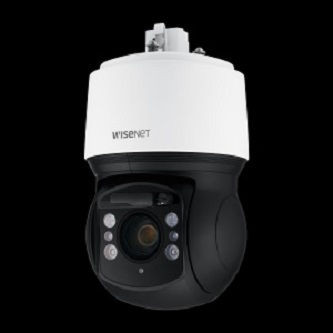
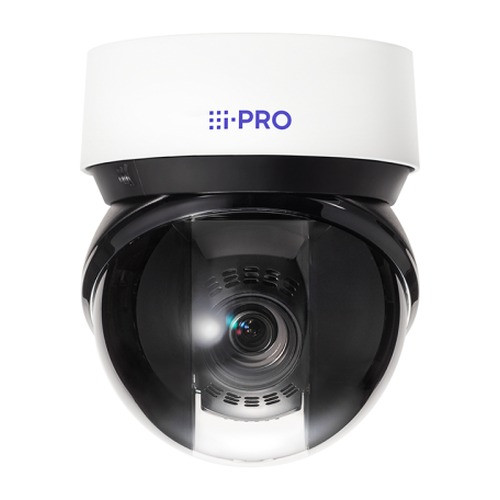
In This Guide
How do the imaging specs compare?
Both cameras use a 1/2.8" CMOS sensor at 1920×1080 and deliver 60 fps. The XNP-6400RW provides 40x optical zoom (4.25–170 mm, F1.6–F4.95) with an additional 32x digital stage for a rated 1280x total zoom, while the WV-S66300-Z3 delivers 32x optical zoom (4.25–136 mm, F1.6–F4.4) extendable to 48x when resolution is reduced to 1280×720. For long-range tele identification at 250 ppm the XNP-6400RW rates 234.0 m versus the WV-S66300-Z3 at 183.3 m, reflecting the longer focal length. The Hanwha unit also carries a wider horizontal FOV at full wide (65.66° vs. 65°), a marginal difference in practice.
On low-light performance the WV-S66300-Z3 holds a clear specification advantage: minimum illumination is rated at 0.006 lux versus the XNP-6400RW's 0.05 lux (color), a roughly 8× difference. The XNP-6400RW supplements this with a built-in IR illuminator rated to 200 m, whereas the WV-S66300-Z3 specification sheet does not list an IR illuminator distance — the spec field for IR LED Light is listed as a dash. WDR is rated at 150 dB (Extreme WDR, SSDR) for the XNP-6400RW and 144 dB (Super Dynamic) for the WV-S66300-Z3. Both include a gyro-based digital image stabilizer and mechanical Day/Night ICR.
What about installation and environment?
Both cameras carry IP66, NEMA 4X (Type 4X), and IK10 ratings, confirming equivalence on weatherproofing and vandal resistance for outdoor pole or parapet mounting. The XNP-6400RW also adds NEMA-TS 2 (2.2.8, 2.2.9) certification for traffic-control deployments; the WV-S66300-Z3 lists NEMA-TS2 under 'Other Standard' as well. Power draw differs: the XNP-6400RW is rated typical 20 W / max 42 W on HPoE (IEEE 802.3bt Class 6, injector included); the WV-S66300-Z3 is rated at 37.8 W on PoE++ — both requiring an 802.3bt Class 6 switch port or injector.
Operating temperature favors the i-PRO unit slightly: -50 °C to +60 °C versus the Hanwha's -40 °C to +55 °C, relevant in sub-arctic deployments. The XNP-6400RW includes an integrated wiper for lens clearing in rain or debris environments; no wiper is listed in the WV-S66300-Z3 spec. The i-PRO model additionally specifies wind resistance up to 40 m/s (~89 mph). The XNP-6400RW weighs approximately 5.4 kg (11.90 lb) versus the WV-S66300-Z3's approximately 3 kg (without attachment), a notable difference for pole-load calculations. Physical diameter is also larger on the Hanwha (Ø184.9 mm) versus i-PRO (Ø167 mm).
Which fits your VMS and analytics better?
Both cameras support ONVIF Profiles G, S, and T. The WV-S66300-Z3 additionally supports ONVIF Profile M. The XNP-6400RW adds Wisenet open platform and Hanwha SUNAPI (HTTP API) for native Wisenet VMS integration. The WV-S66300-Z3 declares FIPS 140-2 Level 3 compliance and certificate-based authentication alongside HTTPS and 802.1X; the XNP-6400RW lists 802.1X (EAP-TLS, EAP-LEAP), HTTPS/SSL, digest authentication, IP filtering, a user access log, and Hanwha Techwin Root CA device certificates with UL CAP (UL 2900-1) cybersecurity certification. PTZ preset capacity is 256 positions on the WV-S66300-Z3 versus the XNP-6400RW spec card listing 300 presets.
For on-camera analytics, the WV-S66300-Z3 specifies AI-based face, people, vehicle, non-mask detection, occupancy, scene change, and AI Sound Classification (gunshot, yell, vehicle horn, glass break). The XNP-6400RW lists directional detection, fog detection, face detection, motion detection, appear/disappear, enter/exit, loitering, tampering, virtual line, shock detection, and audio/sound classification contingent on an external NW I/O Box. Audio I/O is built-in on the WV-S66300-Z3 (4× audio input jacks, 1× audio output, 3 alarm inputs / 1 alarm output), while the XNP-6400RW has no onboard audio or alarm I/O — all require an external NW I/O Box accessory. Edge storage is micro SD/SDHC/SDXC up to 1 TB (2 slots) on the XNP-6400RW; the WV-S66300-Z3 supports a single microSDXC card with no maximum capacity stated in the provided spec.
Which should you choose: the XNP-6400RW or the S66300-Z3?
Our take: The XNP-6400RW is the stronger choice when long-range optical reach, an integrated wiper, and dual-slot edge storage are the priority: its 40x optical zoom (170 mm tele) extends the 250-ppm identification range to 234 m versus 183.3 m for the WV-S66300-Z3, its 200 m IR illuminator provides passive night coverage without external lighting, and its built-in wiper sustains lens clarity in rain-heavy environments. Conversely, the WV-S66300-Z3 holds the advantage when minimum-illumination sensitivity matters (0.006 lux vs. 0.05 lux), when native audio I/O and on-board alarm terminals are required without additional hardware, when ONVIF Profile M compliance is mandated by the VMS, or when extreme cold operation (to -50 °C) is a site requirement. Buyers on Wisenet VMS ecosystems benefit from XNP-6400RW's SUNAPI native integration; buyers on multi-vendor platforms may value the i-PRO's FIPS 140-2 Level 3 security posture.
Side-by-Side Comparison
Spec-for-spec, from manufacturer data.
| Specification | Hanwha XNP-6400RW | i-PRO S66300-Z3 |
|---|---|---|
| Resolution | 1920×1080 (2MP) | 1920×1080 (2MP) |
| Image Sensor | 1/2.8" CMOS | Approx. 1/2.8" CMOS |
| Optical Zoom / Focal Length | 40x (4.25–170 mm) | 32x (4.25–136 mm); 48x extended at 720p |
| Max Aperture (Wide/Tele) | F1.6 / F4.95 | F1.6 / F4.4 |
| Min. Illumination (Color) | 0.05 lux | 0.006 lux |
| IR Illuminator Range | 200 m (Wise IR) | — (not specified) |
| WDR | 150 dB Extreme WDR | 144 dB Super Dynamic |
| Max Frame Rate | 60 fps | 60 fps |
| Video Compression | H.265 / H.264 / MJPEG | H.265 / H.264 / MJPEG |
| Pan Speed (Preset) | 500°/s | 700°/s |
| Tilt Speed (Preset) | 350°/s | 500°/s |
| Preset Positions | 300 (implied from ±0.1° accuracy spec; not explicitly stated as count) | 256 |
| IP / Impact Rating | IP66, NEMA 4X, IK10 | IP66, Type 4X, IK10 |
| Operating Temperature | -40 °C to +55 °C | -50 °C to +60 °C |
| Power Input / PoE Class | HPoE IEEE 802.3bt Class 6; max 42 W | PoE++ 802.3bt; 37.8 W |
| Audio I/O | — (requires NW I/O Box accessory) | 4× audio in (3.5 mm); 1× audio out (3.5 mm) |
| Alarm I/O | — (requires NW I/O Box accessory) | 3 alarm inputs / 1 alarm output |
| Edge Storage | Micro SD/SDHC/SDXC; 2 slots; up to 1 TB | microSDXC; 1 slot; capacity not specified |
| ONVIF Profiles | S / G / T | G / M / S / T |
| Wiper | Yes (integrated) | — (not specified) |
| Weight | 5.4 kg (11.90 lb) | Approx. 3 kg (without attachment) |
| Warranty | 5-year | 5-year |
Frequently Asked Questions
Which should you choose: the XNP-6400RW or the S66300-Z3?
The XNP-6400RW is the stronger choice when long-range optical reach, an integrated wiper, and dual-slot edge storage are the priority: its 40x optical zoom (170 mm tele) extends the 250-ppm identification range to 234 m versus 183.3 m for the WV-S66300-Z3, its 200 m IR illuminator provides passive night coverage without external lighting, and its built-in wiper sustains lens clarity in rain-heavy environments. Conversely, the WV-S66300-Z3 holds the advantage when minimum-illumination sensitivity matters (0.006 lux vs. 0.05 lux), when native audio I/O and on-board alarm terminals are required without additional hardware, when ONVIF Profile M compliance is mandated by the VMS, or when extreme cold operation (to -50 °C) is a site requirement. Buyers on Wisenet VMS ecosystems benefit from XNP-6400RW's SUNAPI native integration; buyers on multi-vendor platforms may value the i-PRO's FIPS 140-2 Level 3 security posture.
Is the XNP-6400RW or WV-S66300-Z3 better for low-light performance without IR?
Based on published specs, the WV-S66300-Z3 has a significantly lower minimum illumination rating — 0.006 lux versus the XNP-6400RW's 0.05 lux (color) — meaning it requires less ambient light for color imaging. However, the XNP-6400RW includes a built-in 200 m IR illuminator that provides active illumination when ambient light is absent; the WV-S66300-Z3 spec does not list a built-in IR illuminator distance.
Which camera do I need to add hardware to for audio recording?
The WV-S66300-Z3 has built-in audio inputs (4× 3.5 mm stereo jacks) and one audio output, plus 3 alarm inputs and 1 alarm output on the unit itself. The XNP-6400RW has no onboard audio input, audio output, or alarm I/O — those functions require an external Hanwha NW I/O Box accessory, which is not included.
Does either camera work in extreme cold climates below -40 °C?
Only the i-PRO WV-S66300-Z3 is rated for operation down to -50 °C. The Hanwha XNP-6400RW specifies an operating temperature floor of -40 °C. For installations in sub-arctic environments where temperatures drop below -40 °C, the WV-S66300-Z3 meets that threshold; the XNP-6400RW does not according to its published spec.
Get a Second Opinion on Your Camera Choice
Share your site layout, coverage goals, and budget. Our team will validate the camera selection, flag anything we would change, and recommend products that match the use case.