
Hanwha XND-9082RV vs i-PRO U85402-V2L1: Specification Comparison
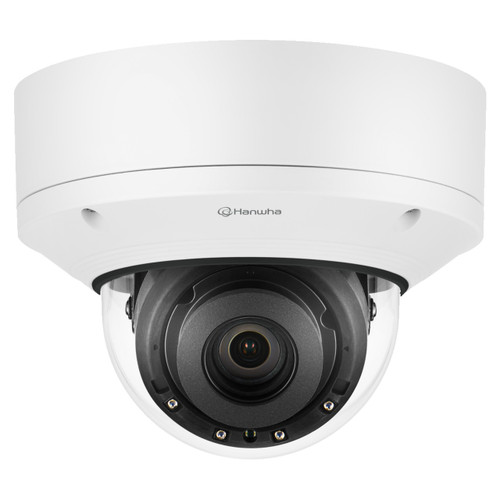
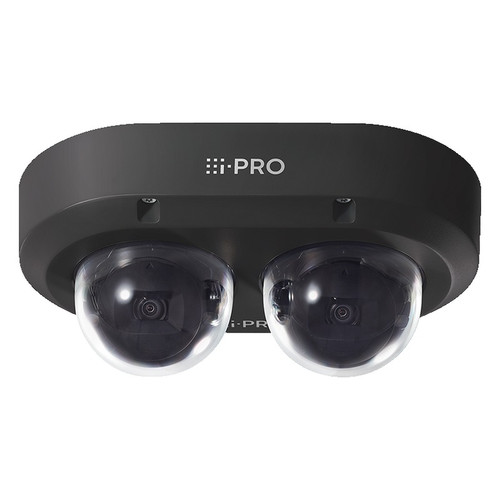
This comparison examines two 8MP fixed dome IP cameras from Hanwha and i-PRO aimed at professional security integrators. The Hanwha XND-9082RV is a single-sensor 8MP indoor dome with motorized varifocal optics and an extensive onboard analytics suite. The i-PRO WV-U85402-V2L1 is a dual-sensor outdoor dome combining two 4MP sensors for an 8MP total system, rated for harsh environments. Buyers evaluating high-resolution fixed domes for mixed indoor/outdoor deployments or weighing single-sensor depth against dual-sensor coverage will find meaningful differences across imaging, installation, and integration criteria.
In This Guide
How do the imaging specs compare?
The Hanwha XND-9082RV uses a single 1/2.8" progressive CMOS sensor delivering a native 3840×2160 (8MP) image from one optical path, with a 2.8–8.4mm (3x) motorized varifocal lens at a maximum aperture of F1.2 (wide) to F2.8 (tele). Minimum illumination is rated at 0.05 Lux in color and 0 Lux with IR active, with WiseIR reaching 40m. Its extremeWDR is rated at 120dB. The i-PRO WV-U85402-V2L1 uses two 1/2.7" CMOS sensors, each producing 4MP (2688×1520), combining to an 8MP total system across a wider horizontal field. Its 2.9–7.3mm (2.5x) motorized lens opens to F2.0 wide and F3.0 tele, with minimum illumination rated at 0.12 Lux (B&W, 50IRE). IR range is also 40m, and WDR is rated at Super Dynamic 108dB maximum.
At low-light thresholds, the Hanwha's F1.2 maximum aperture and 0.05 Lux color rating represent a meaningful advantage over the i-PRO's F2.0 and 0.12 Lux B&W figure, particularly in dimly lit interior spaces. The Hanwha also delivers a 120dB WDR rating versus the i-PRO's 108dB, a 12dB advantage that can matter in scenes with mixed direct sunlight and shadow. The i-PRO's dual-sensor architecture provides a fundamentally different coverage geometry — two simultaneous optical paths — which trades per-sensor light collection for broader scene coverage without mechanical pan. DORI identification range favors the Hanwha at tele (21.1m vs 13.6m), while the Hanwha's wider 3x zoom range also extends its tele detection distance to 211m versus the i-PRO's 136.5m at the detect threshold.
What about installation and environment?
The Hanwha XND-9082RV is rated IP52 and IK10, designed for indoor use with limited dust and water-spray resistance. It operates from -25°C to +60°C and draws a maximum of 12.95W over PoE IEEE 802.3af (Class 3) or 12VDC — standard PoE switches will support it without upgrade. Its aluminum body with hard-coated dome bubble weighs 1,600g and measures ø160×125mm. The i-PRO WV-U85402-V2L1 is rated IP67/IP66, IK10, NEMA 4X (UL50E), and includes wind resistance up to 40 m/s (~89 mph) with an anti-condensation Temish element. It operates from -40°C to +60°C, making it suited for extreme cold environments. Power requires PoE+ (IEEE 802.3at) at up to 18.9W, meaning the infrastructure must support 802.3at switches or injectors. The i-PRO chassis is aluminum die cast at approximately 1.8kg, with stainless steel screws for corrosion resistance.
For indoor-only deployments with standard PoE infrastructure, the Hanwha is the simpler install. For outdoor, traffic, or industrial environments demanding full weather sealing, rated wind resistance, and a -40°C cold floor, the i-PRO's environmental credentials are substantially stronger. The i-PRO also carries c-UL CSA C22.2 and ICES-003 certifications relevant to Canadian projects, and NEMA TS 2 compliance for traffic applications — none of which appear in the Hanwha's spec sheet.
Which fits your VMS and analytics better?
Both cameras support ONVIF Profile S, G, and T, ensuring broad VMS compatibility. The Hanwha XND-9082RV streams to up to 20 simultaneous unicast users with up to 10 configurable profiles and 3 virtual channels, and supports dual Micro SD slots totaling up to 1TB (512GB×2) for edge redundancy. Its onboard analytics include defocus detection, directional detection, digital auto tracking, appear/disappear, enter/exit, loitering, tampering, fog detection, virtual line, audio detection, sound classification, shock detection, face and upper body detection, as well as business intelligence functions — people counting, queue management, and heatmap. The i-PRO WV-U85402-V2L1 streams to up to 24 simultaneous users and provides VMD (4 areas), scene change detection (1 area), and audio detection. Its spec sheet lists AI analytics and AI sound classification as "—" (not specified or not available). Edge storage is a single microSD slot up to 512GB.
For analytics-heavy deployments — retail intelligence, perimeter intrusion, crowd management — the Hanwha's onboard suite is far more capable per spec. The i-PRO offers a stronger security posture with FIPS 140-2 Level 3 certification and signed firmware, which matters in government, critical infrastructure, or high-security IT environments where firmware chain-of-custody is a procurement requirement. Audio: the Hanwha provides a selectable mic/line in with built-in microphone and line out, supporting a broader audio integration scenario; the i-PRO provides 3.5mm stereo in and mono out with G.726/G.711 compression. The Hanwha's dual SD slots also provide a redundancy tier the i-PRO's single slot does not.
Which should you choose: the XND-9082RV or the U85402-V2L1?
Our take: The XND-9082RV is the stronger choice when the deployment is indoors, analytics depth is a priority, and standard PoE infrastructure is in place. Its F1.2 maximum aperture and 0.05 Lux color sensitivity outperform the i-PRO's F2.0 and 0.12 Lux B&W threshold, its 120dB WDR exceeds the i-PRO's 108dB by 12dB, and its onboard analytics suite — including people counting, heatmap, loitering, and sound classification — goes substantially beyond the i-PRO's VMD-plus-audio-detection offering per spec. Dual 512GB SD slots double the edge recording capacity of the i-PRO's single slot. The WV-U85402-V2L1 is the stronger choice for outdoor and harsh-environment installations: IP67/IP66/NEMA 4X sealing, a -40°C operating floor, 40 m/s wind resistance, and FIPS 140-2 Level 3 with signed firmware make it the correct specification for exterior, traffic, or high-security-IT deployments where the Hanwha's IP52 indoor rating is insufficient.
Side-by-Side Comparison
Spec-for-spec, from manufacturer data.
| Specification | Hanwha XND-9082RV | i-PRO U85402-V2L1 |
|---|---|---|
| Resolution | 3840×2160 (8MP, single sensor) | 2×2688×1520 (2×4MP = 8MP total, dual sensor) |
| Image Sensor | 1/2.8" progressive CMOS | 2× 1/2.7" CMOS |
| Optical Zoom | 3x motorized varifocal | 2.5x motorized zoom |
| Focal Length | 2.8–8.4mm | 2.9–7.3mm |
| Min. Illumination | 0.05 Lux color / 0 Lux IR | 0.12 Lux (B&W, 50IRE) |
| IR Range | WiseIR 40m (131ft) | 40m (High mode) |
| WDR / Dynamic Range | extremeWDR 120dB | Super Dynamic 108dB max |
| Max Frame Rate | 30fps @ 8MP | 30fps |
| Video Compression | H.265 / H.264 / MJPEG | H.265 / H.264 (CBR/VBR) / MJPEG (max 1920×1080) |
| IP Rating | IP52 | IP67 / IP66 |
| IK Rating | IK10 | IK10 |
| Operating Temperature | -25°C ~ +60°C | -40°C ~ +60°C |
| Power Input / PoE Class | PoE IEEE 802.3af (Class 3) or 12VDC | PoE+ IEEE 802.3at |
| Max Power Draw | 12.95W | 18.9W |
| Edge Storage | Dual Micro SD/SDHC/SDXC, max 1TB (512GB×2) | Single microSD/SDHC/SDXC, max 512GB |
| Audio I/O | Selectable mic/line in + built-in mic; line out | 3.5mm stereo mini jack in; 3.5mm mono jack out |
| Alarm I/O | 2 configurable I/O ports | 3 terminals (IN1 / IN2 / IN3) |
| Analytics | Defocus, directional, loitering, enter/exit, people counting, heatmap, queue, face/upper body, sound classification, and more | VMD (4 areas), scene change (1 area), audio detection; AI analytics listed as — |
| Simultaneous Streams / Users | Unicast 20 users; up to 10 profiles, 3 virtual channels | 24 simultaneous users |
| Dimensions | ø160×125mm (ø6.30×4.92") | 250mm(D) × 150mm(W) × 105mm(H) |
| Weight | 1,600g (3.53 lb) | ~1.8 kg (~3.97 lb) |
| Warranty | 3-year | 3-year |
Frequently Asked Questions
Which should you choose: the XND-9082RV or the U85402-V2L1?
The XND-9082RV is the stronger choice when the deployment is indoors, analytics depth is a priority, and standard PoE infrastructure is in place. Its F1.2 maximum aperture and 0.05 Lux color sensitivity outperform the i-PRO's F2.0 and 0.12 Lux B&W threshold, its 120dB WDR exceeds the i-PRO's 108dB by 12dB, and its onboard analytics suite — including people counting, heatmap, loitering, and sound classification — goes substantially beyond the i-PRO's VMD-plus-audio-detection offering per spec. Dual 512GB SD slots double the edge recording capacity of the i-PRO's single slot. The WV-U85402-V2L1 is the stronger choice for outdoor and harsh-environment installations: IP67/IP66/NEMA 4X sealing, a -40°C operating floor, 40 m/s wind resistance, and FIPS 140-2 Level 3 with signed firmware make it the correct specification for exterior, traffic, or high-security-IT deployments where the Hanwha's IP52 indoor rating is insufficient.
Can the i-PRO WV-U85402-V2L1 be used indoors?
The i-PRO WV-U85402-V2L1 is specified and rated for outdoor use with IP67/IP66 and NEMA 4X sealing, but its specs do not restrict it to outdoor-only installation. However, it requires PoE+ (802.3at) power at up to 18.9W and its dual-sensor form factor is physically larger (250mm deep) than a typical indoor dome, so it is generally over-engineered and more expensive to install indoors compared to a purpose-built indoor unit like the XND-9082RV.
Will either camera work on a standard PoE switch without an upgrade?
The Hanwha XND-9082RV draws a maximum of 12.95W and is powered by IEEE 802.3af (Class 3), which is supported by all standard PoE switches — no upgrade required. The i-PRO WV-U85402-V2L1 requires PoE+ (IEEE 802.3at) at up to 18.9W, which exceeds the 15.4W budget of 802.3af ports. You will need to verify that your switch supports 802.3at on the port you intend to use, or provide a separate 802.3at injector.
Which camera has better onboard video analytics for retail or loss prevention use cases?
Based on the provided specifications, the Hanwha XND-9082RV has a significantly more extensive analytics suite. It includes people counting, queue management, heatmap, loitering detection, enter/exit, appear/disappear, directional detection, face and upper body detection, sound classification, and virtual line, among others. The i-PRO WV-U85402-V2L1's spec sheet lists its AI analytics and AI sound classification as not specified or not available, with coverage limited to VMD across 4 areas, scene change detection, and basic audio detection. For retail intelligence and loss prevention analytics running on the edge, the Hanwha is the better-specified option per the data provided.
Get a Second Opinion on Your Camera Choice
Share your site layout, coverage goals, and budget. Our team will validate the camera selection, flag anything we would change, and recommend products that match the use case.