
Hanwha XND-9082RV vs i-PRO U85402-V2L: Specification Comparison
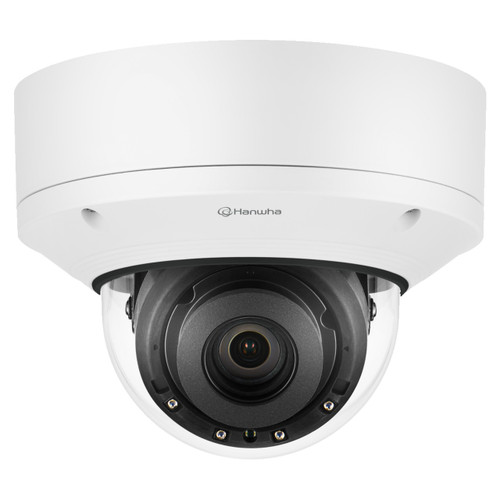
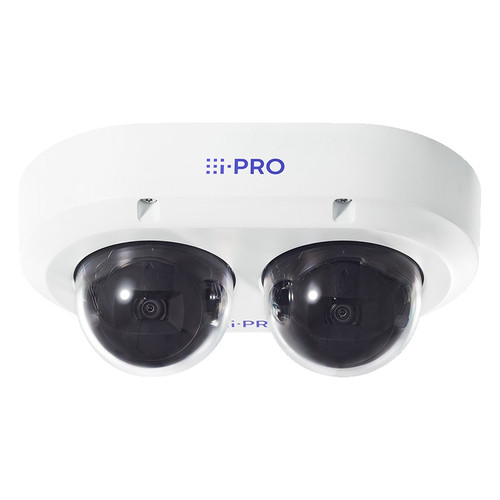
Both the Hanwha XND-9082RV and the i-PRO WV-U85402-V2L are fixed varifocal dome cameras with built-in IR, ONVIF compliance, and IK10 vandal resistance — products a systems integrator might evaluate side by side for an 8MP indoor/outdoor deployment. However, the Hanwha delivers a single 8MP (3840×2160) sensor while the i-PRO is a dual-sensor device with two 4MP (2688×1520) imagers. These represent different architectural approaches to 8MP-class coverage and are legitimately cross-shopped at this resolution tier.
In This Guide
How do the imaging specs compare?
The Hanwha XND-9082RV uses a single 1/2.8" progressive CMOS sensor delivering 3840×2160 (8MP) at 30 fps, with a 2.8–8.4mm (3x) motorized varifocal lens, a maximum aperture of F1.2 (wide) to F2.8 (tele), and a minimum illumination of 0.05 Lux color / 0 Lux with IR. Its extremeWDR is rated at 120 dB. IR reach is specified at 40m (131 ft) via WiseIR, enabling 0 Lux capture. DORI detect range stretches to 211.0m at tele. The i-PRO WV-U85402-V2L uses two 1/2.7" CMOS sensors, each at 2688×1520 (4MP per channel), also at 30 fps. Its 2.9–7.3mm motorized zoom delivers 2.5x optical zoom with a maximum aperture of F2.0 (wide) to F3.0 (tele). Minimum illumination is 0.12 Lux (BW, 50IRE, F2.0, 1/30s) — higher (less sensitive) than the Hanwha. WDR (Super Dynamic) is rated at 108 dB maximum (at level 31). IR reach is 40m at 30IRE / 30m at 50IRE. DORI detect range is 136.5m at tele.
On per-channel resolution, the Hanwha's single 8MP frame offers more pixel density for identification tasks than either individual 4MP i-PRO channel. The Hanwha's F1.2 wide aperture and 0.05 Lux minimum illumination indicate superior low-light color sensitivity compared to the i-PRO's F2.0 and 0.12 Lux. The Hanwha also carries a 12 dB advantage in rated WDR (120 dB vs. 108 dB). The i-PRO's dual-sensor architecture provides a wider composite field — horizontal FOV 43–100° per sensor — which may be relevant for split-scene or multi-direction coverage without a second camera. The Hanwha's FOV is 114° (H) at wide, narrowing with zoom.
What about installation and environment?
The Hanwha XND-9082RV carries an IP52 rating (dust-protected, splash-resistant) and IK10 impact resistance, positioned as an indoor dome with limited moisture ingress protection — it is not rated for direct outdoor rain exposure. Its operating temperature range is -25°C to +60°C, and it draws a maximum of 12.95W via PoE (IEEE 802.3af, Class 3) or 12VDC. Physical dimensions are ø160×125mm, weight 1,600g. It includes two Micro SD card slots supporting up to 1TB (512GB×2) and offers a CVBS video output and Micro USB port for installation assistance. Conduit compatibility is 12.7mm (1/2") / M20.
The i-PRO WV-U85402-V2L is rated IP67 and IP66 (IEC 60529), NEMA 4X, and IK10, making it suitable for direct outdoor deployment in rain, dust, and high-pressure wash environments. Its ambient operating temperature range is -40°C to +60°C (power-on: -20°C to +60°C), and it includes an anti-condensation Temish element. Wind resistance is specified at up to 40 m/s (~89 mph), and it meets NEMA TS 2 traffic-environment standards. Power is PoE+ (802.3at, 18.9W) or DC 54V — requiring a PoE+ switch or injector rather than standard PoE. Dimensions are 250mm (D) × 150mm (W) × 105mm (H), weight approximately 1.8 kg. It is a physically larger and heavier unit than the Hanwha.
Which fits your VMS and analytics better?
Both cameras support ONVIF Profile S/G/T and H.265/H.264/MJPEG compression. The Hanwha XND-9082RV adds WiseStream II smart codec (manual 5-area), up to 10 streaming profiles with 3 virtual channels, unicast up to 20 users, and a protocol stack including MQTT, SRTP, SNMPv1/v2c/v3, DDNS, Bonjour, LLDP, CDP, and 802.1X (EAP-TLS, EAP-LEAP, EAP-PEAP). Security includes HTTPS/SSL, Digest Authentication, IP filtering, user access log, and a pre-installed Hanwha Techwin Root CA device certificate. Edge analytics on the Hanwha are extensive: defocus detection, directional detection, digital auto tracking, appear/disappear, enter/exit, loitering, tampering, fog detection, virtual line, audio detection, sound classification, shock detection, face/upper body detection, people counting, queue management, and heatmap — all on-device. Two configurable alarm I/O ports are included. Audio is supported via selectable mic-in/line-in/built-in mic and line out. Dual Micro SD slots allow up to 1TB on-board storage.
The i-PRO WV-U85402-V2L supports up to 24 simultaneous users, GOP control smart coding, G.726/G.711 audio, and MQTT. Its security stack includes FIPS 140-2 Level 3 and signed firmware — a differentiator for government, critical infrastructure, or cybersecurity-mandated deployments. The i-PRO spec lists VMD (4 areas) and Scene Change Detection (1 area) as on-device analytics; the AI Analytics and AI Sound Classification fields are listed as "—" in the provided specifications, meaning those capabilities are not confirmed in the supplied data. Three alarm I/O terminals are provided. Audio uses 3.5mm jacks (mic input and mono output). Edge storage is a single microSD/SDHC/SDXC slot (up to 512GB). The Ambarella CV22 SoC is specified. Mobile compatibility is noted for iOS and Android.
Which should you choose: the XND-9082RV or the U85402-V2L?
Our take: The XND-9082RV is the stronger choice when single-sensor pixel density, low-light color sensitivity, and on-camera AI analytics depth are the primary requirements. Its 3840×2160 single-frame resolution exceeds either individual 4MP channel of the i-PRO, its minimum illumination of 0.05 Lux color outperforms the i-PRO's 0.12 Lux BW figure, and its 120 dB extremeWDR exceeds the i-PRO's 108 dB Super Dynamic rating. However, the XND-9082RV is rated only IP52 and is not suitable for direct outdoor rain exposure — a critical limitation versus the i-PRO's IP67/IP66/NEMA 4X outdoor-rated enclosure. The i-PRO also operates to -40°C vs. the Hanwha's -25°C, carries FIPS 140-2 Level 3 and signed firmware for cybersecurity-mandated environments, and uses PoE+ (18.9W). Choose the XND-9082RV for indoor or covered-exterior analytics-heavy deployments on standard PoE infrastructure; choose the WV-U85402-V2L for exposed outdoor locations with strict IP, temperature, or government cybersecurity requirements.
Side-by-Side Comparison
Spec-for-spec, from manufacturer data.
| Specification | Hanwha XND-9082RV | i-PRO U85402-V2L |
|---|---|---|
| Resolution | 3840×2160 (8MP, single sensor) | 2×2688×1520 (4MP per sensor, dual sensor) |
| Image Sensor | 1/2.8" progressive CMOS | 2× 1/2.7" CMOS |
| Lens / Focal Length | 2.8–8.4mm, 3x motorized varifocal | 2.9–7.3mm, 2.5x motorized zoom |
| Max Aperture (Wide) | F1.2 | F2.0 |
| Min Illumination | 0.05 Lux color / 0 Lux IR | 0.12 Lux BW (50IRE, F2.0, 1/30s) |
| IR Range | 40m (131 ft), WiseIR | 40m (30IRE) / 30m (50IRE) |
| WDR | 120 dB (extremeWDR) | 108 dB max (Super Dynamic level 31) |
| Max Frame Rate | 30 fps @ 8MP | 30 fps |
| Video Compression | H.265, H.264, MJPEG, WiseStream II | H.265, H.264, MJPEG, GOP control |
| IP Rating | IP52 | IP67 / IP66 / NEMA 4X |
| IK / Impact Rating | IK10 | IK10 |
| Operating Temperature | -25°C to +60°C | -40°C to +60°C (power-on: -20°C) |
| Power Input / PoE Class | PoE 802.3af Class 3 / 12VDC, 12.95W max | PoE+ 802.3at 18.9W / DC 54V |
| Edge Storage | 2× microSD/SDHC/SDXC, max 1TB (512GB×2) | 1× microSD/SDHC/SDXC, max 512GB |
| On-Device Analytics | Directional, loitering, enter/exit, face detection, people counting, heatmap, queue, +more | VMD (4 areas), SCD (1 area); AI Analytics not confirmed in supplied specs |
| Cybersecurity | HTTPS, 802.1X (EAP-TLS/LEAP/PEAP), device certificate | FIPS 140-2 Level 3, HTTPS, 802.1X, signed firmware |
| Audio I/O | Mic-in/line-in/built-in mic; line out | 3.5mm stereo mic input; 3.5mm mono output |
| Alarm I/O | 2 configurable I/O ports | 3 alarm I/O terminals |
| Dimensions | ø160×125mm | 250mm (D) × 150mm (W) × 105mm (H) |
| Weight | 1,600g (3.53 lb) | Approx. 1,800g |
| Warranty | 3-year | 3-year |
Frequently Asked Questions
Which should you choose: the XND-9082RV or the U85402-V2L?
The XND-9082RV is the stronger choice when single-sensor pixel density, low-light color sensitivity, and on-camera AI analytics depth are the primary requirements. Its 3840×2160 single-frame resolution exceeds either individual 4MP channel of the i-PRO, its minimum illumination of 0.05 Lux color outperforms the i-PRO's 0.12 Lux BW figure, and its 120 dB extremeWDR exceeds the i-PRO's 108 dB Super Dynamic rating. However, the XND-9082RV is rated only IP52 and is not suitable for direct outdoor rain exposure — a critical limitation versus the i-PRO's IP67/IP66/NEMA 4X outdoor-rated enclosure. The i-PRO also operates to -40°C vs. the Hanwha's -25°C, carries FIPS 140-2 Level 3 and signed firmware for cybersecurity-mandated environments, and uses PoE+ (18.9W). Choose the XND-9082RV for indoor or covered-exterior analytics-heavy deployments on standard PoE infrastructure; choose the WV-U85402-V2L for exposed outdoor locations with strict IP, temperature, or government cybersecurity requirements.
Is the XND-9082RV or WV-U85402-V2L better for low-light performance?
Based on supplied specifications, the XND-9082RV has a lower minimum illumination (0.05 Lux color / 0 Lux with IR active) compared to the WV-U85402-V2L (0.12 Lux BW at F2.0). The Hanwha also has a wider maximum aperture (F1.2 wide vs. F2.0 wide on the i-PRO), which collects more light at wide angle. Both cameras specify 40m IR range, though the i-PRO notes 40m at 30IRE and 30m at the stricter 50IRE benchmark.
Can the WV-U85402-V2L be mounted outdoors where the XND-9082RV cannot?
Yes. The WV-U85402-V2L is rated IP67 and IP66 (IEC 60529), NEMA 4X, and includes an anti-condensation system and wind resistance up to 40 m/s — it is designed for direct outdoor exposure. The XND-9082RV is rated IP52 only, which provides limited splash protection but is not suitable for rain-exposed outdoor locations.
Which camera requires less switch infrastructure — standard PoE or PoE+?
The XND-9082RV draws a maximum of 12.95W and is powered by standard PoE (IEEE 802.3af, Class 3), compatible with most existing PoE switches and injectors. The WV-U85402-V2L requires PoE+ (802.3at) at 18.9W or DC 54V, which requires a PoE+ capable switch or injector — an infrastructure consideration if the existing plant is 802.3af-only.
Get a Second Opinion on Your Camera Choice
Share your site layout, coverage goals, and budget. Our team will validate the camera selection, flag anything we would change, and recommend products that match the use case.