
Hanwha XND-8082RV vs i-PRO X25700-V2LN: Specification Comparison
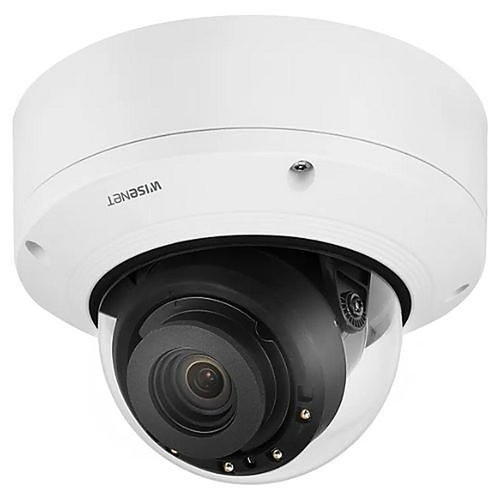
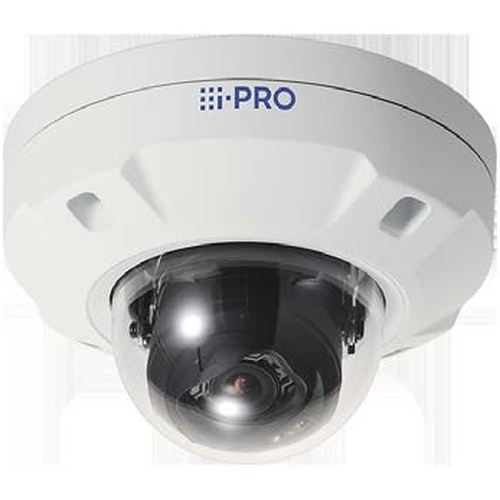
Both the Hanwha XND-8082RV and the i-PRO WV-X25700-V2LN are fixed dome IP cameras in the 6MP resolution class, making them direct cross-shop candidates for integrators spec'ing high-detail coverage. The Hanwha is positioned as an IK10 indoor vandal dome with motorized varifocal optics and 120 dB WDR, while the i-PRO is an outdoor-rated dome with a larger image sensor, longer IR throw, AI-driven analytics, and hardened environmental certifications. The comparison below is based strictly on published specifications for each model.
In This Guide
How do the imaging specs compare?
Both cameras deliver 6 MP at 30 fps with H.265/H.264/MJPEG compression, but their sensor and optics differ meaningfully. The Hanwha XND-8082RV uses a 1/2.8" CMOS sensor with a motorized varifocal lens spanning 2.8–8.4 mm (3× zoom), yielding a native resolution of 3328×1872. Minimum illumination is specified at 0.05 Lux (color, F1.2) with IR on reaching 0 Lux, and WDR is rated at 120 dB. IR illumination range is 40 m (131 ft). The i-PRO WV-X25700-V2LN uses a larger 1/1.8" CMOS sensor scanning a 7.68×4.32 mm area at 3840×2160 (4K pixel grid, 6MP equivalent output), with a motorized varifocal lens from 4.3–8.6 mm (2× optical zoom). Minimum illumination is 0.03 Lux (B/W, 50 IRE, F1.5, 1/30 s) and Super Dynamic WDR is rated at up to 132 dB at maximum setting. IR illumination reaches 70 m (230 ft).
In low-light performance, the i-PRO's larger 1/1.8" sensor provides a measurable light-gathering advantage over the Hanwha's 1/2.8" sensor, and its minimum illumination figure of 0.03 Lux (B/W) undercuts the Hanwha's 0.05 Lux (color). The i-PRO's IR throw of 70 m is 75% greater than the Hanwha's 40 m. On dynamic range, the i-PRO's Super Dynamic peaks at 132 dB versus Hanwha's 120 dB extreme WDR. The Hanwha offers a wider zoom range (3× vs. 2× optical) which can be advantageous in constrained indoor mounting scenarios, and its 2.8 mm wide-end provides a broader horizontal field of view at close range. The i-PRO also includes a built-in gyro image stabilizer, a feature not specified for the Hanwha.
What about installation and environment?
The Hanwha XND-8082RV is rated IP52 and IK10, with an indoor environment rating. IP52 provides protection against limited dust ingress and water dripping at an angle up to 15°—adequate for protected indoor ceilings but not for outdoor or wash-down environments. It operates from -25°C to +60°C and draws power via PoE Class 3 (IEEE 802.3af, ~12.95 W) or 12 VDC. Dual microSD slots support up to 512 GB each. Mounting is ceiling-oriented per published specs.
The i-PRO WV-X25700-V2LN carries IP66/IP67 ratings plus NEMA 4X and Type 4X (UL50E) certifications, confirming full dust exclusion and submersion resistance to 1 m—appropriate for outdoor and harsh-wash installations. Its IK10 impact resistance is independently certified at 50 J (IEC 60068-2-75), and it is rated for wind loads up to 40 m/s (~89 mph). Operating temperature spans -40°C to +55°C, substantially wider than the Hanwha's range on the cold end (-40°C vs. -25°C). Power requires PoE+ Class 4 (802.3at, 14 W) or DC 12 V 1.2 A; installers must confirm PoE+ switch port availability. The i-PRO also provides 4× alarm I/O terminals and separate 3.5 mm audio in/out jacks.
Which fits your VMS and analytics better?
Both cameras support ONVIF Profile S/G/T, ensuring broad VMS compatibility. The i-PRO additionally supports ONVIF Profile M, which covers metadata streams used for AI-driven search and event filtering in modern VMS platforms. The Hanwha communicates via SUNAPI (HTTP API) in addition to ONVIF, which is advantageous in Hanwha Wisenet VMS environments. The i-PRO runs on an Ambarella CV52 SoC and offers on-camera AI analytics including Motion Detection, Face Detection, Vehicle Detection, and AI Sound Classification (gunshot, yell, vehicle horn, glass break). The Hanwha provides defocus detection, directional detection, motion detection, digital auto tracking, audio detection, shock detection, and face/upper-body detection. Neither camera's analytics tier is independently tested here; these are manufacturer-listed capabilities.
For edge storage, both cameras support a single microSD/SDHC/SDXC slot up to 512 GB; the Hanwha specifies dual microSD slots (up to 512 GB each), providing redundant local recording without a separate NVR. Audio support on the Hanwha includes a selectable input (mic in/line in/built-in mic). The i-PRO provides a 3.5 mm stereo audio input and a separate 3.5 mm audio output, plus G.726, G.711, and AAC-LC compression. The i-PRO lists support for MQTT, SRTP, SFTP, SNMPv1/v2/v3, and IEEE 802.1X—a broader protocol stack than is specified for the Hanwha. Signed firmware and secure boot are explicitly specified for the i-PRO; the Hanwha lists HTTPS encryption but signed firmware and secure boot are not stated in the provided specs.
Which should you choose: the XND-8082RV or the X25700-V2LN?
Our take: The WV-X25700-V2LN is the stronger choice when the deployment is outdoor, requires extended IR coverage, or demands hardened cybersecurity and AI analytics on-camera. Its 1/1.8" sensor versus the Hanwha's 1/2.8" provides a tangible low-light advantage (0.03 Lux vs. 0.05 Lux), its IR throw of 70 m is 30 m longer than the Hanwha's 40 m, and its IP67/NEMA 4X environmental rating far exceeds the Hanwha's IP52 indoor spec—making the i-PRO suitable for exterior perimeter, loading docks, and harsh industrial spaces where the Hanwha cannot be deployed. The XND-8082RV is the better fit for indoor high-risk spaces (lobbies, retail floors, server rooms) where its IK10 rating, dual microSD redundant storage, wider 2.8 mm minimum focal length, and native Hanwha SUNAPI ecosystem integration matter more than extended IR throw or outdoor weatherproofing. Confirm PoE+ switch availability before specifying the i-PRO; the Hanwha runs on standard 802.3af.
Side-by-Side Comparison
Spec-for-spec, from manufacturer data.
| Specification | Hanwha XND-8082RV | i-PRO X25700-V2LN |
|---|---|---|
| Resolution | 6MP (3328×1872) | 6MP (3840×2160) |
| Image Sensor | 1/2.8" CMOS | Approx. 1/1.8" CMOS |
| Lens / Focal Length | Motorized varifocal 2.8–8.4 mm (3× zoom) | Motorized varifocal 4.3–8.6 mm (2× optical zoom) |
| Min. Illumination | 0.05 Lux color (F1.2); 0 Lux B/W (IR on) | 0.03 Lux B/W (50 IRE, F1.5, 1/30 s) |
| IR Range | 40 m (131 ft) | 70 m (230 ft) |
| Wide Dynamic Range | 120 dB (Extreme WDR) | Up to 132 dB (Super Dynamic, level 31) |
| Max Frame Rate | 30 fps @ 6MP | 30 fps |
| Video Compression | H.265, H.264, MJPEG | H.265, H.264, MJPEG |
| IP Rating | IP52 | IP66 / IP67 / NEMA 4X / Type 4X |
| IK / Impact Rating | IK10 | IK10 (50 J per IEC 60068-2-75) |
| Operating Temperature | -25°C to +60°C | -40°C to +55°C |
| Power Input / PoE Class | PoE Class 3 (802.3af) or 12 VDC | PoE+ Class 4 (802.3at, 14W) or DC 12V 1.2A |
| Edge Storage | Dual microSD up to 512 GB each | Single microSD/SDHC/SDXC up to 512 GB |
| Audio | Input: mic in / line in / built-in mic | 3.5 mm stereo audio in + 3.5 mm audio out |
| Environment Rating | Indoor | Outdoor |
| Warranty | 5-Year | 5-Year |
Frequently Asked Questions
Which should you choose: the XND-8082RV or the X25700-V2LN?
The WV-X25700-V2LN is the stronger choice when the deployment is outdoor, requires extended IR coverage, or demands hardened cybersecurity and AI analytics on-camera. Its 1/1.8" sensor versus the Hanwha's 1/2.8" provides a tangible low-light advantage (0.03 Lux vs. 0.05 Lux), its IR throw of 70 m is 30 m longer than the Hanwha's 40 m, and its IP67/NEMA 4X environmental rating far exceeds the Hanwha's IP52 indoor spec—making the i-PRO suitable for exterior perimeter, loading docks, and harsh industrial spaces where the Hanwha cannot be deployed. The XND-8082RV is the better fit for indoor high-risk spaces (lobbies, retail floors, server rooms) where its IK10 rating, dual microSD redundant storage, wider 2.8 mm minimum focal length, and native Hanwha SUNAPI ecosystem integration matter more than extended IR throw or outdoor weatherproofing. Confirm PoE+ switch availability before specifying the i-PRO; the Hanwha runs on standard 802.3af.
Is the XND-8082RV or WV-X25700-V2LN better for low-light performance?
Based on published specs, the i-PRO WV-X25700-V2LN has the lower minimum illumination figure—0.03 Lux (B/W, F1.5, 1/30 s) versus the Hanwha XND-8082RV's 0.05 Lux (color, F1.2). The i-PRO also uses a larger 1/1.8" sensor (versus 1/2.8") and provides 70 m of IR illumination compared to the Hanwha's 40 m, giving it a meaningful advantage in low-ambient and long-range night-vision scenarios.
Can the Hanwha XND-8082RV be installed outdoors?
No. The XND-8082RV carries an IP52 rating and is specified for indoor environments only. IP52 does not provide adequate dust exclusion or water resistance for outdoor use. The i-PRO WV-X25700-V2LN is rated IP66/IP67 and NEMA 4X, and is explicitly specified as an outdoor camera rated to -40°C and 40 m/s wind loads.
Do both cameras support edge storage and on-camera recording?
Yes, both support microSD-based edge storage up to 512 GB. The Hanwha XND-8082RV specifies dual microSD slots—each up to 512 GB—offering redundant local recording without an NVR. The i-PRO WV-X25700-V2LN specifies a single microSD/SDHC/SDXC slot up to 512 GB. Both cameras support ONVIF Profile G for edge-recorded stream retrieval.
Get a Second Opinion on Your Camera Choice
Share your site layout, coverage goals, and budget. Our team will validate the camera selection, flag anything we would change, and recommend products that match the use case.