
Hanwha XND-8082RV vs i-PRO S22600-V2LG: Specification Comparison
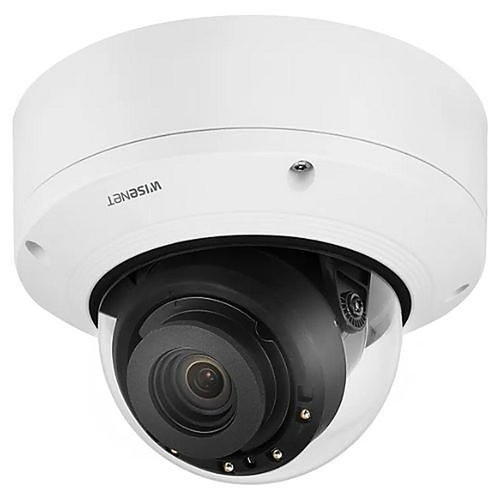
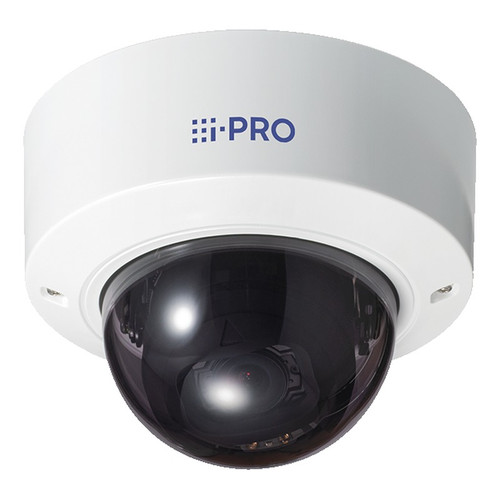
This comparison covers two 6MP indoor dome IP cameras targeting commercial and enterprise physical-security deployments: the Hanwha XND-8082RV and the i-PRO WV-S22600-V2LG. Both share the same resolution class, IK10 vandal resistance, H.265 compression, and a motorized varifocal lens design. The evaluation examines imaging performance, installation requirements, and platform integration to help integrators and IT buyers choose the right unit for their specific project conditions and VMS environment.
In This Guide
How do the imaging specs compare?
The i-PRO WV-S22600-V2LG carries a larger 1/1.8" CMOS sensor versus the Hanwha XND-8082RV's 1/2.8" CMOS. Larger sensors generally capture more light per pixel; this is reflected in the minimum illumination figures: the WV-S22600-V2LG requires 0.12 lx (color, 30 IRE) compared to 0.05 lx (color, F1.2) for the XND-8082RV, making the Hanwha marginally more sensitive in color mode on paper. Both reach 0 lux in IR mode. The WV-S22600-V2LG specifies a maximum WDR of 132 dB (Super Dynamic, Level 31), while the XND-8082RV rates its Extreme WDR at 120 dB — a 12 dB advantage for the i-PRO in high-contrast scenes.
IR reach differs significantly: the XND-8082RV specifies a 40 m IR range, whereas the WV-S22600-V2LG specifies 25 m at 30 IRE and 20 m at 50 IRE — a meaningful gap for longer-corridor or larger-room coverage. Lens zoom range also diverges: the XND-8082RV uses a 2.8–8.4 mm motorized varifocal (3x optical zoom), while the WV-S22600-V2LG offers 4.3–8.6 mm (2.0x optical zoom) plus an electronic extra zoom of 2.0x–6.0x at 1280×720. The i-PRO also provides DORI distances (Detect: 54.9 m wide / 136.5 m tele; Identify: 5.5 m wide / 13.6 m tele), which the Hanwha's published specs do not include. Both output 6MP at 30 fps via H.265, H.264, and MJPEG.
What about installation and environment?
The XND-8082RV holds an IP52 ingress-protection rating, indicating resistance to dust and light dripping water — useful if deployed near HVAC vents or in mildly damp utility spaces. The WV-S22600-V2LG's published specs do not state a numerical IP rating, limiting objective comparison on environmental sealing; installers should confirm its suitability for any damp-location requirement directly with i-PRO documentation. Both cameras carry IK10 impact resistance, the highest standard vandal rating, suitable for publicly accessible ceilings and walls.
On power, the XND-8082RV is PoE Class 3 (802.3af) at approximately 12.95 W and also accepts 12 VDC, giving installers a backup power option. The WV-S22600-V2LG is PoE Class 0 (802.3af) at 12 W max and also accepts 12 VDC 1 A. Operating temperature range differs: the XND-8082RV is rated –25 °C to +60 °C, while the WV-S22600-V2LG is rated –10 °C to +50 °C (with power-on restricted to 0 °C to +50 °C). For cold-storage, loading-dock, or outdoor-adjacent unheated spaces, the Hanwha's wider range is a practical advantage. Network connectivity is 10/100/1000BASE-T on the Hanwha versus 10/100BASE-T on the i-PRO; the Hanwha also adds a USB port. The i-PRO carries UL (UL62368-1), c-UL, CE, FCC Part 15 Class A, and IEC62368-1 safety certifications; comparable certifications for the Hanwha were not listed in the provided specifications.
Which fits your VMS and analytics better?
Both cameras support ONVIF Profile S, G, and T. The WV-S22600-V2LG additionally supports ONVIF Profile M, which covers metadata and analytics interoperability — relevant when integrating AI event data into ONVIF-compliant VMS platforms. The i-PRO also lists a broader protocol stack including IPv6, SRTP, SFTP, MQTT, LLDP, and SNMPv1/v2/v3, plus IEEE 802.1X port authentication on-camera. The Hanwha publishes HTTPS encryption and SUNAPI (HTTP API) as its primary cybersecurity and VMS interface credentials. The WV-S22600-V2LG specifies FIPS 140-2 Level 3 hardware security (NXP SE050F secure element), signed firmware, AES encryption, HTTPS, and 802.1X — a substantially more detailed cybersecurity posture that will matter for federal, healthcare, or high-compliance deployments.
On analytics, the XND-8082RV offers defocus detection, directional detection, motion detection, digital auto tracking, audio detection, shock detection, and face/upper-body detection. The WV-S22600-V2LG specifies eight types of AI Video Analytics, AI Sound Classification (gunshot, yell, vehicle horn, glass break), VMD with four areas, scene change detection, and facial recognition. The i-PRO's AI Sound Classification capability is absent from the Hanwha's spec sheet. Audio I/O also differs: the XND-8082RV provides audio input with selectable mic/line/built-in mic but no listed audio output; the WV-S22600-V2LG provides both input and output (full duplex, 3.5 mm jacks), enabling two-way audio workflows. Edge storage is comparable: the Hanwha offers dual microSD slots up to 512 GB each (1 TB total onboard), while the i-PRO supports a single microSD/SDHC/SDXC card up to 512 GB. Both carry a 5-year warranty.
Which should you choose: the XND-8082RV or the S22600-V2LG?
Our take: The XND-8082RV is the stronger choice when IR range, wide operating temperature, or dual-slot edge storage are the deciding factors; the WV-S22600-V2LG is the stronger choice when cybersecurity compliance, audio analytics, or two-way audio are required. On IR reach the Hanwha extends to 40 m versus the i-PRO's 25 m at 30 IRE — a 60% distance advantage for larger rooms or long corridors. On WDR, the i-PRO leads at 132 dB versus 120 dB, and its 1/1.8" sensor is physically larger than the Hanwha's 1/2.8". On compliance, the i-PRO's FIPS 140-2 Level 3 hardware security and AI Sound Classification (gunshot, glass break) have no equivalent in the Hanwha's published specs. Choose the XND-8082RV for cold or wide-temperature-range environments (–25 °C floor), dual-card redundant recording, or Hanwha/SUNAPI VMS ecosystems. Choose the WV-S22600-V2LG for high-compliance networks, full-duplex audio, or i-PRO/Milestone/Genetec deployments requiring ONVIF Profile M metadata.
Side-by-Side Comparison
Spec-for-spec, from manufacturer data.
| Specification | Hanwha XND-8082RV | i-PRO S22600-V2LG |
|---|---|---|
| Resolution | 6MP (3328×1872) @ 30fps | 6MP (3072×1728 / 3072×2304 4:3) @ 30fps |
| Sensor Size | 1/2.8" CMOS | Approx. 1/1.8" CMOS |
| Lens | 2.8–8.4mm motorized varifocal (3x optical) | 4.3–8.6mm motorized zoom/focus (2.0x optical; extra zoom 2–6x) |
| WDR | 120dB Extreme WDR | 132dB Super Dynamic (Level 31) |
| Min Illumination (Color) | 0.05 lx @ F1.2 | 0.12 lx @ 30IRE |
| IR Range | 40m | 25m @ 30IRE / 20m @ 50IRE |
| IP Rating | IP52 | Not specified |
| IK Rating | IK10 | IK10 |
| Operating Temp | -25°C to +60°C | -10°C to +50°C (power-on 0°C to +50°C) |
| Power | PoE 802.3af Class 3 / 12VDC; ~12.95W | PoE 802.3af Class 0 / DC12V 1A; 12W max |
| Edge Storage | Dual microSD up to 512GB each (1TB total) | Single microSD/SDHC/SDXC up to 512GB |
| ONVIF Profiles | S, G, T | G, M, S, T |
| Audio I/O | Input only (mic/line/built-in mic) | Input + Output (full duplex, 3.5mm jacks) |
| Cybersecurity | HTTPS, SUNAPI | FIPS 140-2 L3, NXP SE050F, HTTPS, 802.1X, AES, signed firmware |
| AI Analytics | Defocus, directional, motion, auto-tracking, face/upper-body, shock, audio | 8-type AI Video Analytics, AI Sound Classification (gunshot/yell/horn/glass break), VMD, facial recognition |
| Warranty | 5-Year | 5-Year |
Frequently Asked Questions
Which should you choose: the XND-8082RV or the S22600-V2LG?
The XND-8082RV is the stronger choice when IR range, wide operating temperature, or dual-slot edge storage are the deciding factors; the WV-S22600-V2LG is the stronger choice when cybersecurity compliance, audio analytics, or two-way audio are required. On IR reach the Hanwha extends to 40 m versus the i-PRO's 25 m at 30 IRE — a 60% distance advantage for larger rooms or long corridors. On WDR, the i-PRO leads at 132 dB versus 120 dB, and its 1/1.8" sensor is physically larger than the Hanwha's 1/2.8". On compliance, the i-PRO's FIPS 140-2 Level 3 hardware security and AI Sound Classification (gunshot, glass break) have no equivalent in the Hanwha's published specs. Choose the XND-8082RV for cold or wide-temperature-range environments (–25 °C floor), dual-card redundant recording, or Hanwha/SUNAPI VMS ecosystems. Choose the WV-S22600-V2LG for high-compliance networks, full-duplex audio, or i-PRO/Milestone/Genetec deployments requiring ONVIF Profile M metadata.
Does either camera support two-way audio?
The i-PRO WV-S22600-V2LG supports full-duplex audio with both a 3.5 mm input and a 3.5 mm output jack. The Hanwha XND-8082RV's published specifications list audio input (mic/line/built-in mic) but do not include an audio output, so two-way audio is not confirmed for the Hanwha based on available specs.
Which camera is better suited for a cold-storage or unheated space?
The Hanwha XND-8082RV is rated for operation down to –25 °C, while the i-PRO WV-S22600-V2LG is rated to –10 °C (with power-on restricted to 0 °C). For any application below –10 °C, the XND-8082RV is the only option of the two based on published specifications.
Are these cameras suitable for government or high-compliance network deployments?
The i-PRO WV-S22600-V2LG specifies FIPS 140-2 Level 3 hardware security via an NXP SE050F secure element, signed firmware, AES encryption, IEEE 802.1X, and SNMPv3 — a combination typically required for federal or high-compliance environments. The Hanwha XND-8082RV's published specs list HTTPS encryption and SUNAPI but do not reference FIPS 140-2, a hardware secure element, or signed firmware, so it may not meet those compliance thresholds without additional verification from Hanwha.
Get a Second Opinion on Your Camera Choice
Share your site layout, coverage goals, and budget. Our team will validate the camera selection, flag anything we would change, and recommend products that match the use case.