
Hanwha XND-8081VZ vs i-PRO S61501-Z1: Specification Comparison
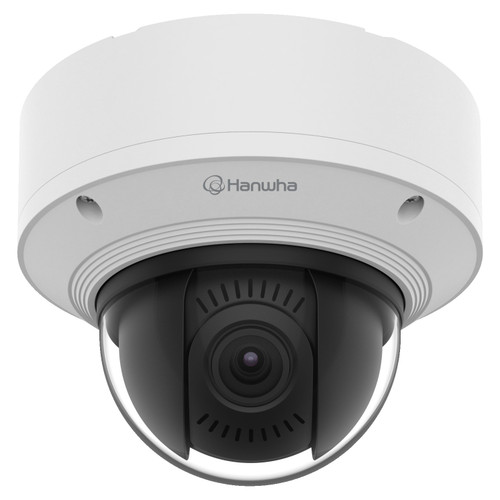
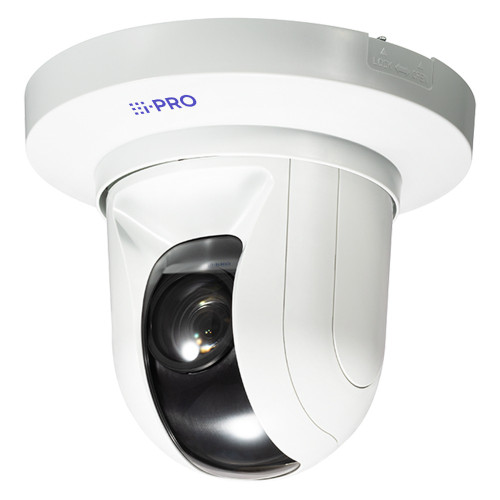
This comparison evaluates two 5MP indoor PTZ dome cameras targeting professional surveillance installations: the Hanwha XND-8081VZ and the i-PRO WV-S61501-Z1. Both deliver 30fps video with motorized zoom, on-board edge storage, ONVIF compliance, and AI-assisted analytics. They differ meaningfully in optical zoom range, low-light sensitivity, PTZ motion range, power requirements, ingress protection ratings, and the depth of their respective analytics platforms. The following sections examine imaging performance, installation considerations, and integration capabilities using only the specifications provided by each manufacturer.
In This Guide
How do the imaging specs compare?
The XND-8081VZ uses a 1/1.8-inch 6MP CMOS sensor outputting a maximum resolution of 2560×1920 pixels, while the WV-S61501-Z1 uses a smaller 1/2.8-inch CMOS with a maximum H.265/H.264 output of 3072×1728 pixels. The larger sensor in the Hanwha unit provides a physical light-gathering advantage. On minimum illumination, the i-PRO specifies 0.004 Lux in B&W mode; the Hanwha specifies 0.07 Lux color and 0.007 Lux B&W — meaning the i-PRO is measurably more sensitive in monochrome low-light conditions. Color minimum illumination is not specified for the WV-S61501-Z1, so a direct color comparison cannot be made.
The WV-S61501-Z1 offers a 10x optical zoom (4.7–47mm focal length) with an extra-zoom mode reaching 15x at 720p, providing a detection range up to 945.4m per the manufacturer's DORI table. The XND-8081VZ is a motorized varifocal design with only 2.6x optical zoom (3.6–9.4mm), suited for wide fixed-angle coverage rather than long-range identification. Dynamic range favors the i-PRO at a stated maximum of 132 dB versus 120 dB for the Hanwha. Both cameras include digital noise reduction, defog/fog compensation, and ICR-based day/night switching. The Hanwha adds digital image stabilization and lens distortion correction (LDC); the i-PRO uses a built-in gyro sensor for its image stabilizer.
What about installation and environment?
The XND-8081VZ carries an IP52 ingress protection rating and IK10 impact resistance rating, making it suitable for dusty or light-moisture indoor environments and resistant to vandal-level mechanical impact. The WV-S61501-Z1 does not specify an IP or IK rating in the provided specifications, which is a meaningful gap for installers assessing vulnerability to incidental water contact or physical tampering. The Hanwha's operating temperature range is -25°C to +60°C, while the i-PRO is rated -10°C to +50°C (with a 0°C power-on constraint), giving the Hanwha a broader thermal envelope for unconditioned spaces.
On power, both cameras accept 12VDC. The XND-8081VZ draws a maximum of 11W and is powered by standard PoE (IEEE 802.3af, Class 3). The WV-S61501-Z1 draws up to 12.95W over the network interface and the provided spec tag lists PoE Class 0, though that wattage exceeds the 802.3af Class 3 budget of 15.4W at the switch port — installers should verify PoE+ (802.3at) switch availability for the i-PRO. The Hanwha is physically larger (ø160×125mm, 1.45kg) compared to the i-PRO (ø117×155mm, 1.2kg), which may influence dome ceiling cutout selection.
Which fits your VMS and analytics better?
Both cameras support ONVIF Profile S, G, and T, ensuring broad VMS compatibility. The XND-8081VZ adds Wisenet SUNAPI (HTTP API) with an open platform SDK. The WV-S61501-Z1 adds ONVIF Profile M, which includes metadata streaming for AI events — relevant for VMS platforms that consume standardized AI object metadata. Edge storage on both uses microSDXC; the Hanwha provides two card slots with a combined maximum of 512GB, while the i-PRO specifies one microSDXC slot with no stated capacity ceiling in the provided specs. Simultaneous streaming supports up to 10 profiles and 20 unicast users on the Hanwha versus up to 14 simultaneous users on the i-PRO.
Analytics depth differs substantially. The XND-8081VZ includes a broad behavioral set: directional detection, enter/exit, loitering, appear/disappear, virtual line, face detection, digital auto tracking, audio detection, sound classification, shock detection, and business intelligence features (people counting, queue management, heatmap) — all on-board. The WV-S61501-Z1 lists AI Motion Detection, Face Detection, Vehicle Detection, and AI Sound Classification (gunshot, yell, vehicle horn, glass break), powered by an Ambarella CV22 SoC. It supports 256 preset positions, Auto Track, Auto Pan, Patrol, and Preset Sequence auto modes, and provides 3 alarm inputs plus 1 alarm output. The Hanwha provides 1 alarm input and 1 alarm output. Security credentials also differ: the i-PRO holds FIPS 140-2 Level 3 certification with a GlobalSign certificate; the Hanwha does not claim FIPS certification in the provided specs.
Which should you choose: the XND-8081VZ or the S61501-Z1?
Our take: The XND-8081VZ is the stronger choice when wide-angle indoor coverage, dual-slot edge redundancy, richer behavioral analytics, and a broader operating temperature range (-25°C vs. -10°C) are the primary requirements — particularly in spaces where IK10 vandal resistance and confirmed IP52 ingress protection matter, since the WV-S61501-Z1 does not specify those ratings. The i-PRO WV-S61501-Z1 is the stronger choice when long-range identification is required: its 10x optical zoom (4.7–47mm) versus the Hanwha's 2.6x (3.6–9.4mm) covers identification distances up to 94.5m per its DORI specification, and its 132 dB dynamic range exceeds the Hanwha's 120 dB by 12 dB. Its 256 preset positions and 350°/s preset pan speed also suit patrol-intensive deployments. FIPS 140-2 Level 3 certification makes the i-PRO the compliant option for U.S. federal or regulated-sector projects. Installers must confirm PoE+ switch availability for the WV-S61501-Z1 given its 12.95W draw.
Side-by-Side Comparison
Spec-for-spec, from manufacturer data.
| Specification | Hanwha XND-8081VZ | i-PRO S61501-Z1 |
|---|---|---|
| Resolution | 2560×1920 (5MP effective) | 3072×1728 (5MP stream) |
| Image Sensor | 1/1.8" 6MP CMOS | 1/2.8" CMOS |
| Lens / Focal Length | 3.6–9.4mm motorized varifocal | 4.7–47mm motorized zoom |
| Optical Zoom | 2.6x | 10x (up to 15x extra zoom at 720p) |
| Min Illumination (B&W) | 0.007 Lux | 0.004 Lux |
| Dynamic Range (WDR) | 120 dB | 132 dB (Super Dynamic, Level 31) |
| Max Frame Rate | 30fps | 30fps |
| Video Compression | H.265 / H.264 / MJPEG | H.265 / H.264 / MJPEG |
| IP Rating | IP52 | Not specified |
| IK / Impact Rating | IK10 | Not specified |
| Operating Temperature | -25°C to +60°C | -10°C to +50°C (power-on ≥0°C) |
| Power Input | PoE 802.3af Class 3 / 12VDC, 11W max | PoE+ recommended / 12VDC, 12.95W max |
| Pan Range | ±175° (remote adjustment) | 0–350° |
| Tilt Range | 0–85° | -30° to +90° |
| Preset Positions | Not specified | 256 |
| Edge Storage | Dual microSD/SDHC/SDXC, up to 512GB | 1x microSDXC (capacity not specified) |
| Simultaneous Users | 20 unicast / multicast | 14 |
| Alarm I/O | 1 input / 1 output | 3 inputs / 1 output + 1 AUX out |
| ONVIF Profiles | S / G / T | G / M / S / T |
| Warranty | 3-year | 3-year |
Frequently Asked Questions
Which should you choose: the XND-8081VZ or the S61501-Z1?
The XND-8081VZ is the stronger choice when wide-angle indoor coverage, dual-slot edge redundancy, richer behavioral analytics, and a broader operating temperature range (-25°C vs. -10°C) are the primary requirements — particularly in spaces where IK10 vandal resistance and confirmed IP52 ingress protection matter, since the WV-S61501-Z1 does not specify those ratings. The i-PRO WV-S61501-Z1 is the stronger choice when long-range identification is required: its 10x optical zoom (4.7–47mm) versus the Hanwha's 2.6x (3.6–9.4mm) covers identification distances up to 94.5m per its DORI specification, and its 132 dB dynamic range exceeds the Hanwha's 120 dB by 12 dB. Its 256 preset positions and 350°/s preset pan speed also suit patrol-intensive deployments. FIPS 140-2 Level 3 certification makes the i-PRO the compliant option for U.S. federal or regulated-sector projects. Installers must confirm PoE+ switch availability for the WV-S61501-Z1 given its 12.95W draw.
Is the XND-8081VZ or WV-S61501-Z1 better for low-light performance?
In B&W mode the WV-S61501-Z1 specifies a lower minimum illumination of 0.004 Lux compared to 0.007 Lux for the XND-8081VZ, so the i-PRO has a measurable monochrome low-light advantage. Color minimum illumination is not specified for the WV-S61501-Z1, so a direct color comparison cannot be drawn from the provided specifications.
Can I run either camera on a standard PoE switch, or do I need PoE+?
The XND-8081VZ is rated for standard PoE (IEEE 802.3af, Class 3, maximum 11W) and will work on any compliant PoE switch. The WV-S61501-Z1 draws up to 12.95W over the network port; the provided spec lists PoE Class 0, but that wattage exceeds the 802.3af Class 3 budget, so a PoE+ (802.3at) switch is the safe assumption. Verify with the i-PRO installation guide before planning switch infrastructure.
Which camera supports more preset positions for patrol routes?
The WV-S61501-Z1 supports 256 preset positions with a preset pan speed of 350°/s and modes including Auto Pan, Preset Sequence, and Patrol. The XND-8081VZ supports remote pan/tilt/rotate adjustment but its provided specifications do not state a discrete preset position count, making the i-PRO the clear choice for complex multi-position patrol deployments.
Get a Second Opinion on Your Camera Choice
Share your site layout, coverage goals, and budget. Our team will validate the camera selection, flag anything we would change, and recommend products that match the use case.