
Hanwha SWT-F11MGHP vs Hanwha SWT-G11MGHP: Specification Comparison
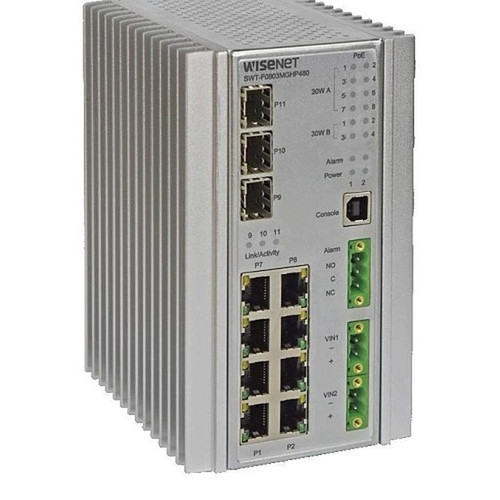
The Hanwha SWT-F11MGHP and SWT-G11MGHP are both 11-port industrial managed PoE++ switches from Hanwha's surveillance-grade networking line. Each delivers eight RJ-45 copper PoE ports, three SFP fiber uplinks, a 240 W PoE budget, DIN-rail or wall-mount installation, and a hardened –40 °C to +75 °C operating range. The comparison centers on switching bandwidth, uplink port configuration, security feature depth, and per-port PoE architecture — the axes most likely to drive selection in mid-size surveillance and edge-IoT deployments.
In This Guide
- How do port configuration and switching throughput differ between the SWT-F11MGHP and SWT-G11MGHP?
- Which switch delivers more capable PoE power architecture for high-draw devices?
- How do the management depth and security feature sets compare for network hardening?
- Which should you choose: the SWT-F11MGHP or the SWT-G11MGHP?
- Side-by-Side Specs
- FAQ
How do port configuration and switching throughput differ between the SWT-F11MGHP and SWT-G11MGHP?
Both switches provide eight RJ-45 copper ports and three SFP slots, but the fiber uplink specifications diverge. The SWT-F11MGHP ships with two 100/1000/2500Base-FX SFP ports plus one 100/1000Base-FX SFP port — a mixed-speed uplink arrangement. The SWT-G11MGHP equips all three SFP slots identically as 100/1000/2500Base-FX, giving uniform multi-gigabit uplink capability across every fiber port.
The bandwidth gap is material: the SWT-F11MGHP delivers 13.6 Gbps switching bandwidth, while the SWT-G11MGHP more than doubles that at 28 Gbps. Both operate at 7 µs switching latency and use Store-and-Forward processing. For high-density camera backbones or uplinks aggregating multiple streams simultaneously, the SWT-G11MGHP's 28 Gbps fabric provides substantially more headroom before congestion becomes a design constraint.
Which switch delivers more capable PoE power architecture for high-draw devices?
Both models share a 240 W PoE budget and 57 VDC input with overload current and reverse polarity protection. The per-port allocation is where they differ. The SWT-F11MGHP supports 60 W PoE++ on ports 1–4 and 30 W PoE+ on ports 5–8. The SWT-G11MGHP's datasheet describes ports 1–4 at 60 W and ports 5–8 at 30 W as well, but the product's tagged PoE standard is listed as PoE+ (802.3at) versus the SWT-F11MGHP's PoE++ (802.3bt) tag — a spec-level discrepancy in the provided data that buyers should verify directly with Hanwha before deploying high-draw devices such as PTZ cameras or access-control panels requiring IEEE 802.3bt.
Maximum system draw also differs slightly: the SWT-F11MGHP is rated at 250 W max with PoE++; the SWT-G11MGHP is rated at 255 W max with PoE++. Both include redundant 48–57 VDC dual inputs. The SWT-G11MGHP specs list a 3-pin terminal block fault relay, while the SWT-F11MGHP specifies a 2×2-pin terminal block fault relay — a wiring consideration for alarm integration.
How do the management depth and security feature sets compare for network hardening?
Both switches share a common feature baseline: 256 VLANs (Voice, Private, Multicast), 128 IGMP multicast groups per VLAN, 8K MAC address table, 9.6K byte jumbo frames, 32 static routes, 8 priority queues, and STP/RSTP/MSTP/ERPS redundancy. DRAM is 1 GB and Flash is 128 Mb on each unit.
The SWT-F11MGHP's published specifications include an explicit, itemized security feature list: SNMPv3 encrypted authentication, device binding, MAC-based access security, HTTPS/SSH, port-based 802.1x network access control, ACL, ARP inspection, IP source guard, AAA RADIUS server authentication, and TACACS+. The SWT-G11MGHP's provided specifications do not enumerate equivalent security features individually. This absence may reflect an incomplete spec sheet rather than a true capability gap, but buyers requiring documented security compliance should confirm with Hanwha before specifying the SWT-G11MGHP in a segmented or credentialed network. Both units carry identical environmental certifications: FCC Part 15, CISPR Class A, EN61000-4 series EMS, IEC60068 shock/vibration/free-fall, EN60950-1 safety, EN50121-4 rail, and NEMA TS2 traffic.
Which should you choose: the SWT-F11MGHP or the SWT-G11MGHP?
Our take: The SWT-G11MGHP is the stronger choice when switching fabric capacity and uniform multi-gigabit fiber uplinks are the primary constraints. Its 28 Gbps switching bandwidth is 2.06× the SWT-F11MGHP's 13.6 Gbps, and all three SFP ports are rated identically at 100/1000/2500Base-FX versus the SWT-F11MGHP's mixed uplink (2× 2500FX + 1× 1000FX). Conversely, the SWT-F11MGHP is the better-documented choice for deployments requiring explicit network security controls: its spec sheet enumerates SNMPv3, TACACS+, 802.1x, ARP inspection, IP source guard, and ACL — none of which appear in the SWT-G11MGHP's provided specs. Maximum system draw differs by 5 W (250 W vs. 255 W), a negligible delta. Choose the SWT-G11MGHP for high-bandwidth camera aggregation or multi-uplink fiber backbones; choose the SWT-F11MGHP for hardened, compliance-sensitive or credentialed network segments where per-feature security documentation is required.
Side-by-Side Comparison
Spec-for-spec, from manufacturer data.
| Specification | Hanwha SWT-F11MGHP | Hanwha SWT-G11MGHP |
|---|---|---|
| SKU | SWT-F11MGHP | SWT-G11MGHP |
| Total Ports | 11 (8× RJ-45 + 3× SFP) | 11 (8× RJ-45 + 3× SFP) |
| RJ-45 Port Speed | 10/100Base-TX | Gigabit (10/100/1000) |
| SFP Uplinks | 2× 100/1000/2500FX + 1× 100/1000FX | 3× 100/1000/2500FX |
| Switching Bandwidth | 13.6 Gbps | 28 Gbps |
| Switching Latency | 7 µs | 7 µs |
| Processing | Store-and-Forward | Store-and-Forward |
| PoE Budget | 240 W | 240 W |
| Max System Power | 250 W | 255 W |
| PoE Per-Port (Ports 1–4) | 60 W | 60 W |
| PoE Per-Port (Ports 5–8) | 30 W | 30 W |
| PoE Standard (Tagged) | PoE++ (802.3bt) | PoE+ (802.3at) |
| Power Input | 57 VDC (redundant 48–57 VDC) | 57 VDC (redundant 48–57 VDC) |
| Fault Relay | 2× 2-Pin Terminal Block | 3-Pin Terminal Block |
| Max VLANs | 256 | 256 |
| MAC Table | 8K | 8K |
| IGMP Groups | 128 per VLAN | 128 per VLAN |
| Network Redundancy | STP, RSTP, MSTP, ERPS | STP, RSTP, MSTP, ERPS |
| Static Routes | 32 | 32 |
| Jumbo Frame | Up to 9.6K Bytes | Up to 9.6K Bytes |
| Priority Queues | 8 | 8 |
| DRAM | 1 GB | 1 GB |
| Flash | 128 Mb | 128 Mb |
| Security Features (Documented) | SNMPv3, 802.1x, ACL, ARP Inspection, IP Source Guard, TACACS+, RADIUS AAA, HTTPS/SSH | Not enumerated in provided specs |
| Operating Temperature | –40 to +75 °C | –40 to +75 °C |
| Storage Temperature | –40 to +85 °C | –40 to +85 °C |
| Operating Humidity | 5%–95% Non-condensing | 5%–95% Non-condensing |
| MTBF | >100,000 hours | >100,000 hours |
| Dimensions (H×W×D) | 6.0 × 3.5 × 4.5 in | 6.0 × 3.5 × 4.5 in |
| Weight | 2.6 lb / 1.2 kg | 2.6 lb / 1.2 kg |
| Installation | DIN-Rail or Wall Mount | DIN-Rail or Wall Mount |
| Housing Color | White | White |
| EMI Certification | FCC Part 15, CISPR EN55022 Class A | FCC Part 15, CISPR EN55022 Class A |
| Rail Certification | EN50121-4 | EN50121-4 |
| Traffic Certification | NEMA TS2 | NEMA TS2 |
Frequently Asked Questions
Which should you choose: the SWT-F11MGHP or the SWT-G11MGHP?
The SWT-G11MGHP is the stronger choice when switching fabric capacity and uniform multi-gigabit fiber uplinks are the primary constraints. Its 28 Gbps switching bandwidth is 2.06× the SWT-F11MGHP's 13.6 Gbps, and all three SFP ports are rated identically at 100/1000/2500Base-FX versus the SWT-F11MGHP's mixed uplink (2× 2500FX + 1× 1000FX). Conversely, the SWT-F11MGHP is the better-documented choice for deployments requiring explicit network security controls: its spec sheet enumerates SNMPv3, TACACS+, 802.1x, ARP inspection, IP source guard, and ACL — none of which appear in the SWT-G11MGHP's provided specs. Maximum system draw differs by 5 W (250 W vs. 255 W), a negligible delta. Choose the SWT-G11MGHP for high-bandwidth camera aggregation or multi-uplink fiber backbones; choose the SWT-F11MGHP for hardened, compliance-sensitive or credentialed network segments where per-feature security documentation is required.
Is the SWT-F11MGHP or SWT-G11MGHP better for a high-camera-count surveillance backbone?
Based on the provided specifications, the SWT-G11MGHP is better suited for high-camera-count backbones. Its 28 Gbps switching bandwidth — more than double the SWT-F11MGHP's 13.6 Gbps — provides significantly more fabric headroom for aggregating simultaneous high-bitrate streams. All three of its SFP uplinks also support 2500Base-FX equally, which simplifies multi-gigabit uplink planning.
Can either switch power a 60 W PoE++ device like a high-end PTZ camera on any port?
Both switches provide 60 W on ports 1–4 only. Ports 5–8 on both models deliver 30 W. The SWT-F11MGHP is tagged as PoE++ (802.3bt) in the provided specs; the SWT-G11MGHP is tagged as PoE+ (802.3at) despite the 60 W figure. This is a discrepancy in the supplied data. Buyers deploying 802.3bt-dependent devices should confirm the actual IEEE standard supported by the SWT-G11MGHP directly with Hanwha before purchasing.
Which switch is easier to integrate into a network that requires 802.1x port authentication and TACACS+?
Based on the provided specifications, the SWT-F11MGHP explicitly lists 802.1x port-based network access control, TACACS+, RADIUS AAA authentication, SNMPv3, ACL, ARP inspection, and IP source guard. The SWT-G11MGHP's provided specifications do not enumerate these features. This does not confirm they are absent — it may reflect an incomplete spec sheet — but the SWT-F11MGHP is the safer selection where documented security feature support is a procurement requirement.
Get a Second Opinion on Your Camera Choice
Share your site layout, coverage goals, and budget. Our team will validate the camera selection, flag anything we would change, and recommend products that match the use case.