
Hanwha QNV-8010R vs Hanwha XNV-8020R: Specification Comparison
The Hanwha QNV-8010R and XNV-8020R are both 5MP fixed-lens vandal-resistant IP dome cameras from Hanwha's Wisenet lineup, making them genuine cross-shop candidates for indoor/outdoor perimeter and general surveillance deployments. This comparison examines how the two models differ across imaging performance, physical installation requirements, and VMS/analytics integration — drawing exclusively from the published specifications of each unit to help installers and IT buyers identify which model best fits their specific project requirements.
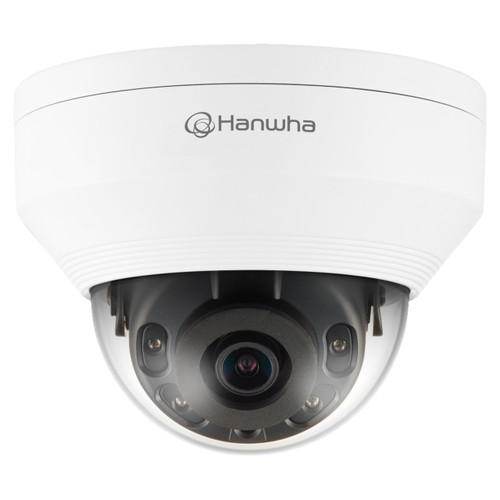
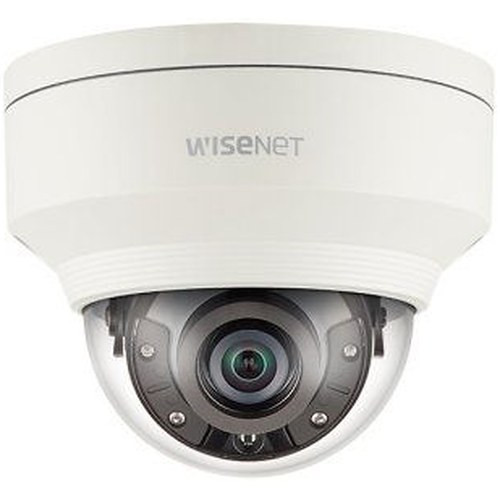
In This Guide
How do the imaging specs compare?
The QNV-8010R uses a 1/2.8" 5MP CMOS sensor producing 2592×1944 at 30fps, with a 2.8mm fixed lens at F2.0 delivering a 105° horizontal field of view. The XNV-8020R uses a larger 1/1.8" 6MP CMOS sensor (operating in 5MP output mode at 2560×1920, 30fps), with a 3.7mm fixed lens at F1.6 yielding a 97.5° horizontal field of view. The larger sensor and wider aperture on the XNV-8020R provide a marginal low-light advantage: minimum color illumination is 0.16 Lux versus 0.15 Lux on the QNV-8010R — a negligible real-world difference — though the XNV-8020R spec sheet also lists 0.016 Lux in B&W mode explicitly. Both cameras reach 0 Lux in IR mode.
IR range is a meaningful differentiator: the XNV-8020R illuminates to 30m (98.4ft) while the QNV-8010R reaches 20m (65.6ft), a 50% extension useful in longer corridors or outdoor approaches. Both cameras specify 120dB WDR, Auto ICR day/night switching, BLC, and SSNR-class digital noise reduction (the XNV-8020R labels its implementation SSNRV). The XNV-8020R additionally lists Digital Image Stabilization via a built-in gyro sensor and a built-in optical defog filter — neither feature is listed in the QNV-8010R specifications. Both support H.265/H.264 (Main/High) and MJPEG compression with WiseStream II smart codec and CBR/VBR bitrate control.
What about installation and environment?
Both cameras carry IP66 and IK10 ratings, confirming dust-tight, high-pressure water-jet resistance and protection against 20-joule impact — suitable for vandal-prone indoor or sheltered outdoor locations. The XNV-8020R adds IP67 (temporary submersion) certification, providing an additional margin in wash-down or high-moisture environments. Operating temperature range is identical: -30°C to +55°C for both. Storage temperature differs slightly: the QNV-8010R is rated to -30°C storage minimum while the XNV-8020R extends to -50°C storage minimum — relevant for equipment stored in unheated facilities in cold climates.
Both cameras are powered via PoE IEEE 802.3af Class 3. The XNV-8020R additionally accepts 12VDC, offering a backup power path where PoE infrastructure is unavailable. Maximum PoE draw is 7.5W on the QNV-8010R versus 9.0W on the XNV-8020R — both within 802.3af budget but worth noting on loaded switches. The QNV-8010R ships in white/aluminum (RAL9003) at 510g; the XNV-8020R ships in ivory/aluminum at 615g. Form factor is nearly identical (Ø120mm diameter) with the XNV-8020R standing 5.8mm taller. Hanwha lists a SBP-122HMW hanging mount and SBV-120GW backbox as accessories for the QNV-8010R; corresponding accessory compatibility for the XNV-8020R is not specified in the provided data.
Which fits your VMS and analytics better?
Both cameras support ONVIF Profile S and G, SUNAPI (HTTP API), and the Wisenet open platform. The QNV-8010R additionally lists ONVIF Profile T in its API specification; the XNV-8020R's primary spec block lists Profile S/G only — though a secondary field in the XNV-8020R data also references S, G, T. Buyers requiring confirmed Profile T support should verify directly against the XNV-8020R datasheet. On-board edge storage differs substantially: the QNV-8010R provides a single Micro SD/SDHC/SDXC slot supporting up to 128GB; the XNV-8020R provides two slots supporting up to 512GB total — a significant advantage for extended local recording or redundant storage configurations.
Analytics capability diverges considerably. The QNV-8010R provides motion detection (4 polygonal zones), tampering, defocus detection, virtual area intrusion/enter/exit, and virtual line crossing/direction. The XNV-8020R extends this with loitering detection, directional detection, fog detection, digital auto-tracking, sound classification, heatmap, people counting, and queue management — including business intelligence functions not present on the QNV-8010R. Audio is another differentiator: the XNV-8020R includes a selectable mic/line audio input (2.5VDC, 2KΩ) and line-level audio output (1Vrms), with G.711/G.726 audio compression; the QNV-8010R specifies no audio input or output. Unicast stream concurrency is also higher on the XNV-8020R (20 users, 10 profiles) versus the QNV-8010R (6 users, 3 profiles). RAM is 1024MB on the XNV-8020R versus 512MB on the QNV-8010R, consistent with the higher analytics load. Both cameras carry a 3-year warranty.
Which should you choose: the QNV-8010R or the XNV-8020R?
Our take: The XNV-8020R is the stronger choice when the installation demands extended IR range, two-way audio, advanced analytics, or dual-slot edge storage. Concretely: IR illumination extends 30m versus the QNV-8010R's 20m (50% further); on-board storage capacity reaches 512GB across two SD slots versus a single 128GB slot; and analytics include people counting, queue management, heatmap, sound classification, and digital auto-tracking — none of which are listed for the QNV-8010R. The XNV-8020R also adds IP67 submersion rating, 12VDC backup power, built-in gyro-based image stabilization, and a built-in optical defog filter. The QNV-8010R is the appropriate selection where budget, simpler integration, or lower PoE draw (7.5W max vs. 9.0W) are priorities, and where the analytics suite and audio I/O of the XNV-8020R are not required by the project scope. Both cameras are rated IP66/IK10 and operate identically over -30°C to +55°C.
Side-by-Side Comparison
Spec-for-spec, from manufacturer data.
| Specification | Hanwha QNV-8010R | Hanwha XNV-8020R |
|---|---|---|
| Resolution | 2592×1944 (5MP) | 2560×1920 (5MP) |
| Image Sensor | 1/2.8" CMOS | 1/1.8" 6MP CMOS |
| Focal Length | 2.8mm fixed | 3.7mm fixed |
| Max Aperture | F2.0 | F1.6 |
| Horizontal FOV | 105° | 97.5° |
| Min Illumination (Color / IR) | 0.15 Lux / 0 Lux | 0.16 Lux / 0 Lux |
| IR Range | 20m (65.6ft) | 30m (98.4ft) |
| Wide Dynamic Range | 120dB | 120dB |
| Max Frame Rate | 30fps @ 5MP | 30fps |
| Video Compression | H.265/H.264 Main/High; MJPEG | H.265/H.264 Main/Baseline/High; MJPEG |
| IP Rating | IP66 | IP66 / IP67 |
| Impact Rating | IK10 | IK10 |
| Operating Temperature | -30°C to +55°C | -30°C to +55°C |
| Power Input / PoE Class | PoE 802.3af Class 3 (max 7.5W) | PoE 802.3af Class 3 (max 9.0W); 12VDC (max 8.0W) |
| Edge Storage | 1x Micro SD/SDHC/SDXC; max 128GB | 2x Micro SD/SDHC/SDXC; max 512GB |
| Audio I/O | — | In: mic/line selectable; Out: line out 1Vrms |
| Analytics | Motion, tampering, defocus, virtual area/line | Motion, tampering, loitering, directional, fog, auto-tracking, sound classification, heatmap, people counting, queue management |
| Concurrent Unicast Streams / Profiles | 6 users / 3 profiles | 20 users / 10 profiles |
| RAM | 512MB | 1024MB |
| Image Stabilization | — | Digital (built-in gyro sensor) |
| Defog | — | Support (built-in optical filter) |
| ONVIF Profiles | S, G, T | S, G (T listed in secondary field — verify against datasheet) |
| Dimensions | Ø120.3×91.7mm; 510g (1.12 lb) | Ø120.0×97.5mm; 615g (1.36 lb) |
| Housing Color / Material | White / Aluminum (RAL9003) | Ivory / Aluminum |
| Warranty | 3 years | 3 years |
Frequently Asked Questions
Which should you choose: the QNV-8010R or the XNV-8020R?
The XNV-8020R is the stronger choice when the installation demands extended IR range, two-way audio, advanced analytics, or dual-slot edge storage. Concretely: IR illumination extends 30m versus the QNV-8010R's 20m (50% further); on-board storage capacity reaches 512GB across two SD slots versus a single 128GB slot; and analytics include people counting, queue management, heatmap, sound classification, and digital auto-tracking — none of which are listed for the QNV-8010R. The XNV-8020R also adds IP67 submersion rating, 12VDC backup power, built-in gyro-based image stabilization, and a built-in optical defog filter. The QNV-8010R is the appropriate selection where budget, simpler integration, or lower PoE draw (7.5W max vs. 9.0W) are priorities, and where the analytics suite and audio I/O of the XNV-8020R are not required by the project scope. Both cameras are rated IP66/IK10 and operate identically over -30°C to +55°C.
Is the QNV-8010R or XNV-8020R better for low-light and IR coverage?
Both cameras reach 0 Lux in IR mode. For IR range, the XNV-8020R covers 30m (98.4ft) versus 20m (65.6ft) for the QNV-8010R — a 50% advantage. Color minimum illumination is essentially equal (0.15 Lux vs. 0.16 Lux). The XNV-8020R also has a larger 1/1.8" sensor and wider F1.6 aperture compared to the QNV-8010R's 1/2.8" sensor at F2.0, which generally supports better low-light performance at the sensor level, though both cameras list 120dB WDR.
Can I use either camera for people counting or queue management analytics?
Only the XNV-8020R lists people counting, queue management, and heatmap analytics in its specifications. These business intelligence functions are not listed in the QNV-8010R specifications. If those analytics are a project requirement, the XNV-8020R is the only option of the two.
Do both cameras support on-board SD card recording, and how much storage do they support?
Yes, both cameras support Micro SD/SDHC/SDXC edge recording. The QNV-8010R has a single card slot with a maximum capacity of 128GB. The XNV-8020R has two card slots supporting a combined maximum of 512GB — four times the storage capacity and with the redundancy benefit of a second slot.
Get a Second Opinion on Your Camera Choice
Share your site layout, coverage goals, and budget. Our team will validate the camera selection, flag anything we would change, and recommend products that match the use case.