
Hanwha QNV-7082R vs i-PRO X35402-F2LM: Specification Comparison
Both the Hanwha QNV-7082R and the i-PRO WV-X35402-F2LM are outdoor-rated, IK10-vandal-resistant fixed dome cameras delivering 4MP (2560×1440) resolution with onboard IR illumination and PoE power. They occupy the same general product class and resolution tier, making them legitimate cross-shop candidates for installers evaluating perimeter, transit, or industrial surveillance deployments where ruggedization, dynamic range, and VMS integration are primary concerns.
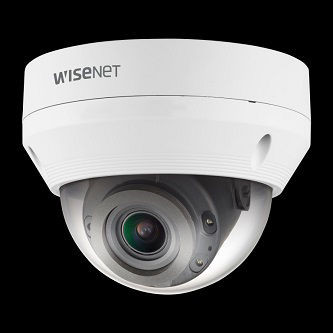
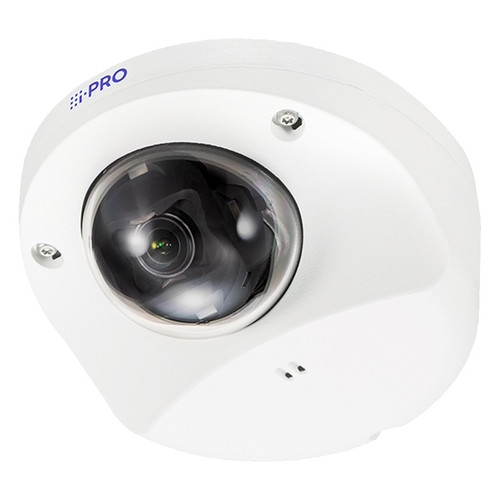
In This Guide
How do the imaging specs compare?
The QNV-7082R uses a 1/3" CMOS sensor with a 3.2–10 mm (3.1×) motorized varifocal lens (F1.6 wide / F2.9 tele), providing an angular field of view from 98.6° (wide) to 30.8° (tele). Minimum illumination is 0.1 lux in color and 0 lux with IR, and IR range extends to 30 m (98 ft). WDR is rated at 120 dB. DORI figures at wide end show Detect at 27 m and Identify at 3 m; at tele end, Detect reaches 129 m and Identify 13 m.
The WV-X35402-F2LM uses an approx. 1/2.8" CMOS sensor with a fixed 2.4 mm lens (F2.1), delivering a wide 121° horizontal field of view with no optical zoom. Minimum illumination is 0.07 lux in color and 0.06 lux in B&W (0 lux with IR), with IR range rated at 14 m (46 ft). WDR (Super Dynamic) reaches 132 dB at maximum level. DORI figures show Detect at 29.0 m and Identify at 2.9 m. The i-PRO sensor is larger (1/2.8" vs 1/3"), offers marginally better low-light performance in color (0.07 lux vs 0.1 lux), and has higher peak WDR (132 dB vs 120 dB), while the Hanwha provides a motorized varifocal lens versus the i-PRO's fixed lens and nearly double the IR throw distance (30 m vs 14 m).
What about installation and environment?
Both cameras carry IP66 and IK10 ratings, making them suitable for outdoor and vandal-prone installations. The QNV-7082R operates from −40°C to +55°C with a weight of approximately 710 g (1.565 lb) and dimensions of Ø137.0 × 106.1 mm. It accepts PoE (IEEE 802.3af, Class 3) or 12 VDC and draws up to 11.4 W. It uses a standard RJ-45 connector. Compatible conduit entries include 3/4" (M25) single, double, and 4" octagon gangbox. Accessory mounting options include a hanging mount (SBP-301HMW2), skin cover (SPB-VAW72), and backbox (SBV-136BW).
The WV-X35402-F2LM operates from −40°C to +60°C (power-on threshold −20°C) and weighs approximately 475 g (1.05 lb) with dimensions of 109 mm (W) × 53 mm (H) × 119 mm (D). It draws up to 8.6 W via PoE (PoE Class 0 per spec). A notable differentiator is its M12 Ethernet connector rather than RJ-45, which is purpose-designed for vibration-prone and transportation environments. It also carries NEMA 4X / Type 4X, EN50155, IEC61373, JIS E 5006, and EN45545 railway/vehicle certifications that the QNV-7082R does not list. The i-PRO unit also specifies wind resistance up to 40 m/s (approx. 89 mph), a spec absent from the Hanwha data sheet.
Which fits your VMS and analytics better?
The QNV-7082R supports ONVIF Profile S/G/T and Hanwha's SUNAPI (HTTP API). It offers H.265/H.264 (Main/High) and MJPEG compression, WiseStream II smart codec, CBR/VBR bitrate control, and up to three simultaneous streaming profiles with unicast (up to 6 users) or multicast. Edge analytics include defocus detection, directional detection, motion detection, enter/exit, tampering, and virtual line crossing. Audio input (line in) is supported; audio output is not listed. On-board microSD/SDHC/SDXC storage is supported up to 128 GB (1 slot). Security features include HTTPS/SSL, Digest authentication, IP filtering, user access log, and 802.1X.
The WV-X35402-F2LM supports ONVIF Profile G/M/S/T. It offers H.265/H.264 and JPEG compression with Variable GOP smart coding. It supports up to 14 simultaneous users. AI analytics include 7 detection types (the spec lists AI video analytics generally and specifically references AI Sound Classification with four event classes: gunshot, yell, vehicle horn, glass break) plus scene change detection and audio detection. The product spec also references facial recognition in the product attributes. Security credentials include FIPS 140-2 Level 3, device certificate, brute-force protection, alteration detection, SRTP, SFTP, and MQTT — a substantially broader security posture than the QNV-7082R. On-board microSD storage is supported up to 512 GB. Audio is listed as supported (built-in mic per product attributes). The i-PRO supports SNMP v1/v2/v3 and MQTT, with additional mobile compatibility listed for iOS and Android.
Which should you choose: the QNV-7082R or the X35402-F2LM?
Our take: The QNV-7082R is the stronger choice when lens flexibility and IR range are the primary drivers: its 3.2–10 mm motorized varifocal lens covers 98.6°–30.8° field of view versus the WV-X35402-F2LM's fixed 2.4 mm / 121° lens, and its IR throw of 30 m nearly doubles the i-PRO's 14 m. Conversely, the WV-X35402-F2LM leads in WDR headroom (132 dB vs 120 dB), low-light color sensitivity (0.07 lux vs 0.1 lux), higher-capacity edge storage (up to 512 GB vs 128 GB), a stronger security certification stack (FIPS 140-2 Level 3 vs none stated), AI sound classification, and a broader analytics set including scene change detection. The i-PRO also operates 5°C higher at the top end (60°C vs 55°C) and carries railway certifications (EN50155, IEC61373) the Hanwha does not list. Choose the QNV-7082R for general outdoor perimeter surveillance requiring zoom flexibility and long-range IR; choose the WV-X35402-F2LM for transit, rail, or high-security environments requiring railway certification, superior WDR, and an M12 connector.
Side-by-Side Comparison
Spec-for-spec, from manufacturer data.
| Specification | Hanwha QNV-7082R | i-PRO X35402-F2LM |
|---|---|---|
| Resolution | 2560×1440 (4MP) | 2560×1440 (4MP) |
| Image Sensor | 1/3" CMOS | Approx. 1/2.8" CMOS |
| Lens / Focal Length | 3.2–10 mm motorized varifocal (3.1×) | 2.4 mm fixed |
| Max Aperture | F1.6 (Wide) / F2.9 (Tele) | F2.1 |
| Horizontal Field of View | 98.6° (Wide) – 30.8° (Tele) | 121° |
| Min. Illumination (Color) | 0.1 lux | 0.07 lux |
| Min. Illumination (B&W / IR) | 0 lux (IR) | 0.06 lux B&W / 0 lux (IR) |
| IR Range | 30 m (98 ft) | 14 m (46 ft) |
| Wide Dynamic Range | 120 dB | 132 dB (Super Dynamic, Level 31) |
| Max Frame Rate | 30 fps | 25/30 fps |
| Video Compression | H.265 / H.264 / MJPEG | H.265 / H.264 / JPEG |
| IP Rating | IP66 | IP66 / NEMA 4X / Type 4X |
| Impact / Vandal Rating | IK10 | IK10 |
| Operating Temperature | -40°C to +55°C | -40°C to +60°C (power-on: -20°C) |
| Power Input / PoE Class | PoE 802.3af Class 3 / 12 VDC; 11.4 W max | PoE Class 0; 8.6 W max |
| Network Connector | RJ-45 (10/100BASE-T) | M12 (10BASE-T/100BASE-TX) |
| Edge Storage | microSD/SDHC/SDXC up to 128 GB | microSD/SDHC/SDXC up to 512 GB |
| Audio | Line in (no audio out listed) | Built-in mic (audio detection + AI sound classification) |
| ONVIF Profile | S / G / T | G / M / S / T |
| AI / Edge Analytics | Defocus, directional, enter/exit, tampering, virtual line | 7 AI detection types; AI sound classification (4 classes); SCD |
| Railway Certification | — | EN50155 / JIS E 5006 / IEC61373 / EN50121 / EN45545 |
| Cybersecurity Certification | — | FIPS 140-2 Level 3 |
| Weight | 710 g (1.565 lb) | 475 g (1.05 lb) |
| Warranty | 3-year | 5-year |
Frequently Asked Questions
Which should you choose: the QNV-7082R or the X35402-F2LM?
The QNV-7082R is the stronger choice when lens flexibility and IR range are the primary drivers: its 3.2–10 mm motorized varifocal lens covers 98.6°–30.8° field of view versus the WV-X35402-F2LM's fixed 2.4 mm / 121° lens, and its IR throw of 30 m nearly doubles the i-PRO's 14 m. Conversely, the WV-X35402-F2LM leads in WDR headroom (132 dB vs 120 dB), low-light color sensitivity (0.07 lux vs 0.1 lux), higher-capacity edge storage (up to 512 GB vs 128 GB), a stronger security certification stack (FIPS 140-2 Level 3 vs none stated), AI sound classification, and a broader analytics set including scene change detection. The i-PRO also operates 5°C higher at the top end (60°C vs 55°C) and carries railway certifications (EN50155, IEC61373) the Hanwha does not list. Choose the QNV-7082R for general outdoor perimeter surveillance requiring zoom flexibility and long-range IR; choose the WV-X35402-F2LM for transit, rail, or high-security environments requiring railway certification, superior WDR, and an M12 connector.
Is the QNV-7082R or WV-X35402-F2LM better for low-light performance?
Based on stated specifications, the WV-X35402-F2LM has a slight edge in color low-light performance at 0.07 lux versus the QNV-7082R's 0.1 lux. Both cameras reach 0 lux in B&W mode with IR active. However, the QNV-7082R's IR illuminator is rated to 30 m, more than double the WV-X35402-F2LM's 14 m, so at longer distances the Hanwha will provide usable IR-lit images where the i-PRO's illuminator cannot reach.
Can either camera be used in a railway or transit vehicle application?
Only the WV-X35402-F2LM lists railway and vehicle certifications in its specifications: EN50155, JIS E 5006, IEC62236, EN50121, IEC61373, and EN45545. It also uses an M12 Ethernet connector suited to vibration-prone installations and specifies wind resistance up to 40 m/s. The QNV-7082R's published specifications do not include any of these railway or vehicle certifications.
Which camera offers better VMS security integration and cybersecurity features?
The WV-X35402-F2LM lists FIPS 140-2 Level 3 certification, device certificate, SRTP, SFTP, MQTT, brute-force protection, and alteration detection alongside 802.1X and HTTPS. The QNV-7082R lists HTTPS/SSL, Digest authentication, IP filtering, user access log, and 802.1X, but does not state FIPS 140-2 or equivalent certification in the provided specifications. For high-security or government-adjacent deployments where FIPS compliance is a requirement, the WV-X35402-F2LM is the documented choice based on available spec data.
Get a Second Opinion on Your Camera Choice
Share your site layout, coverage goals, and budget. Our team will validate the camera selection, flag anything we would change, and recommend products that match the use case.