
Hanwha QNV-7082R vs i-PRO S35402-F2LG: Specification Comparison
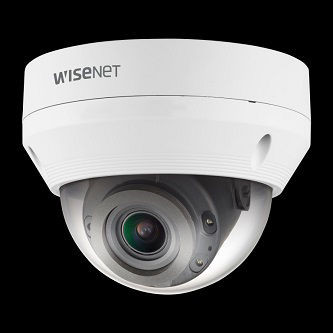
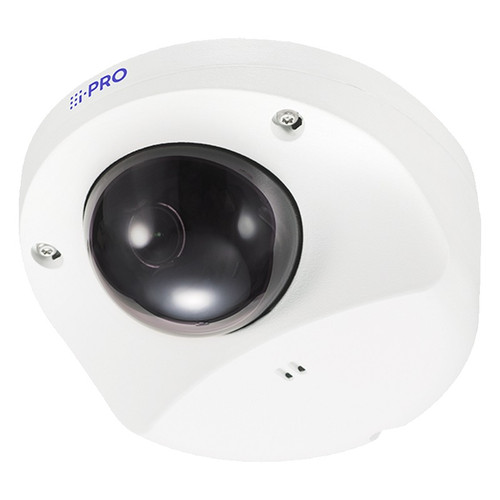
Both the Hanwha QNV-7082R and the i-PRO WV-S35402-F2LG are 4MP outdoor-rated vandal-resistant fixed IP dome cameras aimed at commercial and light-industrial surveillance installations. The QNV-7082R is a motorized varifocal dome targeting flexible field-of-view deployment, while the WV-S35402-F2LG is a compact fixed-lens dome emphasizing AI analytics and a wider native field of view. Installers and IT buyers evaluating both will weigh optical flexibility against AI capability, IR range, WDR depth, and platform integration differences.
In This Guide
How do the imaging specs compare?
Both cameras deliver 4MP (2560×1440) at up to 30fps using H.265/H.264 compression. The QNV-7082R uses a 1/3" CMOS sensor with a 3.2–10mm (3.1×) motorized varifocal lens offering an angular field of view of 98.6° wide to 30.8° tele, with DC auto-iris aperture ranging F1.6 (wide) to F2.9 (tele). The WV-S35402-F2LG uses an approx. 1/2.8" CMOS sensor with a fixed 2.4mm lens at F2.1, covering a wider 121° horizontal field of view but with no optical zoom. The larger sensor format of the i-PRO unit is a meaningful advantage for light sensitivity, while the Hanwha's motorized zoom provides on-site scene-width adjustment without a lens swap.
In low-light performance, the QNV-7082R specifies 0.1 lux color and 0 lux with IR active, with an IR illuminator rated to 30m (98.4ft). The WV-S35402-F2LG specifies 0.19 lux at 30 IRE and 0.16 lux B&W (color and B&W values respectively), with IR rated to 14m at high power and 10m at medium power. The Hanwha's IR reach is approximately 2–3× longer. On WDR, the QNV-7082R rates 120dB via Hanwha's SSDR/WDR implementation; the WV-S35402-F2LG rates 132dB maximum (Super Dynamic on, Level 31). DORI detect distances are comparable: Hanwha 27m wide / 129m tele vs. i-PRO 29m fixed.
What about installation and environment?
Both cameras carry IP66 and IK10 ratings, making them suitable for outdoor and vandal-prone locations. The WV-S35402-F2LG additionally meets NEMA 4X (UL50E) and Type 4X standards and is rated for wind resistance up to 40 m/s (approx. 89 mph), neither of which is specified for the QNV-7082R. Operating temperature ranges are similar but not identical: the QNV-7082R is rated –40°C to +55°C, while the WV-S35402-F2LG is rated –40°C to +50°C — a 5°C advantage for the Hanwha in high-heat environments.
Power delivery differs: the QNV-7082R accepts PoE (IEEE 802.3af, Class 3) or 12VDC and draws up to 11.4W, offering a wired DC fallback option. The WV-S35402-F2LG is PoE only (IEEE 802.3af, Class 0) at a maximum of 8.6W — a lower power budget that may ease switch port planning. Physically, the QNV-7082R is larger at Ø137×106.1mm and 710g (1.57 lb), while the WV-S35402-F2LG is more compact at 109×53×119mm and approximately 475g (1.05 lb). The QNV-7082R supports pan/tilt/rotate adjustment (0°–350° / 0°–67° / 0°–355°) plus installation CVBS video out; the WV-S35402-F2LG supports pan –45° to +45°, tilt 0° to +90°, yaw –90° to +90°, with no CVBS output specified.
Which fits your VMS and analytics better?
Both cameras support ONVIF Profile S, G, and T. The WV-S35402-F2LG additionally supports ONVIF Profile M, which adds metadata and analytics interoperability for compatible VMS platforms. The QNV-7082R's API is ONVIF plus Hanwha SUNAPI (HTTP API); the WV-S35402-F2LG does not list a proprietary HTTP API in the provided specs. Protocol support is broad on both units; the i-PRO model adds SRTP and SFTP to its IPv4 stack and supports MQTT on both IPv4 and IPv6, which the Hanwha spec does not list. The WV-S35402-F2LG supports up to 14 simultaneous users; the QNV-7082R specifies up to 6 unicast users.
On-board analytics differ substantially. The QNV-7082R includes defocus detection, directional detection, enter/exit, virtual line, and tampering. The WV-S35402-F2LG adds AI-driven motion (AI Motion), face detection, people detection, vehicle detection, mask/non-mask detection, and occupancy detection, plus AI sound classification (gunshot, yell, vehicle horn, glass break) and scene change detection. Audio input is available on both (QNV-7082R via line in; WV-S35402-F2LG via built-in microphone). Edge storage is supported on both: the QNV-7082R supports up to 128GB microSD; the WV-S35402-F2LG supports up to 512GB microSDXC. The QNV-7082R also supports WiseStream II smart codec; the WV-S35402-F2LG spec does not list an equivalent. Warranty terms differ: Hanwha provides 3 years; i-PRO provides 5 years.
Which should you choose: the QNV-7082R or the S35402-F2LG?
Our take: The QNV-7082R is the stronger choice when optical flexibility and IR reach are the primary requirements — its 3.2–10mm motorized varifocal lens eliminates post-mount lens changes, its IR illuminator covers 30m versus the WV-S35402-F2LG's 14m maximum, and it operates up to +55°C versus the i-PRO's +50°C ceiling. The WV-S35402-F2LG is the stronger choice when AI analytics depth, edge storage capacity, and wider protocol ecosystem matter more: it delivers AI-based face, people, vehicle, mask, and occupancy detection versus the Hanwha's rule-based analytics, supports up to 512GB microSD versus 128GB, and carries ONVIF Profile M plus MQTT support absent from the QNV-7082R spec. Its 132dB Super Dynamic WDR exceeds the Hanwha's rated 120dB in high-contrast scenes. Both share IP66/IK10 ratings. Specify the QNV-7082R for variable-distance perimeter coverage needing longer IR; specify the WV-S35402-F2LG for fixed wide-angle interior or entry-point deployments requiring AI classification and a 5-year warranty.
Side-by-Side Comparison
Spec-for-spec, from manufacturer data.
| Specification | Hanwha QNV-7082R | i-PRO S35402-F2LG |
|---|---|---|
| Resolution | 2560×1440 (4MP) | 2560×1440 (4MP) |
| Image Sensor | 1/3" CMOS | Approx. 1/2.8" CMOS |
| Lens / Focal Length | 3.2–10mm motorized varifocal (3.1×) | 2.4mm fixed |
| Horizontal Field of View | 98.6° (wide) – 30.8° (tele) | 121° |
| Min. Illumination (Color) | 0.1 lux | 0.19 lux @ 30 IRE |
| Min. Illumination (B&W / IR) | 0 lux (IR on) | 0.16 lux B&W; 0 lux (IR on) |
| IR Range | 30m (98.4 ft) | 14m high / 10m medium |
| Wide Dynamic Range | 120 dB | 132 dB max (Super Dynamic Level 31) |
| Max Frame Rate | 30 fps | 25/30 fps |
| Video Compression | H.265, H.264, MJPEG | H.265, H.264, JPEG |
| IP Rating | IP66 | IP66, NEMA 4X, Type 4X |
| IK / Impact Rating | IK10 | IK10 |
| Operating Temperature | –40°C to +55°C | –40°C to +50°C |
| Power Input / PoE Class | PoE 802.3af Class 3 or 12VDC; 11.4W max | PoE 802.3af Class 0; 8.6W max |
| Edge Storage | MicroSD/SDHC/SDXC up to 128GB | MicroSDXC/SDHC/SD up to 512GB |
| On-board Analytics | Directional, virtual line, enter/exit, tampering, defocus | AI motion, face, people, vehicle, mask, occupancy, AI sound classification |
| ONVIF Profiles | S, G, T | G, M, S, T |
| Audio | Line in (no built-in mic specified) | Built-in microphone |
| Weight | 710g (1.57 lb) | Approx. 475g (1.05 lb) |
| Warranty | 3 years | 5 years |
Frequently Asked Questions
Which should you choose: the QNV-7082R or the S35402-F2LG?
The QNV-7082R is the stronger choice when optical flexibility and IR reach are the primary requirements — its 3.2–10mm motorized varifocal lens eliminates post-mount lens changes, its IR illuminator covers 30m versus the WV-S35402-F2LG's 14m maximum, and it operates up to +55°C versus the i-PRO's +50°C ceiling. The WV-S35402-F2LG is the stronger choice when AI analytics depth, edge storage capacity, and wider protocol ecosystem matter more: it delivers AI-based face, people, vehicle, mask, and occupancy detection versus the Hanwha's rule-based analytics, supports up to 512GB microSD versus 128GB, and carries ONVIF Profile M plus MQTT support absent from the QNV-7082R spec. Its 132dB Super Dynamic WDR exceeds the Hanwha's rated 120dB in high-contrast scenes. Both share IP66/IK10 ratings. Specify the QNV-7082R for variable-distance perimeter coverage needing longer IR; specify the WV-S35402-F2LG for fixed wide-angle interior or entry-point deployments requiring AI classification and a 5-year warranty.
Is the QNV-7082R or WV-S35402-F2LG better for low-light performance?
The QNV-7082R specifies 0.1 lux color and 0 lux with IR active, with an IR range of 30m. The WV-S35402-F2LG specifies 0.19 lux color (at 30 IRE) and 0.16 lux B&W, with IR reaching 14m at high power. The QNV-7082R has the advantage in IR illumination distance; the WV-S35402-F2LG's larger 1/2.8" sensor may offer a passive-light sensitivity edge, but its rated lux figures are higher (worse) than the Hanwha's. For long-range dark-area coverage, the QNV-7082R's 30m IR is the decisive spec.
Which camera has better WDR for high-contrast scenes like building entrances?
The WV-S35402-F2LG rates 132dB WDR maximum (Super Dynamic on, Level 31), compared to the QNV-7082R's rated 120dB WDR. Both use backlight compensation and support adjustable WDR levels, but the i-PRO's 132dB figure is higher per the provided specifications. For environments with strong simultaneous highlights and shadows — such as sun-lit lobby entrances — the WV-S35402-F2LG's higher rated dynamic range is the spec advantage.
Can either camera support AI people-counting or face detection without a separate server?
Yes, but only the WV-S35402-F2LG includes on-board AI analytics: it detects people, faces, vehicles, mask/non-mask compliance, occupancy, and AI sound classification (gunshot, yell, vehicle horn, glass break) at the edge. The QNV-7082R includes rule-based analytics (directional detection, virtual line, enter/exit, tampering) but does not specify AI-based face, people, or vehicle classification in its provided specifications. If AI classification without an external analytics server is required, the WV-S35402-F2LG is the applicable choice.
Get a Second Opinion on Your Camera Choice
Share your site layout, coverage goals, and budget. Our team will validate the camera selection, flag anything we would change, and recommend products that match the use case.