
Hanwha QNF-9010 vs Pelco SRXF3-12360-I: Specification Comparison
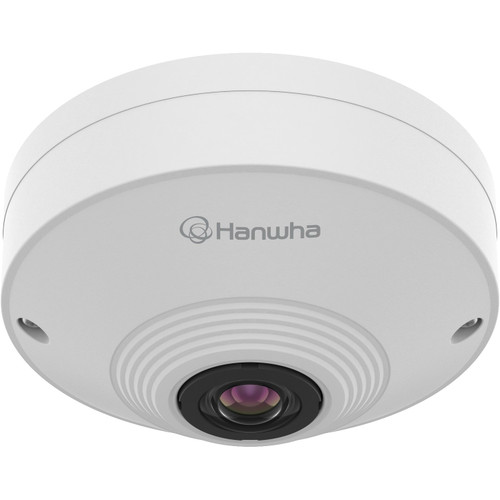
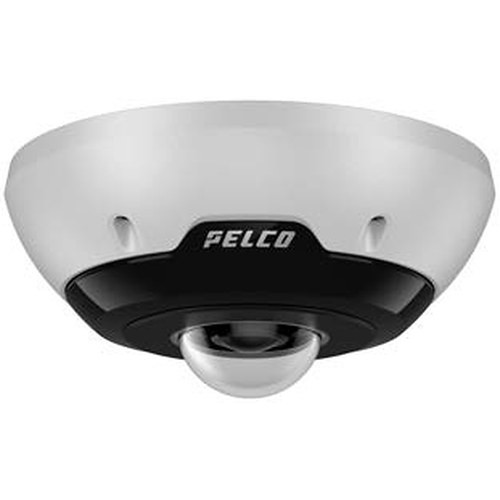
Both the Hanwha QNF-9010 and the Pelco SRXF3-12360-I are 12MP 360-degree indoor fisheye IP cameras aimed at single-point panoramic coverage in commercial and enterprise environments. Installers and IT buyers evaluating either model are weighing similar ceiling-mount footprints, full-panorama dewarping, and PoE-based deployment against differences in sensor performance, analytics depth, environmental ratings, and VMS ecosystem fit. This comparison draws exclusively from the manufacturer-provided specifications for each model.
In This Guide
How do the imaging specs compare?
The QNF-9010 uses a 1/2.3-inch 12MP CMOS sensor delivering a native 3008×3008 resolution at up to 30fps in H.265/H.264, with a 1.08mm fixed focal length at F2.2 and a 187° horizontal, vertical, and diagonal field of view. Its minimum illumination is rated at 0.39 lux (color, F2.2, 1/30s), and it offers a specified WDR performance of 120dB via BLC, WDR, and SSDR processing. Digital noise reduction is handled by Hanwha's SSNRv technology. DORI distances are published: Detect at 34.9m, Observe at 13.9m, Recognize at 7.0m, and Identify at 3.5m.
The SRXF3-12360-I is specified at 12MP with a maximum resolution of 3840×2160, which is a different aspect ratio (16:9 versus the QNF-9010's 1:1 square). The Pelco's lens is listed as both 2.7mm f/2.5 and 1.4mm F2.0 in different spec fields—these are conflicting values in the provided data and cannot be reconciled without a definitive datasheet. Frame rate at full resolution is 12.5fps, notably lower than the Hanwha's 30fps. Minimum illumination is rated at 0.10 lux, which is lower (more sensitive) than the QNF-9010's 0.39 lux. WDR is listed as present with a figure of up to 83dB per one spec field, versus the QNF-9010's specified 120dB. No DORI distances are provided for the Pelco.
What about installation and environment?
The QNF-9010 carries an IP42 rating, meaning it is protected against solid objects greater than 1mm but offers only limited drip protection—positioning it as an indoor-only camera where moisture is not a concern. It is PoE-powered via IEEE 802.3af (Class 3, max 7.7W, typical 6.4W) and operates from -10°C to +40°C. Physical dimensions are Ø99×49mm at 370g (0.82 lb), and the body is white plastic (RAL9003). Mounting options per spec include wall and ceiling.
The SRXF3-12360-I holds an IP52 rating (dust protection against limited ingress and protection against vertically dripping water) and an IK10 impact rating—the highest standard vandal resistance rating, making it significantly more robust mechanically than the QNF-9010 which carries no IK rating. It requires PoE+ (IEEE 802.3at, Class 3) rather than the standard PoE of the QNF-9010, so switch infrastructure must support PoE+. Its operating temperature range extends to +60°C versus the QNF-9010's +40°C ceiling, and storage temperature reaches +70°C. Dimensions are listed as 6×6×2.81 inches. The Pelco spec notes multiple mount types: wall, ceiling, pole, pendant, and corner.
Which fits your VMS and analytics better?
The QNF-9010 supports ONVIF Profile S, G, and T, as well as Hanwha's SUNAPI (HTTP API) and the Wisenet open platform. Built-in analytics include people counting, heatmap, defocus detection, motion detection (4 polygonal zones), and tampering alerts. Privacy masking supports 6 rectangular zones. Business intelligence outputs include people counting and heatmap data. Smart codec is available via WiseStreamII with up to 5 manual areas. Edge storage is supported via a single Micro SD/SDHC/SDXC slot up to 256GB. Security features include HTTPS/SSL, Digest authentication, IP filtering, 802.1X (EAP-TLS, EAP-LEAP), user access logging, and device certificates. Audio capability is not specified for this model. RAM/Flash is listed at 2048MB / 256MB.
The SRXF3-12360-I is ONVIF Profile S and Profile T compliant (Profile G is not listed). Its analytics platform is Pelco Smart Analytics with 8 behaviors—specific behavior names are not enumerated in the provided specs. Edge storage support is noted (microSD). Audio microphone support is listed. RAM is listed at 4GB with 4GB Flash—substantially more on-board memory than the QNF-9010. Video compression is listed as H.264 in one field and H.265/H.264 in another field; the conflicting values cannot be resolved from the provided data. Bandwidth management is noted via HDSM Smart Codec technology. HTTPS encryption is confirmed. No API or SDK details are specified beyond ONVIF.
Which should you choose: the QNF-9010 or the SRXF3-12360-I?
Our take: The QNF-9010 is the stronger choice when frame rate, WDR performance, and deep VMS/API integration are the primary criteria; the SRXF3-12360-I is the stronger choice when impact resistance, extended operating temperature, or lower-light sensitivity drives the decision. Key spec deltas: the QNF-9010 delivers 30fps versus the Pelco's 12.5fps at full resolution—a meaningful gap for motion-heavy scenes; the QNF-9010 specifies 120dB WDR versus the Pelco's listed maximum of 83dB; and the Pelco's 0.10 lux minimum illumination outperforms the QNF-9010's 0.39 lux where ambient light is scarce. The Pelco's IK10 rating and IP52 dust/drip protection offer substantially greater physical robustness than the QNF-9010's IP42 and no IK rating. The Pelco also requires PoE+ infrastructure, which eliminates standard 802.3af switches. Buyers on Hanwha's Wisenet VMS, or needing rich built-in analytics, should favor the QNF-9010; those on Pelco's ecosystem or in environments requiring vandal-resistance should favor the SRXF3-12360-I.
Side-by-Side Comparison
Spec-for-spec, from manufacturer data.
| Specification | Hanwha QNF-9010 | Pelco SRXF3-12360-I |
|---|---|---|
| Resolution | 12MP (3008×3008) | 12MP (3840×2160) |
| Image Sensor | 1/2.3" 12MP CMOS | Not specified |
| Lens / Focal Length | 1.08mm fixed, F2.2 | 2.7mm f/2.5 (also listed as 1.4mm F2.0 — conflicting spec) |
| Field of View | H/V/D: 187° | 180° / 360° |
| Min. Illumination | 0.39 lux (color, F2.2, 1/30s) | 0.10 lux |
| IR Range | — | — (ambient light required) |
| WDR | 120dB | Up to 83dB (per spec field; listed as 'WDR' elsewhere without dB value) |
| Max Frame Rate | 30fps @ 3008×3008 | 12.5fps @ full resolution |
| Video Compression | H.265 / H.264 (Main/High) / MJPEG | H.264 (also H.265/H.264 listed — conflicting spec) |
| IP Rating | IP42 | IP52 |
| IK / Impact Rating | — | IK10 |
| Operating Temperature | -10°C to +40°C | -10°C to +60°C |
| Power Input / PoE Class | PoE IEEE 802.3af, Class 3 (max 7.7W) | PoE+ IEEE 802.3at, Class 3 |
| Edge Storage | Micro SD/SDHC/SDXC, 1 slot, up to 256GB | microSD (capacity not specified) |
| Audio | — | Microphone supported |
| ONVIF Compliance | Profile S, G, T | Profile S, T |
| Dimensions | Ø99×49mm | 6" × 6" × 2.81" |
| Weight | 370g (0.82 lb) | Not specified (with wall mount: 1.001kg / 2.21lb) |
| Warranty | 3-year | 5-year |
Frequently Asked Questions
Which should you choose: the QNF-9010 or the SRXF3-12360-I?
The QNF-9010 is the stronger choice when frame rate, WDR performance, and deep VMS/API integration are the primary criteria; the SRXF3-12360-I is the stronger choice when impact resistance, extended operating temperature, or lower-light sensitivity drives the decision. Key spec deltas: the QNF-9010 delivers 30fps versus the Pelco's 12.5fps at full resolution—a meaningful gap for motion-heavy scenes; the QNF-9010 specifies 120dB WDR versus the Pelco's listed maximum of 83dB; and the Pelco's 0.10 lux minimum illumination outperforms the QNF-9010's 0.39 lux where ambient light is scarce. The Pelco's IK10 rating and IP52 dust/drip protection offer substantially greater physical robustness than the QNF-9010's IP42 and no IK rating. The Pelco also requires PoE+ infrastructure, which eliminates standard 802.3af switches. Buyers on Hanwha's Wisenet VMS, or needing rich built-in analytics, should favor the QNF-9010; those on Pelco's ecosystem or in environments requiring vandal-resistance should favor the SRXF3-12360-I.
Is the QNF-9010 or SRXF3-12360-I better for low-light performance?
Based on the provided specs, the SRXF3-12360-I has a lower minimum illumination rating at 0.10 lux versus the QNF-9010's 0.39 lux, indicating greater sensitivity in low-ambient-light conditions. Note that neither model specifies IR illuminators; both rely on ambient or supplemental lighting.
Can I power both cameras from a standard PoE switch?
No. The QNF-9010 operates on standard PoE (IEEE 802.3af, Class 3, max 7.7W) and is compatible with any 802.3af-capable switch port. The SRXF3-12360-I requires PoE+ (802.3at); a standard 802.3af port will not supply sufficient power, so your switch infrastructure must support 802.3at on the ports used for the Pelco.
Which camera offers more built-in video analytics?
The QNF-9010 specifies named analytics: people counting, heatmap, defocus detection, motion detection (4 polygonal zones), and tampering detection—with people counting and heatmap also available as business intelligence outputs. The SRXF3-12360-I lists Pelco Smart Analytics with 8 behaviors, but the specific behavior names are not enumerated in the provided specifications, so a direct capability-by-capability comparison cannot be made from the available data.
Get a Second Opinion on Your Camera Choice
Share your site layout, coverage goals, and budget. Our team will validate the camera selection, flag anything we would change, and recommend products that match the use case.