
Hanwha QNF-9010 vs Pelco SRXF3-12360-ERS: Specification Comparison
Both the Hanwha QNF-9010 and the Pelco SRXF3-12360-ERS are 12MP fixed fisheye IP cameras designed to deliver panoramic 360° coverage from a single mounting point, placing them squarely in the same resolution class and camera-type category. This comparison examines how they differ across imaging performance, installation and environmental requirements, and VMS/analytics integration—giving installers and IT buyers a spec-grounded view of where each product is best suited.
In This Guide
How do the imaging specs compare?
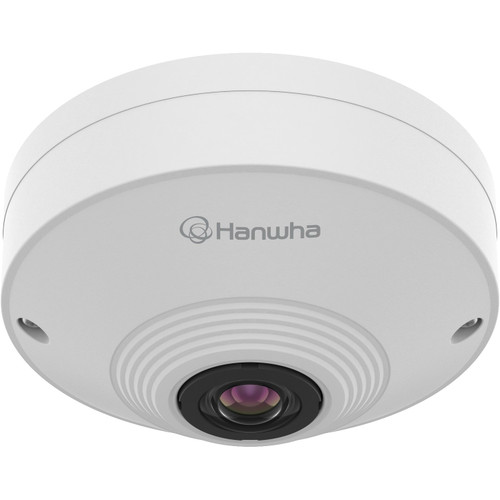
The QNF-9010 uses a 1/2.3-inch 12MP CMOS sensor with a 1.08mm fixed focal length lens at F2.2 and delivers a native 3008×3008 resolution at up to 30fps. Its angular field of view is 187° horizontal, vertical, and diagonal—slightly beyond a true hemisphere. Minimum illumination is specified at 0.39 lux (color). Wide dynamic range is rated at a quantified 120dB, and digital noise reduction is handled by Hanwha's SSNR V engine. The QNF-9010 includes real-time dewarping and supports CVBS analog video output (720×480/576) for installation alignment.
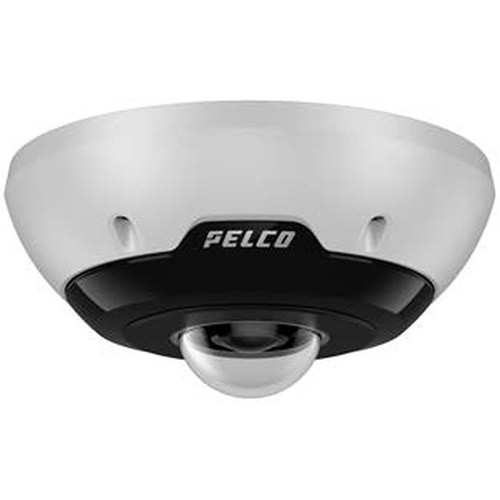
The SRXF3-12360-ERS uses a 2.7mm f/2.5 lens and delivers a maximum resolution of 3840×2160 (also listed as 3520×1920 in a secondary spec field), with a full-resolution frame rate of 12.5fps—less than half the QNF-9010's 30fps. Its field of view supports both 180° and 360° modes. The Pelco includes integrated IR illumination (850nm) for active night performance, while the QNF-9010 specifies an electrical day/night mode with no active IR emitter. WDR is listed for the Pelco but no dB value is provided in the available specs; the QNF-9010 specifies 120dB explicitly. Minimum illumination for the Pelco is not stated in the provided specifications.
What about installation and environment?
The QNF-9010 is rated IP42—dust and drip-resistant—and is explicitly designated as an indoor camera. Its operating temperature range is -10°C to +40°C. Power is supplied via PoE IEEE 802.3af (Class 3), with a maximum draw of 7.7W. Physical dimensions are Ø99×49mm at 370g (0.82 lb). Mounting options specified include wall and ceiling. The unit is finished in RAL9003 white plastic.
The SRXF3-12360-ERS is rated IP66 and NEMA 4X (weatherproof, corrosion-resistant) with an IK10 impact rating, making it suitable for outdoor and exposed environments. Its operating temperature range is -40°C to +60°C, providing far broader thermal coverage than the QNF-9010. Power requires PoE+ (IEEE 802.3at), which demands a compatible PoE+ switch or injector. Dimensions are 153.5×153.5×71.3mm and weight (with wall mount) is approximately 1.001kg (2.21 lb). Mount types listed include wall, ceiling, pole, pendant, and corner.
Which fits your VMS and analytics better?
The QNF-9010 supports ONVIF Profile S, G, and T, and also exposes Hanwha's SUNAPI (HTTP API) and the Wisenet open platform. On-board analytics include people counting, heatmap generation, defocus detection, motion detection (4 polygonal zones), and tampering detection. Privacy masking supports 6 rectangular zones. Smart codec is WiseStream II with manual 5-area control. Edge storage supports Micro SD/SDHC/SDXC up to 256GB in a single slot. The camera has 2048MB RAM and 256MB flash. No microphone or audio input is specified.
The SRXF3-12360-ERS supports ONVIF Profile S and Profile T. Analytics are described as 'Pelco Smart Analytics' covering 8 behaviors, but specific behavior names are not detailed in the provided specifications. Video compression is listed as H.264 (the secondary spec field also notes H.265, but the primary spec states H.264 only—buyers should verify with Pelco). The Pelco carries 4GB RAM and 4GB flash. Microphone support is noted. Edge storage (microSD) is listed as supported, though capacity is not specified. Audio input/output capability beyond microphone support is not detailed in the provided specs.
Which should you choose: the QNF-9010 or the SRXF3-12360-ERS?
Our take: The QNF-9010 is the stronger choice when the installation is indoors, frame rate is critical, and a quantified WDR spec matters. It delivers 30fps versus the SRXF3-12360-ERS's 12.5fps—a 2.4× advantage at full resolution—and its WDR is rated at a documented 120dB while the Pelco's WDR value is unspecified. The QNF-9010 also supports ONVIF Profile G, which the Pelco does not list, enabling direct NVR recording via ONVIF. Conversely, the SRXF3-12360-ERS is the only option here rated for outdoor deployment: its IP66/NEMA 4X enclosure, IK10 impact resistance, and -40°C to +60°C operating range make it suitable for perimeter and exterior locations where the IP42-rated, 0°C-floor QNF-9010 cannot be installed. The Pelco also includes integrated IR illumination, which the QNF-9010 lacks. Platform qualifier: if your VMS leverages Hanwha's SUNAPI or Wisenet SDK, the QNF-9010 integrates more deeply; Pelco's analytics ecosystem is required for the SRXF3-12360-ERS's full behavioral analytics capability.
Side-by-Side Comparison
Spec-for-spec, from manufacturer data.
| Specification | Hanwha QNF-9010 | Pelco SRXF3-12360-ERS |
|---|---|---|
| Resolution | 12MP (3008×3008) | 12MP (3840×2160 / 3520×1920) |
| Image Sensor | 1/2.3" 12MP CMOS | Not specified |
| Lens / Focal Length | 1.08mm fixed, F2.2 | 2.7mm fixed, F2.5 |
| Field of View | H/V/D: 187° | 180° / 360° (selectable) |
| Max Frame Rate | 30fps @ full resolution | 12.5fps @ full resolution |
| Min Illumination | 0.39 lux (color, F2.2) | Not specified |
| IR Illumination | None (electrical D/N only) | Integrated IR, 850nm |
| Wide Dynamic Range | 120dB (quantified) | WDR (dB value not specified) |
| Video Compression | H.265 / H.264 / MJPEG | H.264 (H.265 noted in secondary spec) |
| IP Rating | IP42 | IP66, NEMA 4X |
| IK / Impact Rating | — | IK10 |
| Operating Temperature | -10°C to +40°C | -40°C to +60°C |
| Power Input / PoE Class | PoE 802.3af, Class 3, max 7.7W | PoE+ 802.3at, Class 3 |
| ONVIF Compliance | Profile S / G / T | Profile S / T |
| Edge Storage | Micro SD/SDHC/SDXC up to 256GB | microSD (capacity not specified) |
| Audio | Not specified | Microphone supported |
| RAM / Flash | 2048MB RAM / 256MB Flash | 4GB RAM / 4GB Flash |
| Dimensions | Ø99×49mm | 153.5×153.5×71.3mm |
| Weight | 370g (0.82 lb) | ~1.001kg (2.21 lb) with wall mount |
| Environment | Indoor only | Indoor / Outdoor |
| Warranty | 3-year | 5-year |
Frequently Asked Questions
Which should you choose: the QNF-9010 or the SRXF3-12360-ERS?
The QNF-9010 is the stronger choice when the installation is indoors, frame rate is critical, and a quantified WDR spec matters. It delivers 30fps versus the SRXF3-12360-ERS's 12.5fps—a 2.4× advantage at full resolution—and its WDR is rated at a documented 120dB while the Pelco's WDR value is unspecified. The QNF-9010 also supports ONVIF Profile G, which the Pelco does not list, enabling direct NVR recording via ONVIF. Conversely, the SRXF3-12360-ERS is the only option here rated for outdoor deployment: its IP66/NEMA 4X enclosure, IK10 impact resistance, and -40°C to +60°C operating range make it suitable for perimeter and exterior locations where the IP42-rated, 0°C-floor QNF-9010 cannot be installed. The Pelco also includes integrated IR illumination, which the QNF-9010 lacks. Platform qualifier: if your VMS leverages Hanwha's SUNAPI or Wisenet SDK, the QNF-9010 integrates more deeply; Pelco's analytics ecosystem is required for the SRXF3-12360-ERS's full behavioral analytics capability.
Is the QNF-9010 or SRXF3-12360-ERS better for low-light performance?
Based on the provided specifications, the SRXF3-12360-ERS has an advantage in low-light scenarios because it includes integrated IR illumination (850nm) for active night operation. The QNF-9010 relies on electrical day/night switching with a minimum illumination of 0.39 lux but has no active IR emitter. Minimum illumination for the Pelco is not stated in the available specs, so a direct lux comparison cannot be made.
Can either camera be used outdoors?
Only the SRXF3-12360-ERS is rated for outdoor use. It carries an IP66/NEMA 4X weatherproof rating, IK10 impact resistance, and operates from -40°C to +60°C. The QNF-9010 is rated IP42 (indoor, drip-resistant only) with an operating range of -10°C to +40°C and is explicitly designated as an indoor camera.
Which camera requires less from the network switch—standard PoE or PoE+?
The QNF-9010 runs on standard PoE (IEEE 802.3af, Class 3) with a maximum draw of 7.7W, so any 802.3af-capable switch port is sufficient. The SRXF3-12360-ERS requires PoE+ (IEEE 802.3at), which delivers up to 30W and demands a PoE+-capable switch or injector—a factor that may affect infrastructure cost and compatibility in existing deployments.
Get a Second Opinion on Your Camera Choice
Share your site layout, coverage goals, and budget. Our team will validate the camera selection, flag anything we would change, and recommend products that match the use case.