
Hanwha QND-6012R1 vs i-PRO X35302-F2LM: Specification Comparison
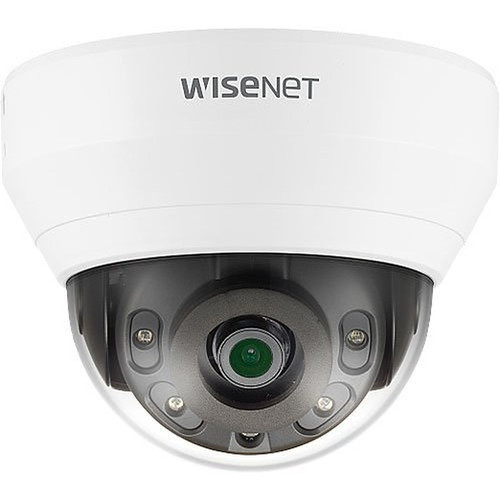
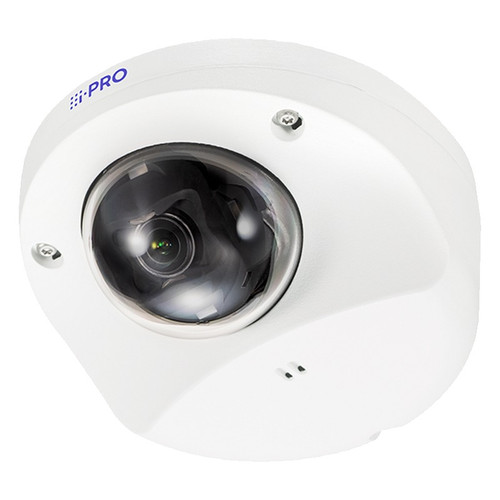
Both the Hanwha QND-6012R1 and the i-PRO WV-X35302-F2LM are 2MP fixed-lens IP dome cameras aimed at the commercial security market. The Hanwha is an indoor-rated unit with a 2.8mm lens and 120dB WDR, while the i-PRO is an outdoor-hardened model carrying IP66/NEMA 4X/IK10 ratings, 144dB Super Dynamic WDR, and onboard AI analytics. Buyers choosing between them are typically weighing indoor cost-efficiency against outdoor durability and advanced AI capabilities.
In This Guide
How do the imaging specs compare?
Both cameras use a 1/2.8-inch 2MP CMOS sensor. The Hanwha QND-6012R1 delivers 1920×1080 resolution at a fixed 30fps and achieves minimum illumination of 0.03 lux (color) / 0 lux (IR), with IR coverage rated at 20m. Its 2.8mm fixed lens produces a horizontal field of view of 113.7° and a max aperture of F2.0. WDR is specified at 120dB via Hanwha's SSDR processing. The i-PRO WV-X35302-F2LM resolves at 2048×1536 (3MP pixel array, though marketed as 2MP class) with a variable frame rate, achieving 0.02 lux (color) / 0 lux (B&W with IR) minimum illumination and IR coverage of 21m at 30 IRE. Its 2.4mm lens delivers a wider 132° horizontal field of view with an F2.1 aperture. WDR is rated at 144dB maximum via Super Dynamic processing at level 31.
The i-PRO holds measurable advantages in low-light sensitivity (0.02 lux vs 0.03 lux color), WDR headroom (144dB vs 120dB), and slightly greater IR reach (21m vs 20m). The Hanwha's 2.8mm lens offers a marginally narrower but still wide 113.7° H-FOV, while the i-PRO's 2.4mm lens reaches 132° H—useful for corner or wide-area coverage. The Hanwha includes CVBS analog video output for installation alignment; the i-PRO spec does not list one. The Hanwha's fixed 30fps is explicitly stated; the i-PRO lists frame rate as variable with no maximum fps figure provided in the supplied specs.
What about installation and environment?
The Hanwha QND-6012R1 is rated for indoor use only, with no IP ingress protection or IK impact rating listed. Its operating temperature range is -10°C to +55°C. It is constructed of white plastic and weighs 255g. Mounting articulation covers 0°–350° pan, 0°–67° tilt, and 0°–355° rotation. Power is via PoE IEEE 802.3af Class 3 or 12VDC, with a maximum draw of 7.4W. The i-PRO WV-X35302-F2LM is outdoor-rated to IP66 (IEC 60529), NEMA 4X (UL50E), and IK10 (IEC 62262) vandal resistance, with wind resistance up to 40 m/s (approx. 89 mph). It operates from -40°C to +60°C (power-on at -20°C), making it suitable for harsh environments. It also carries EN50155/IEC61373 railway/vehicle application certifications. Power is PoE Class 0, with a maximum draw of 8.6W. It uses an M12 network connector rather than a standard RJ-45, which may require an adapter or specific cabling in some deployments. The i-PRO body is aluminum die-cast and PC resin, weighing approximately 475g. Pan/tilt/yaw adjustment is ±45°/0–90°/±90°.
Which fits your VMS and analytics better?
Both cameras support ONVIF Profiles S, G, and T. The i-PRO additionally supports ONVIF Profile M, which covers metadata and analytics interoperability—relevant when integrating AI event streams into a VMS. The Hanwha supports SUNAPI (HTTP API) and the Wisenet open platform in addition to ONVIF. The i-PRO supports up to 14 simultaneous streams; the Hanwha supports up to 6 unicast users with up to 3 simultaneous profiles. Both support H.265 and H.264 with CBR/VBR bitrate control and smart coding (Hanwha WiseStream II; i-PRO GOP control). Only the i-PRO lists audio compression support (G.726 ADPCM, G.711) and audio detection including AI Sound Classification (gunshot, yell, vehicle horn, glass break); the Hanwha spec lists no audio input or output. For edge analytics, the Hanwha provides defocus detection, directional detection, virtual line, enter/exit, and tampering. The i-PRO adds AI-based Face, People, and Vehicle Detection, Scene Change Detection, and VIQS (variable image quality on specified zones), along with FIPS 140-2 Level 3 cybersecurity certification—relevant for government or high-compliance deployments. Both support microSD/SDHC/SDXC edge storage up to 512GB (i-PRO) and 128GB (Hanwha). The i-PRO also supports SFTP and MQTT in addition to standard protocols.
Which should you choose: the QND-6012R1 or the X35302-F2LM?
Our take: The QND-6012R1 is the stronger choice when deploying indoors on a tight budget where AI analytics and outdoor hardening are not required. At 7.4W PoE Class 3 draw, it fits standard PoE switches without negotiation concerns, and its 113.7° FOV with 120dB WDR covers typical retail or office environments effectively. However, the WV-X35302-F2LM holds decisive advantages for any outdoor or high-security application: its IP66/NEMA 4X/IK10 enclosure survives weather and vandalism that would end the Hanwha's unrated plastic housing, its operating range extends to -40°C vs -10°C, and its 144dB Super Dynamic WDR outperforms the Hanwha's 120dB in high-contrast lighting. The i-PRO's onboard AI—Face, People, and Vehicle Detection plus AI Sound Classification—eliminates the need for server-side analytics licenses in many VMS deployments. Choose the Hanwha for cost-driven indoor rollouts on Wisenet or ONVIF VMSs; choose the i-PRO where outdoor durability, FIPS-grade cybersecurity, or edge AI metadata are operational requirements.
Side-by-Side Comparison
Spec-for-spec, from manufacturer data.
| Specification | Hanwha QND-6012R1 | i-PRO X35302-F2LM |
|---|---|---|
| Resolution | 1920×1080 | 2048×1536 |
| Image Sensor | 1/2.8" 2MP CMOS | Approx. 1/2.8" CMOS (5.57×3.13mm scan area) |
| Lens / Focal Length | 2.8mm fixed | 2.4mm fixed |
| Max Aperture | F2.0 | F2.1 |
| Horizontal Field of View | 113.7° | 132° (16:9) |
| Min. Illumination (Color / IR) | 0.03 lux / 0 lux | 0.02 lux / 0 lux |
| IR Range | 20m (65.6ft) | 21m (30 IRE) / 15m (50 IRE) |
| Wide Dynamic Range | 120dB (SSDR) | 144dB max (Super Dynamic level 31) |
| Max Frame Rate | 30fps | Variable (max fps not specified) |
| Video Compression | H.265, H.264, MJPEG | H.265, H.264, JPEG |
| Audio | — (none specified) | G.726 / G.711; AI Sound Classification |
| IP / Ingress Rating | — (indoor only) | IP66, NEMA 4X |
| IK / Impact Rating | — | IK10 (IEC 62262) |
| Operating Temperature | -10°C to +55°C | -40°C to +60°C (power-on at -20°C) |
| Power Input / PoE Class | PoE 802.3af Class 3 / 12VDC; 7.4W max | PoE Class 0; 8.6W max |
| Network Connector | RJ-45 (10/100BASE-T) | M12 (10BASE-T/100BASE-TX) |
| ONVIF Profiles | S, G, T | G, M, S, T |
| Edge AI Analytics | Rule-based (directional, virtual line, enter/exit, defocus, tampering) | AI: Face, People, Vehicle Detection; Sound Classification |
| Edge Storage | microSD/SDHC/SDXC up to 128GB | microSD/SDHC/SDXC up to 512GB |
| Cybersecurity Certification | — | FIPS 140-2 Level 3 |
| Dimensions | Ø110.0×86.0mm (Ø4.33×3.39") | 109×53×119mm (4.27"×2.09"×4.69") |
| Weight | 255g (0.56 lb) | 475g (1.05 lb) |
| Environment Rating | Indoor | Outdoor |
| Warranty | 3 years | 5 years |
Frequently Asked Questions
Which should you choose: the QND-6012R1 or the X35302-F2LM?
The QND-6012R1 is the stronger choice when deploying indoors on a tight budget where AI analytics and outdoor hardening are not required. At 7.4W PoE Class 3 draw, it fits standard PoE switches without negotiation concerns, and its 113.7° FOV with 120dB WDR covers typical retail or office environments effectively. However, the WV-X35302-F2LM holds decisive advantages for any outdoor or high-security application: its IP66/NEMA 4X/IK10 enclosure survives weather and vandalism that would end the Hanwha's unrated plastic housing, its operating range extends to -40°C vs -10°C, and its 144dB Super Dynamic WDR outperforms the Hanwha's 120dB in high-contrast lighting. The i-PRO's onboard AI—Face, People, and Vehicle Detection plus AI Sound Classification—eliminates the need for server-side analytics licenses in many VMS deployments. Choose the Hanwha for cost-driven indoor rollouts on Wisenet or ONVIF VMSs; choose the i-PRO where outdoor durability, FIPS-grade cybersecurity, or edge AI metadata are operational requirements.
Is the QND-6012R1 or WV-X35302-F2LM better for low-light performance?
The i-PRO WV-X35302-F2LM has a slight edge in low-light color sensitivity at 0.02 lux versus the Hanwha's 0.03 lux, and its IR reach is marginally greater at 21m (30 IRE) compared to the Hanwha's 20m. Both cameras reach 0 lux in IR (black-and-white) mode. The i-PRO also specifies a wider 144dB Super Dynamic WDR range versus the Hanwha's 120dB, which helps in mixed high-contrast lighting conditions.
Can the QND-6012R1 be used outdoors?
No. The Hanwha QND-6012R1 is specified as an indoor camera with no IP ingress protection rating or IK impact rating listed in its specs. It should not be deployed outdoors or in wet, dusty, or high-humidity environments. The i-PRO WV-X35302-F2LM carries IP66, NEMA 4X, and IK10 ratings and is rated for outdoor use down to -40°C.
Do both cameras support AI analytics on the edge?
The i-PRO WV-X35302-F2LM includes onboard AI analytics for Face, People, and Vehicle Detection, plus AI Sound Classification (gunshot, yell, vehicle horn, glass break) and Scene Change Detection. The Hanwha QND-6012R1 provides rule-based analytics including directional detection, virtual line, enter/exit, defocus detection, and tampering, but does not list AI-based object classification in the supplied specifications.
Get a Second Opinion on Your Camera Choice
Share your site layout, coverage goals, and budget. Our team will validate the camera selection, flag anything we would change, and recommend products that match the use case.