
Hanwha QND-6012R1 vs i-PRO X25300-V3LN: Specification Comparison
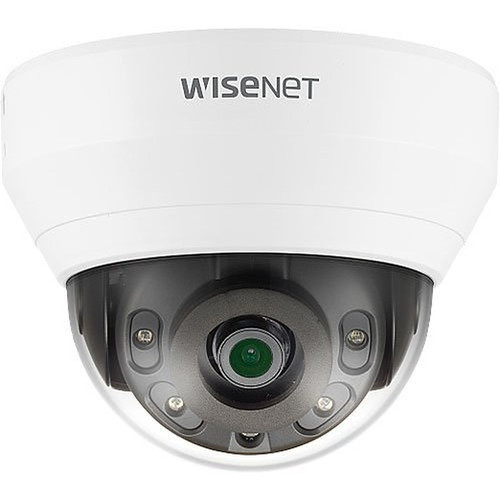
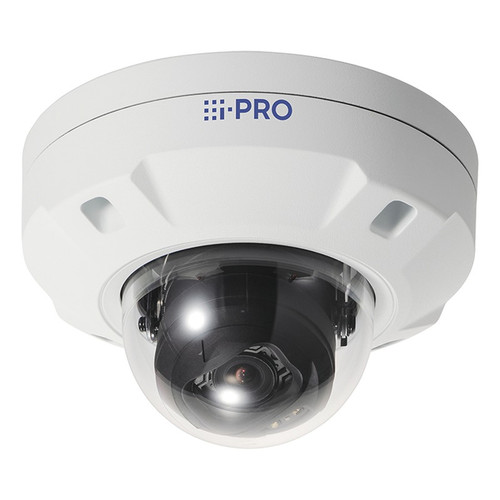
Both the Hanwha QND-6012R1 and the i-PRO WV-X25300-V3LN are 2MP (1920×1080) IP dome cameras aimed at networked surveillance deployments. The Hanwha is a fixed-lens indoor unit; the i-PRO is a motorized-zoom outdoor unit. Despite the dome form factor and identical resolution, they serve meaningfully different environments and use cases — the QND-6012R1 targets interior installations where cost and compactness matter, while the X25300-V3LN targets demanding outdoor sites requiring variable focal length, AI analytics, and all-weather hardening. This comparison examines how their specs line up across imaging, installation, and integration dimensions.
In This Guide
How do the imaging specs compare?
Both cameras share a 1/2.8-inch 2MP CMOS sensor delivering 1920×1080 at 30fps. Low-light performance diverges sharply: the i-PRO X25300-V3LN reaches 0.005 lux (B&W, F1.5, 1/30s), versus the Hanwha QND-6012R1 at 0.03 lux color / 0 lux in IR mode. The i-PRO also extends IR illumination to 70m (230ft), more than triple the Hanwha's 20m (65.6ft) — a decisive difference for long-corridor or perimeter applications. Dynamic range likewise favors the i-PRO at a specified maximum of 144dB (Super Dynamic on, level 31), compared to the Hanwha's 120dB WDR.
Lens architecture sets the cameras further apart. The QND-6012R1 uses a fixed 2.8mm lens (F2.0, 113.7° H-FOV), suited to wide-area coverage in confined spaces. The X25300-V3LN offers 3.1x motorized zoom over a 2.9–9mm range (F1.3 wide to F2.5 tele), yielding a 36–113° horizontal field of view. At tele end, its DORI Detect range reaches 118.2m (387.7ft) versus the Hanwha's 25.1m (82.2ft) at fixed wide. The i-PRO also incorporates a built-in gyro-based image stabilizer (30fps mode) and fog compensation; neither feature is listed in the Hanwha spec sheet.
What about installation and environment?
The Hanwha QND-6012R1 is rated for indoor use only — no IP ingress protection rating is listed in the provided specifications. It operates from -10°C to +55°C and is powered by PoE IEEE 802.3af (Class 3) or 12VDC at a maximum of 7.4W. Its compact plastic housing measures Ø110×86mm and weighs 255g (0.56 lb), making it straightforward to install on standard indoor junction boxes. Pan/tilt/rotate adjustment ranges are 0–350° / 0–67° / 0–355°.
The i-PRO X25300-V3LN is built for outdoor deployment, carrying IP66/IP67 (IEC 60529), Type 4X (UL50E), and NEMA 4X ratings, plus IK10 impact resistance (IEC 62262) and 50J shock compliance (IEC 60068-2-75). It is wind-rated to 40m/s (~89mph). Operating temperature spans -40°C to +55°C (power-on from -30°C), and it accepts PoE+ (up to 14W, PoE Class 4) or DC12V 1.2A. Its aluminum/stainless steel/PC-resin housing is considerably heavier at 1.1kg (2.43 lb) and larger at Ø154×105mm. The mounting adjustment range is -194° to +166° pan, -30° to +85° tilt, ±100° yaw.
Which fits your VMS and analytics better?
Both cameras support ONVIF Profile S/G/T and H.265/H.264/MJPEG compression, making them broadly VMS-compatible. The Hanwha adds SUNAPI (HTTP API) and the Wisenet open platform, along with WiseStream II smart codec for bandwidth optimization. Edge analytics on the QND-6012R1 cover defocus detection, directional detection, motion detection, enter/exit, tampering, and virtual line — solid for interior intrusion detection. It supports up to 128GB via microSD (1 slot), has 1 alarm input and 1 output, and does not list audio input/output in the provided specs.
The i-PRO X25300-V3LN adds ONVIF Profile M and an Ambarella CV52 SoC enabling on-camera AI analytics: motion detection, face detection, people detection, vehicle detection, and AI sound classification (gunshot, yell, vehicle horn, glass break). It supports up to 14 simultaneous users versus the Hanwha's 6, and expands edge storage to 512GB microSDXC. Audio is fully bidirectional — 3.5mm stereo mic input and mono line output, with G.726, G.711, and AAC-LC compression. Alarm I/O is 2-in/2-out. Security posture is strengthened by FIPS 140-2 Level 3 certification, SFTP/SRTP/MQTT protocol support, signed firmware, and secure boot — none of which appear in the Hanwha spec sheet.
Which should you choose: the QND-6012R1 or the X25300-V3LN?
Our take: The QND-6012R1 is the stronger choice when the deployment is strictly indoors, the budget is constrained, and a wide fixed field of view (113.7°) at low power (7.4W, PoE Class 3) is sufficient. For outdoor, perimeter, or high-security applications, the X25300-V3LN is the specification-driven choice: its IR range is 3.5× longer (70m vs 20m), its dynamic range is 24dB wider (144dB vs 120dB), and its minimum illumination is 6× lower (0.005 lux vs 0.03 lux color). The i-PRO's IP66/IP67/IK10 outdoor hardening, -40°C cold-start rating, and FIPS 140-2 Level 3 certification have no equivalent in the Hanwha's spec sheet. Choose the QND-6012R1 for cost-efficient indoor coverage on a Wisenet VMS; choose the X25300-V3LN where outdoor resilience, motorized zoom, and on-camera AI classification are required.
Side-by-Side Comparison
Spec-for-spec, from manufacturer data.
| Specification | Hanwha QND-6012R1 | i-PRO X25300-V3LN |
|---|---|---|
| Resolution | 1920×1080 | 1920×1080 |
| Image Sensor | 1/2.8" 2MP CMOS | Approx. 1/2.8" CMOS |
| Lens / Focal Length | 2.8mm fixed, F2.0 | 2.9–9mm motorized zoom (3.1×), F1.3–F2.5 |
| Horizontal Field of View | 113.7° | 36°–113° (wide to tele) |
| Min. Illumination | 0.03 lux color / 0 lux IR | 0.005 lux (B&W, F1.5, 1/30s) |
| IR Range | 20m (65.6ft) | 70m (230ft) |
| Wide Dynamic Range | 120dB | 144dB (Super Dynamic, level 31) |
| Max Frame Rate | 30fps | 30fps |
| Video Compression | H.265, H.264, MJPEG | H.265, H.264, MJPEG |
| IP Rating | — (not listed; indoor only) | IP66 / IP67, NEMA 4X |
| IK / Impact Rating | — | IK10 (IEC 62262), 50J shock |
| Operating Temperature | -10°C to +55°C | -40°C to +55°C (power-on: -30°C) |
| Power Input / PoE Class | PoE 802.3af Class 3; 12VDC (max 7.4W) | PoE+ up to 14W Class 4; DC12V 1.2A |
| Edge Storage | microSD/SDHC/SDXC up to 128GB | microSDXC up to 512GB |
| Audio | — | 3.5mm stereo mic in / mono out; G.726, G.711, AAC-LC |
| Alarm I/O | 1 in / 1 out | 2 in / 2 out |
| ONVIF Profiles | S, G, T | G, S, T, M |
| AI / Edge Analytics | Motion, virtual line, enter/exit, directional, defocus, tampering | AI motion, face, people, vehicle detection; AI sound classification (gunshot, yell, horn, glass break); VMD; SCD |
| Security Certifications | — | FIPS 140-2 Level 3, UL 62368-1, c-UL, CE |
| Dimensions | Ø110×86mm (Ø4.33×3.39") | Ø154×105mm (Ø6-1/16×4-1/8") |
| Weight | 255g (0.56 lb) | 1.1kg (2.43 lb) |
| Environment | Indoor | Outdoor (IP66/67, IK10, wind-rated) |
| Warranty | 3 years | 5 years |
Frequently Asked Questions
Which should you choose: the QND-6012R1 or the X25300-V3LN?
The QND-6012R1 is the stronger choice when the deployment is strictly indoors, the budget is constrained, and a wide fixed field of view (113.7°) at low power (7.4W, PoE Class 3) is sufficient. For outdoor, perimeter, or high-security applications, the X25300-V3LN is the specification-driven choice: its IR range is 3.5× longer (70m vs 20m), its dynamic range is 24dB wider (144dB vs 120dB), and its minimum illumination is 6× lower (0.005 lux vs 0.03 lux color). The i-PRO's IP66/IP67/IK10 outdoor hardening, -40°C cold-start rating, and FIPS 140-2 Level 3 certification have no equivalent in the Hanwha's spec sheet. Choose the QND-6012R1 for cost-efficient indoor coverage on a Wisenet VMS; choose the X25300-V3LN where outdoor resilience, motorized zoom, and on-camera AI classification are required.
Is the QND-6012R1 or X25300-V3LN better for low-light performance?
Based on published specs, the i-PRO X25300-V3LN has a significant low-light advantage: its minimum illumination is 0.005 lux (B&W, F1.5, 1/30s) versus the Hanwha QND-6012R1's 0.03 lux in color mode. In IR mode the Hanwha reaches 0 lux, but its IR illumination extends only 20m compared to the X25300-V3LN's 70m — meaning the i-PRO can reveal subjects in darkness at more than three times the distance.
Can the QND-6012R1 be installed outdoors?
No — based on the provided specifications, the Hanwha QND-6012R1 carries no IP ingress protection rating and is listed as an indoor camera. The i-PRO X25300-V3LN, by contrast, is rated IP66/IP67, NEMA 4X, and IK10, and is designed and warranted for outdoor use including temperatures down to -40°C and wind speeds up to 40m/s.
Which camera offers better analytics and AI features?
The i-PRO X25300-V3LN provides deeper AI analytics, including face detection, people detection, vehicle detection, AI sound classification (gunshot, yell, vehicle horn, glass break), and scene change detection, powered by an Ambarella CV52 SoC. The Hanwha QND-6012R1 supports motion detection, virtual line, enter/exit, directional detection, defocus detection, and tampering — capable for interior intrusion use cases, but lacking the person/vehicle/face classification and audio AI of the i-PRO.
Get a Second Opinion on Your Camera Choice
Share your site layout, coverage goals, and budget. Our team will validate the camera selection, flag anything we would change, and recommend products that match the use case.