
Hanwha QND-6012R1 vs i-PRO S35302-F2L1: Specification Comparison
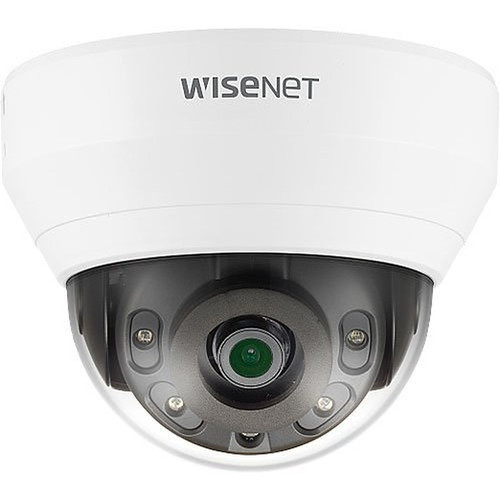
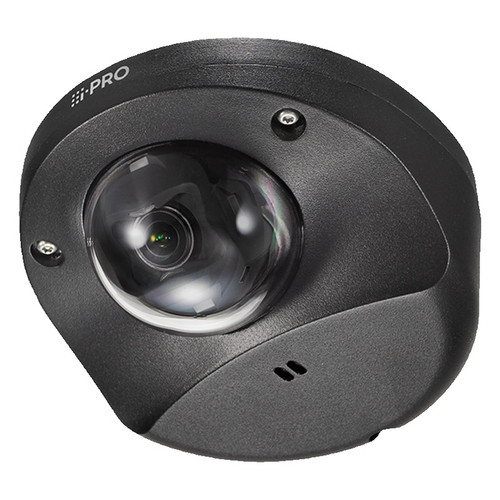
Both the Hanwha QND-6012R1 and the i-PRO WV-S35302-F2L1 are 2MP fixed-lens IP dome cameras aimed at professional surveillance installations. The Hanwha is an indoor-rated unit with a 2.8mm fixed lens and Wisenet analytics, while the i-PRO is an outdoor-hardened model with an Ambarella CV25M SoC, 144dB Super Dynamic WDR, and on-camera AI classification for faces, people, vehicles, and sound events. Installers and IT buyers evaluating these two will primarily be weighing indoor simplicity and cost against outdoor ruggedization and deeper AI analytics capability.
In This Guide
How do the imaging specs compare?
Both cameras use an approximately 1/2.8-inch 2MP CMOS sensor. The Hanwha QND-6012R1 delivers 1920×1080 resolution at a fixed 30fps, with a 2.8mm fixed lens providing a 113.7° horizontal field of view and a maximum aperture of F2.0. Minimum illumination is 0.03 Lux in color mode and 0 Lux with IR active; its IR LEDs reach 20m (65.62ft). WDR is specified at 120dB using Hanwha's SSDR processing. The i-PRO WV-S35302-F2L1 outputs at 2048×1536 resolution with a variable frame rate, using a 2.4mm fixed lens with a wider 132° horizontal field of view and an aperture of F2.1. Minimum illumination is 0.02 Lux in color and 0 Lux in B/W IR mode; its IR range is 21m (30IRE) or 15m (50IRE). The i-PRO's Super Dynamic WDR is specified at 144dB maximum (at level 31), a 24dB advantage over the Hanwha on paper.
On DORI performance, the Hanwha QND-6012R1 achieves Detect at 25.1m, Observe at 10.0m, Recognize at 5.0m, and Identify at 2.5m. The i-PRO WV-S35302-F2L1 scores lower on all four: Detect 17.1m, Observe 6.8m, Recognize 3.4m, Identify 1.7m — a result of its wider FOV compressing pixel density per meter. The Hanwha also offers digital noise reduction (SSNR), BLC/WDR/SSDR backlight modes, and LDC lens distortion correction. The i-PRO adds Adaptive Black Stretch (0–255 range), HLC, Fog Compensation (0–8), and adjustable AGC (0–11), giving it more granular tuning controls for challenging lighting conditions.
What about installation and environment?
The Hanwha QND-6012R1 is rated for indoor use only, with an operating range of -10°C to +55°C and humidity up to 90% RH non-condensing. It carries no IP or IK rating per the provided specifications. Its compact dome measures Ø110.0×86.0mm and weighs 255g (0.56 lb). Power is via PoE IEEE 802.3af Class 3 or 12VDC, drawing a maximum of 7.4W. Mounting flexibility includes pan 0°–350°, tilt 0°–67°, and rotation 0°–355°.
The i-PRO WV-S35302-F2L1 is designed for outdoor deployment, rated IP66 (IEC 60529), NEMA 4X (UL50E), and IK10 (IEC 62262) for impact resistance up to 20 joules. Its operating temperature range extends from -40°C to +50°C (with PoE powering from -20°C to +50°C), and it is rated for 10%–100% humidity. Wind resistance is specified up to 40 m/s (~89 mph). The enclosure is aluminum die-cast with a tamper-resistant design. Dimensions are 109×53×119mm and weight is approximately 475g (1.05 lb). It also draws more power at a maximum of 8.6W over PoE, and its PoE class is listed as Class 0 in the provided specifications, versus Class 3 for the Hanwha.
Which fits your VMS and analytics better?
Both cameras support ONVIF Profiles G, M, S, and T, providing broad VMS compatibility. The Hanwha QND-6012R1 additionally exposes SUNAPI (HTTP API) and the Wisenet open platform for deeper integration with Hanwha ecosystem tools. It supports up to 6 simultaneous unicast users and up to 3 simultaneous stream profiles. Edge analytics include defocus detection, directional detection, motion detection (4 polygonal zones), enter/exit, tampering, and virtual line crossing. Privacy masking supports 6 rectangular zones. On-board storage is microSD/SDHC/SDXC up to 128GB. No audio input or output is specified in the provided data.
The i-PRO WV-S35302-F2L1 supports up to 14 simultaneous users and adds an Ambarella CV25M SoC enabling on-camera AI Video Motion Detection, Face Detection, People Detection, and Vehicle Detection, plus AI Sound Classification (gunshot, yell, vehicle horn, glass break) via its built-in microphone. Audio compression includes G.726 (32/16 kbps) and G.711 (64 kbps). Edge storage supports microSD up to 512GB — four times the Hanwha's ceiling. Scene Change Detection (SCD) and VIQS (variable image quality on specified zones, up to 8) are also available. Security credentials include FIPS 140-2 Level 3 compliance and signed firmware, which the Hanwha spec does not cite.
Which should you choose: the QND-6012R1 or the S35302-F2L1?
Our take: The WV-S35302-F2L1 is the stronger choice when the deployment site is outdoors, subject to weather, vandalism, or environments requiring AI-class analytics. The i-PRO carries IP66/NEMA 4X/IK10 ratings that the Hanwha QND-6012R1 entirely lacks, making direct outdoor comparison moot for that camera. On imaging, the i-PRO's Super Dynamic WDR reaches 144dB versus the Hanwha's 120dB — a 24dB margin that matters in high-contrast entranceways or parking lots. Its on-board microSD edge storage ceiling is 512GB versus the Hanwha's 128GB. Conversely, the QND-6012R1 posts stronger DORI figures (Detect: 25.1m vs 17.1m) due to its narrower FOV, draws less power (7.4W vs 8.6W), and is the correct choice for straightforward indoor dome deployments where Wisenet VMS integration, hallway view rotation, and a lighter enclosure are priorities. Warranty also differs: i-PRO specifies 5 years; Hanwha specifies 3 years.
Side-by-Side Comparison
Spec-for-spec, from manufacturer data.
| Specification | Hanwha QND-6012R1 | i-PRO S35302-F2L1 |
|---|---|---|
| Resolution | 1920×1080 | 2048×1536 |
| Image Sensor | 1/2.8" 2MP CMOS | Approx. 1/2.8" type CMOS (5.57×3.13mm) |
| Lens / Focal Length | 2.8mm fixed | 2.4mm fixed |
| Horizontal Field of View | 113.7° | 132° |
| Max Aperture | F2.0 | F2.1 |
| Min. Illumination (Color / IR) | 0.03 Lux / 0 Lux | 0.02 Lux / 0 Lux |
| IR Range | 20m (65.62ft) | 21m (30IRE) / 15m (50IRE) |
| Wide Dynamic Range | 120dB (SSDR) | 144dB max (Super Dynamic, level 31) |
| Max Frame Rate | 30fps | Variable (not specified as fixed max in provided specs) |
| Video Compression | H.265 / H.264 / MJPEG | H.265 / H.264 / JPEG |
| IP / Impact Rating | — (Indoor only) | IP66 / NEMA 4X / IK10 |
| Operating Temperature | -10°C to +55°C | -40°C to +50°C (PoE: -20°C to +50°C) |
| Power Input / PoE Class | PoE 802.3af Class 3 / 12VDC | PoE 802.3af Class 0 |
| Max Power Draw | 7.4W | 8.6W |
| Edge Storage | microSD up to 128GB | microSD up to 512GB |
| Audio | — (not specified) | Built-in mic; G.726 / G.711 compression |
| On-Camera AI Analytics | Rule-based (motion, enter/exit, virtual line, tampering, directional, defocus) | AI VMD, Face/People/Vehicle Detection, AI Sound Classification |
| ONVIF Profiles | G / M / S / T | G / M / S / T |
| Security Certifications | HTTPS, 802.1X (EAP-TLS, EAP-LEAP) | FIPS 140-2 Level 3, HTTPS, IEEE 802.1X; signed firmware |
| Dimensions | Ø110.0×86.0mm | 109×53×119mm |
| Weight | 255g (0.56 lb) | 475g (1.05 lb) |
| Warranty | 3 years | 5 years |
Frequently Asked Questions
Which should you choose: the QND-6012R1 or the S35302-F2L1?
The WV-S35302-F2L1 is the stronger choice when the deployment site is outdoors, subject to weather, vandalism, or environments requiring AI-class analytics. The i-PRO carries IP66/NEMA 4X/IK10 ratings that the Hanwha QND-6012R1 entirely lacks, making direct outdoor comparison moot for that camera. On imaging, the i-PRO's Super Dynamic WDR reaches 144dB versus the Hanwha's 120dB — a 24dB margin that matters in high-contrast entranceways or parking lots. Its on-board microSD edge storage ceiling is 512GB versus the Hanwha's 128GB. Conversely, the QND-6012R1 posts stronger DORI figures (Detect: 25.1m vs 17.1m) due to its narrower FOV, draws less power (7.4W vs 8.6W), and is the correct choice for straightforward indoor dome deployments where Wisenet VMS integration, hallway view rotation, and a lighter enclosure are priorities. Warranty also differs: i-PRO specifies 5 years; Hanwha specifies 3 years.
Is the QND-6012R1 or WV-S35302-F2L1 better for low-light performance?
Both reach 0 Lux in IR mode. In color (ambient light) mode, the i-PRO WV-S35302-F2L1 has a slight edge at 0.02 Lux versus the Hanwha QND-6012R1's 0.03 Lux. IR range is comparable: 21m for the i-PRO versus 20m for the Hanwha. The i-PRO also provides adjustable AGC (0–11 range) and Adaptive Black Stretch for finer low-light tuning, while both include automatic ICR day/night switching.
Can either camera be installed outdoors?
Only the i-PRO WV-S35302-F2L1 is rated for outdoor use, carrying IP66, NEMA 4X, and IK10 certifications with an operating range of -40°C to +50°C. The Hanwha QND-6012R1 carries no IP or IK rating per its published specifications and is explicitly classified as an indoor camera with an operating range of -10°C to +55°C. Installing the QND-6012R1 outdoors without an additional rated enclosure is not supported by its specifications.
Which camera has better on-board AI analytics?
The i-PRO WV-S35302-F2L1 has a significant advantage, running an Ambarella CV25M SoC that enables AI Video Motion Detection, Face Detection, People Detection, Vehicle Detection, and AI Sound Classification (gunshot, yell, vehicle horn, glass break) entirely on-camera. The Hanwha QND-6012R1 offers rule-based analytics — motion detection, directional detection, enter/exit, virtual line, defocus, and tampering — but does not specify a dedicated AI SoC or object-class classification in its published data.
Get a Second Opinion on Your Camera Choice
Share your site layout, coverage goals, and budget. Our team will validate the camera selection, flag anything we would change, and recommend products that match the use case.