
Hanwha PNM-12082RVD vs i-PRO X25700-V2LN: Specification Comparison
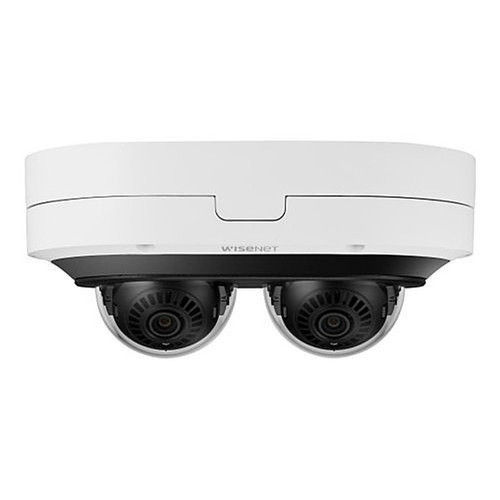
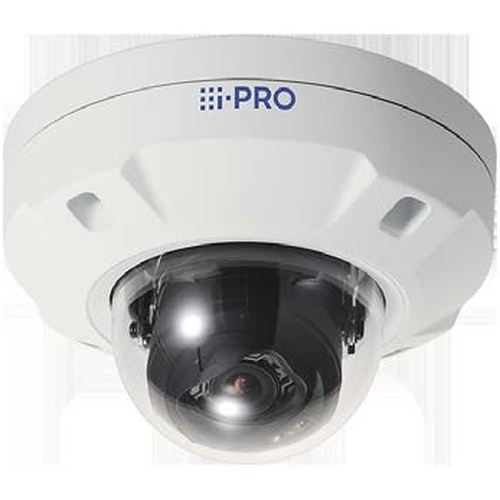
Both the Hanwha PNM-12082RVD and the i-PRO WV-X25700-V2LN are outdoor fixed dome IP cameras sharing a 6MP resolution class, PoE+ power, IK10 vandal resistance, and motorized varifocal lenses — a configuration pair that installers and IT buyers regularly cross-shop for perimeter and entrance coverage. The Hanwha is a dual-channel device delivering two simultaneous 6MP streams from one unit, while the i-PRO is a single-channel camera rated at 4K (3840×2160) with a larger image sensor, longer IR throw, and on-camera AI analytics. This comparison evaluates imaging performance, installation fit, and platform integration using published specifications only.
In This Guide
How do the imaging specs compare?
The Hanwha PNM-12082RVD outputs two independent 6MP (3328×1872) channels simultaneously from a 1/2.8" sensor, with a motorized varifocal lens spanning 3.54–6.69mm (1.9× optical zoom) and a maximum frame rate of 15 fps per channel at full resolution. Minimum illumination is rated at 0.16 lux color / 0.016 lux B/W, dropping to 0 lux with its 850nm IR active. IR throw is specified at 25m (82 ft). Wide dynamic range is rated at 120dB. The dual-channel architecture is the defining differentiator: one physical unit produces two network video streams, effectively doubling coverage density per cable drop.
The i-PRO WV-X25700-V2LN is a single-channel camera but with a significantly larger 1/1.8" CMOS sensor scanning 7.68×4.32mm, outputting 3840×2160 at 30 fps — double the frame rate of the Hanwha at comparable pixel counts. Minimum illumination is 0.03 lux (B/W, 50 IRE, F1.5, 1/30s), and its IR system reaches 70m (230 ft) — nearly three times the Hanwha's 25m. The Super Dynamic WDR is rated at up to 132dB at maximum level (Level 31), exceeding the Hanwha's 120dB. The i-PRO's motorized varifocal covers 4.3–8.6mm (2.0× optical zoom, extendable to 12× digital) with DORI distances specified: Detect to 157.5m and Identify to 15.7m at tele.
What about installation and environment?
Both cameras carry IP66/IP67, NEMA 4X, and IK10 ratings, making them equivalent for outdoor exposure to rain, dust, salt spray, and physical impact. The i-PRO additionally specifies 50J shock resistance per IEC 60068-2-75 and wind resistance up to 40 m/s (≈89 mph) — neither figure appears in the Hanwha's published specifications. The i-PRO's operating temperature range is notably wider: -40°C to +55°C versus the Hanwha's -10°C to +50°C, a meaningful delta for cold-climate deployments.
Both cameras are powered via PoE+ (802.3at, Class 4) over a single cable. The i-PRO also accepts DC 12V at 1.2A as an alternative supply; no DC input is listed for the Hanwha. The Hanwha offers ceiling, wall, and pendant mounting; the i-PRO specifies wall, pole, corner, and rack mounts. The Hanwha's housing is aluminum; the i-PRO combines aluminum, stainless steel, and PC resin. The i-PRO dimensions are ø154mm×105mm H (1.1 kg); Hanwha dimensions and weight are not provided in the supplied specifications.
Which fits your VMS and analytics better?
Both cameras support ONVIF. The Hanwha is certified for ONVIF Profile S and Profile T. The i-PRO supports ONVIF Profiles G, S, T, and M — Profile G adds on-camera recording management and Profile M adds metadata streaming for analytics interoperability, giving the i-PRO broader VMS compatibility out of the box. The i-PRO's supported protocol list is extensive: IPv4 TCP/UDP, HTTP/HTTPS, RTSP, RTP/RTCP, SMTP, DHCP, DNS, DDNS, NTP, SNMPv1/v2/v3, UPnP, IGMP, ICMP, ARP, IEEE 802.1X, DiffServ, SRTP, FTP, SFTP, LLDP, and MQTT. The Hanwha spec sheet does not enumerate its protocol stack beyond ONVIF S/T.
On-camera analytics differ substantially. The i-PRO specifies AI Motion Detection, Face Detection, Vehicle Detection, Scene Change Detection (1 zone), Video Motion Detection (4 zones), Privacy Zone masking (up to 8 zones), Audio Detection, and AI Sound Classification (gunshot, yell, vehicle horn, glass break). The Hanwha's analytics field is listed as empty in the provided specifications. Both cameras support microSD edge storage; the i-PRO's slot accepts cards up to 512GB (SDXC). The Hanwha lists 512MB onboard flash plus microSD backup; a maximum microSD capacity is not specified in the supplied data. The i-PRO provides a dedicated 3.5mm audio input and output jack plus 4× alarm I/O terminals. The Hanwha routes audio input via an optional external I/O box; no built-in audio jack or I/O terminals are listed. Cybersecurity features on the Hanwha include TPM 2.0 (FIPS 140-2), encrypted firmware, secure boot, and signed firmware; the i-PRO lists signed firmware and secure boot.
Which should you choose: the PNM-12082RVD or the X25700-V2LN?
Our take: The WV-X25700-V2LN is the stronger choice when IR throw, AI analytics, and cold-climate operation are the primary decision factors; the PNM-12082RVD is the stronger choice when coverage density per cable drop is the priority. On imaging: the i-PRO delivers 30 fps vs the Hanwha's 15 fps at comparable resolution, 70m IR vs 25m, 132dB WDR vs 120dB, and a larger 1/1.8" sensor vs 1/2.8". On environment: the i-PRO's -40°C floor vs the Hanwha's -10°C is decisive for northern installations. On integration: the i-PRO adds ONVIF Profiles G and M, a full on-board AI suite, native audio I/O, and 4× alarm terminals where the Hanwha's analytics are unspecified and audio requires an accessory box. The Hanwha's unique argument is its dual-channel architecture — two simultaneous 6MP streams from one device — which can halve cable and switch-port count on multi-angle coverage projects. Select the i-PRO for single-view high-performance outdoor deployment; select the Hanwha where dual-view coverage from a single PoE+ drop is the design goal.
Side-by-Side Comparison
Spec-for-spec, from manufacturer data.
| Specification | Hanwha PNM-12082RVD | i-PRO X25700-V2LN |
|---|---|---|
| Resolution | 6MP (3328×1872) per channel × 2 channels | 6MP / 4K (3840×2160), single channel |
| Image Sensor | 1/2.8" CMOS | 1/1.8" CMOS (7.68×4.32mm scanning area) |
| Max Frame Rate | 15 fps @ 6MP | 30 fps @ 3840×2160 |
| Lens / Focal Length | Motorized varifocal 3.54–6.69mm (1.9× optical zoom) | Motorized varifocal 4.3–8.6mm (2.0× optical zoom; up to 12× digital extra zoom) |
| Min Illumination | 0.16 lux color / 0.016 lux B/W / 0 lux (IR on) | 0.03 lux B/W (50 IRE, F1.5, 1/30s) |
| IR Range | 25m (82 ft) — 850nm | 70m (230 ft) |
| Wide Dynamic Range | 120dB WDR | Max 132dB Super Dynamic (Level 31) |
| Video Compression | H.265, H.264, MJPEG | H.265, H.264, MJPEG (G.726, G.711, AAC-LC for audio) |
| IP Rating | IP66 / IP67 / NEMA 4X | IP66 / IP67 / NEMA 4X (UL50E Type 4X) |
| IK / Impact Rating | IK10 (IEC 62262) | IK10 (IEC 62262); 50J shock (IEC 60068-2-75) |
| Operating Temperature | -10°C to +50°C (14°F to 122°F) | -40°C to +55°C (-40°F to +131°F) |
| Power Input / PoE Class | PoE+ (802.3at), Class 4 | PoE+ (802.3at), Class 4 — or DC 12V 1.2A |
| ONVIF Profiles | Profile S, Profile T | Profile G, Profile S, Profile T, Profile M |
| Edge Storage | microSD (max capacity not specified); 512MB onboard flash | microSD / SDHC / SDXC up to 512GB |
| Audio | Via optional external I/O box only | 3.5mm stereo audio input and output; 4× alarm I/O terminals; AI sound classification |
| On-Camera Analytics | Not specified in supplied data | AI Motion, Face, Vehicle Detection; VMD (4 zones); SCD (1 zone); Audio Detection; AI Sound Classification |
| Cybersecurity | TPM 2.0 (FIPS 140-2); encrypted firmware; secure boot; signed firmware | Signed firmware; secure boot |
| Warranty | 5-Year | 5-Year |
Frequently Asked Questions
Which should you choose: the PNM-12082RVD or the X25700-V2LN?
The WV-X25700-V2LN is the stronger choice when IR throw, AI analytics, and cold-climate operation are the primary decision factors; the PNM-12082RVD is the stronger choice when coverage density per cable drop is the priority. On imaging: the i-PRO delivers 30 fps vs the Hanwha's 15 fps at comparable resolution, 70m IR vs 25m, 132dB WDR vs 120dB, and a larger 1/1.8" sensor vs 1/2.8". On environment: the i-PRO's -40°C floor vs the Hanwha's -10°C is decisive for northern installations. On integration: the i-PRO adds ONVIF Profiles G and M, a full on-board AI suite, native audio I/O, and 4× alarm terminals where the Hanwha's analytics are unspecified and audio requires an accessory box. The Hanwha's unique argument is its dual-channel architecture — two simultaneous 6MP streams from one device — which can halve cable and switch-port count on multi-angle coverage projects. Select the i-PRO for single-view high-performance outdoor deployment; select the Hanwha where dual-view coverage from a single PoE+ drop is the design goal.
Is the PNM-12082RVD or WV-X25700-V2LN better for low-light and IR coverage?
Based on published specs, the i-PRO WV-X25700-V2LN has the advantage in both metrics. Its IR illuminator reaches 70m (230 ft) versus the Hanwha's 25m (82 ft), and its minimum illumination is rated at 0.03 lux (B/W) compared to the Hanwha's 0.016 lux (B/W) — both reach 0 lux with IR active, but the i-PRO covers significantly longer distances in darkness.
Can either camera work in very cold environments like unheated parking structures in winter?
The i-PRO WV-X25700-V2LN is rated to -40°C operating temperature. The Hanwha PNM-12082RVD is rated to -10°C (14°F). For installations subject to severe winter cold, only the i-PRO's specification covers sub-zero Fahrenheit ambient temperatures.
Which camera integrates better with third-party VMS platforms that support AI metadata?
The i-PRO WV-X25700-V2LN supports ONVIF Profiles G, S, T, and M — Profile M enables AI/metadata streaming to compatible VMS platforms. It also includes on-board AI for motion, face, and vehicle detection plus audio event classification. The Hanwha PNM-12082RVD supports ONVIF Profiles S and T; no on-camera analytics are listed in its supplied specifications.
Get a Second Opinion on Your Camera Choice
Share your site layout, coverage goals, and budget. Our team will validate the camera selection, flag anything we would change, and recommend products that match the use case.