
Hanwha C9083R vs i-PRO U85402-V2L1: Specification Comparison
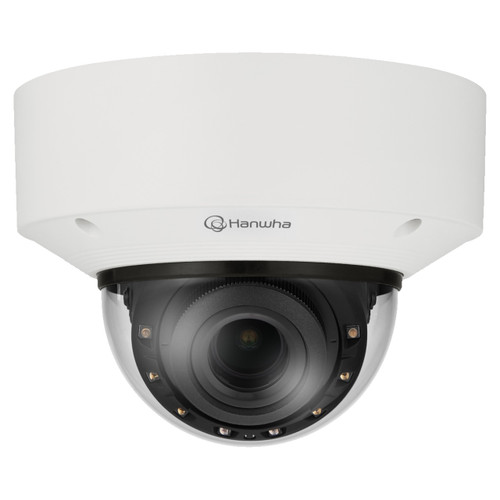
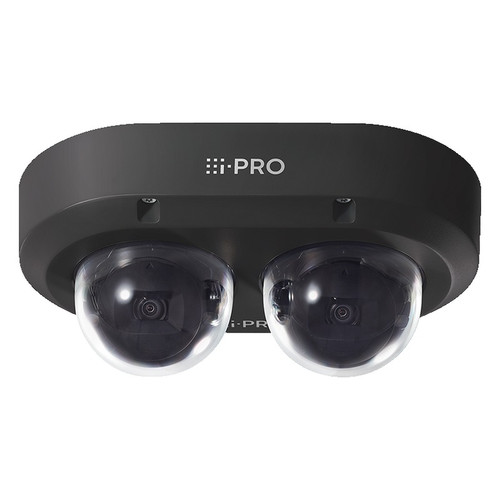
Both the Hanwha XNV-C9083R and the i-PRO WV-U85402-V2L1 are outdoor fixed-dome IP cameras with motorized varifocal lenses, 40-meter IR range, IK10 vandal resistance, and PoE power — a combination that puts them squarely in the outdoor perimeter-surveillance segment. The key structural difference is sensor architecture: the Hanwha is a single 8MP 4K sensor, while the i-PRO is a dual-sensor 4MP-per-channel design. This comparison examines imaging, installation, and integration characteristics strictly from published specifications.
In This Guide
How do the imaging specs compare?
The Hanwha XNV-C9083R uses a single 1/1.8-inch progressive-scan CMOS sensor at 3840×2160 (8MP 4K) delivering 30fps. Its motorized varifocal lens spans 4.4–9.3mm at F1.3–F2.15, yielding a 2.1× optical zoom and a horizontal field of view of 113° at wide. Minimum color illumination is 0.04 Lux, dropping to 0 Lux with WiseIR LEDs rated at 40 meters. WDR is specified at 120dB (extremeWDR). DORI detection reach at tele is 176.6m / 579.49ft.
The i-PRO WV-U85402-V2L1 employs two independent 1/2.7-inch CMOS sensors, each resolving 2688×1520 (approximately 4MP per channel). The motorized lens runs 2.9–7.3mm at F2.0–F3.0, providing 2.5× optical zoom and a horizontal field of view of 43–100°. Minimum illumination is 0.12 Lux (B&W, 50IRE); the IR LEDs also reach 40 meters. Dynamic range is specified at 108dB (Super Dynamic On, Level 31). DORI detection reach at tele is 136.5m / 447.8ft. The dual-sensor architecture enables simultaneous wide and telephoto streams without digital cropping, a capability not present in the single-sensor Hanwha.
What about installation and environment?
Both cameras carry IP66 and IP67 ingress ratings, IK10 impact resistance, and NEMA 4X compliance. The Hanwha adds IP67 alongside IP66 explicitly in its environmental certification text and is rated –40°C to +55°C operating. The i-PRO extends the upper thermal limit to +60°C and includes an anti-condensation Temish element; it also lists NEMA TS 2 (2.2.7–2.2.9) traffic-infrastructure compliance and wind resistance up to 40 m/s (~89 mph), specs not present in the Hanwha datasheet. The i-PRO housing is aluminum die cast in black with stainless steel screws; the Hanwha is aluminum in white (RAL9003) with a hard-coated dome bubble.
Power requirements differ meaningfully. The Hanwha draws a maximum of 12.95W and is powered by PoE IEEE 802.3af Class 3 or 12VDC — standard af budget suffices. The i-PRO requires PoE+ IEEE 802.3at at 18.9W, demanding a Class 4 / 802.3at-capable switch port or midspan. This is a non-trivial infrastructure consideration for retrofit sites with af-only switches. The Hanwha offers a conduit knockout compatible with 1/2-inch (M20) conduit and lists specific compatible gang boxes; the i-PRO dimensions are 250×150×105mm, approximately 60mm wider than the Hanwha footprint of ø160×118mm, and weighs approximately 1.8kg versus 1.45kg for the Hanwha.
Which fits your VMS and analytics better?
Both cameras support ONVIF, H.265/H.264/MJPEG compression, and microSD/SDXC edge storage up to 512GB. The Hanwha supports ONVIF Profiles S, G, T, and M, while the i-PRO supports Profiles G, S, and T — the Hanwha adds Profile M (metadata streaming), relevant for VMS platforms consuming AI metadata streams. The Hanwha allows up to 10 streaming profiles with 3 virtual channels and unicast to 20 simultaneous users; the i-PRO supports 24 simultaneous users but the number of configurable stream profiles is not specified in the provided datasheet.
On analytics, the Hanwha XNV-C9083R embeds an AI engine classifying persons, faces, vehicles (with sub-type: car, bus, truck, motorcycle, bicycle), and license plates, plus business intelligence functions (people counting, queue management, heatmap). The i-PRO WV-U85402-V2L1 lists AI Analytics and AI Sound Classification fields as '–' (not supported per provided spec), with on-camera analytics limited to VMD (4 areas), Scene Change Detection (1 area), and Audio Detection. Security posture differs as well: the i-PRO carries FIPS 140-2 Level 3 certification, a standard not referenced in the Hanwha spec sheet. Both support IEEE 802.1X, HTTPS, and SNMPv3. Audio I/O is present on both; the i-PRO uses 3.5mm jacks (stereo input / mono output) and the Hanwha uses selectable mic/line in with 2.5VDC supply and a line-out at 1Vrms maximum.
Which should you choose: the C9083R or the U85402-V2L1?
Our take: The XNV-C9083R is the stronger choice when on-camera AI analytics, 4K single-sensor resolution, and standard PoE (af) infrastructure are the priority. Its 8MP 3840×2160 sensor outresolves the i-PRO's 4MP-per-channel dual sensors for single-scene capture, DORI detection reaches 176.6m versus 136.5m at tele, and its on-board AI classifies persons, vehicles, and license plates at no additional license cost — capabilities the WV-U85402-V2L1 does not provide per its published spec. The WV-U85402-V2L1 is the stronger choice when dual simultaneous independent video streams are operationally required, the deployment environment demands FIPS 140-2 Level 3 security compliance or NEMA TS 2 traffic certification, or the operating temperature will exceed +55°C (its rated ceiling is +60°C). Sites with only 802.3af switch infrastructure should not select the i-PRO without a switch upgrade or midspan, as it requires 18.9W PoE+.
Side-by-Side Comparison
Spec-for-spec, from manufacturer data.
| Specification | Hanwha C9083R | i-PRO U85402-V2L1 |
|---|---|---|
| Resolution | 8MP (3840×2160) | 4MP per channel (2688×1520); dual sensor |
| Image Sensor | 1/1.8" progressive CMOS (single) | 2× 1/2.7" CMOS (dual) |
| Lens / Focal Length | 4.4–9.3mm motorized varifocal, 2.1× optical | 2.9–7.3mm motorized varifocal, 2.5× optical |
| Max Aperture | F1.3 (Wide) / F2.15 (Tele) | F2.0 (Wide) / F3.0 (Tele) |
| Horizontal FOV | 113° (Wide) | 43–100° (Wide–Tele) |
| Min. Illumination | 0.04 Lux color / 0 Lux (IR) | 0.12 Lux B&W 50IRE |
| WDR | 120 dB (extremeWDR) | 108 dB (Super Dynamic, Level 31) |
| IR Range | 40m WiseIR | 40m (High mode) |
| DORI Detection (Tele) | 176.6m / 579.49ft | 136.5m / 447.8ft |
| Max Frame Rate | 30fps @ 8MP | 30fps |
| Video Compression | H.265 / H.264 / MJPEG | H.265 / H.264 / MJPEG |
| IP Rating | IP66 / IP67 / NEMA 4X | IP67 / IP66 / NEMA 4X |
| IK / Impact Rating | IK10 | IK10 |
| Operating Temperature | –40°C to +55°C | –40°C to +60°C |
| Power Input / PoE Class | PoE IEEE 802.3af Class 3 / 12VDC; 12.95W max | PoE+ IEEE 802.3at; 18.9W |
| Edge Storage | microSD/SDHC/SDXC up to 512GB (1 slot) | microSD 2GB / SDHC up to 32GB / SDXC up to 512GB |
| ONVIF Profiles | S / G / T / M | G / S / T |
| On-Camera AI Analytics | Person, Face, Vehicle (type), License Plate; people counting; heatmap | — (not specified in provided spec) |
| Alarm I/O | 2 configurable I/O ports | 3 alarm I/O terminals (IN1/IN2/IN3) |
| Audio I/O | Mic/line in (2.5VDC supply); line out 1Vrms | 3.5mm stereo mic/line in; 3.5mm mono out 600Ω |
| Security Certifications | 802.1X, HTTPS, Digest Auth, Device Certificate | FIPS 140-2 Level 3, HTTPS, IEEE 802.1X |
| Dimensions | ø160×118mm | 250×150×105mm |
| Weight | 1,450g (3.20 lb) | Approx. 1,800g |
| Housing Finish | White aluminum / hard-coated dome (RAL9003) | Black aluminum die cast / stainless steel screws |
| Warranty | 3-year | 3-year |
Frequently Asked Questions
Which should you choose: the C9083R or the U85402-V2L1?
The XNV-C9083R is the stronger choice when on-camera AI analytics, 4K single-sensor resolution, and standard PoE (af) infrastructure are the priority. Its 8MP 3840×2160 sensor outresolves the i-PRO's 4MP-per-channel dual sensors for single-scene capture, DORI detection reaches 176.6m versus 136.5m at tele, and its on-board AI classifies persons, vehicles, and license plates at no additional license cost — capabilities the WV-U85402-V2L1 does not provide per its published spec. The WV-U85402-V2L1 is the stronger choice when dual simultaneous independent video streams are operationally required, the deployment environment demands FIPS 140-2 Level 3 security compliance or NEMA TS 2 traffic certification, or the operating temperature will exceed +55°C (its rated ceiling is +60°C). Sites with only 802.3af switch infrastructure should not select the i-PRO without a switch upgrade or midspan, as it requires 18.9W PoE+.
Is the C9083R or WV-U85402-V2L1 better for low-light performance?
Based on published specs, the XNV-C9083R has a lower minimum color illumination at 0.04 Lux (versus 0.12 Lux B&W for the WV-U85402-V2L1) and reaches 0 Lux with its WiseIR LEDs. The Hanwha also specifies a larger 1/1.8-inch sensor versus the i-PRO's 1/2.7-inch sensors, which typically correlates with better light collection. The WV-U85402-V2L1's 0.12 Lux figure is measured in black-and-white mode at 50IRE; a direct color-mode comparison figure is not provided in the i-PRO spec.
Can the WV-U85402-V2L1 cover two angles at once without a second camera?
Yes — the i-PRO WV-U85402-V2L1 uses two independent 1/2.7-inch CMOS sensors that simultaneously deliver a wide-angle stream and a telephoto stream as separate video channels. The Hanwha XNV-C9083R has a single sensor and can stream up to 10 profiles but all originate from the same single field of view. If simultaneous independent wide and telephoto coverage from one mounting point is required, the i-PRO's dual-sensor design addresses that need.
Will either camera work on an existing 802.3af (standard PoE) switch?
The Hanwha XNV-C9083R draws a maximum of 12.95W and is rated for PoE IEEE 802.3af Class 3 — standard 802.3af switches can power it. The i-PRO WV-U85402-V2L1 requires PoE+ IEEE 802.3at at 18.9W; a PoE+ (802.3at) capable switch port or a separate midspan injector is required. Plugging the i-PRO into an af-only port risks the camera failing to power on or operating in a reduced-power state, depending on switch behavior.
Get a Second Opinion on Your Camera Choice
Share your site layout, coverage goals, and budget. Our team will validate the camera selection, flag anything we would change, and recommend products that match the use case.