
Hanwha C8303RW vs i-PRO X66600-Z3S: Specification Comparison
Both the Hanwha XNP-C8303RW and the i-PRO WV-X66600-Z3S are outdoor 6MP PTZ cameras targeting perimeter surveillance applications with 30x optical zoom, AI analytics, IP66/IK10 enclosures, and PoE++ power — a direct cross-shop pairing for integrators evaluating AI-capable PTZ platforms. The comparison covers imaging performance, installation and environmental suitability, and VMS/analytics integration to help buyers determine which unit fits their deployment requirements.

In This Guide
How do the imaging specs compare?
Both cameras use an approximately 1/2.8-inch CMOS sensor at 6MP (3328×1872) with 30x optical zoom. The Hanwha's focal length runs 5–150mm at F1.6 (wide) to F4.56 (tele), yielding a 57.42° horizontal field of view at wide end. The i-PRO's focal length is 4.5–135mm at F1.8 (wide) to F4.7 (tele), producing a 62° horizontal field of view at wide end. Both specify 0.1 Lux color minimum illumination, though the i-PRO's figure is cited at F1.8/50IRE/1/30s while Hanwha's figure is cited alongside 0 Lux with IR active. The Hanwha delivers Wise IR illumination to 200m (656ft); the i-PRO's IR range is specified at approximately 20–30m per its datasheet summary — a substantial gap for long-range low-light coverage.
On dynamic range, the Hanwha specifies Extreme WDR at 120dB, while the i-PRO specifies Super Dynamic at a maximum of 132dB (at Level 31). The Hanwha supports up to 60fps frame rate capability (30fps at full 6MP resolution); the i-PRO specifies 30fps maximum. DORI ranges differ: at tele, Hanwha's Identify distance is 348.2m vs the i-PRO's 305.0m; at wide, Hanwha Identify is 12.2m vs i-PRO's 11.1m. Both include a built-in gyro-based digital image stabilizer and ICR day/night switching.
What about installation and environment?
Both cameras carry IP66 and IK10 ratings and are PoE++ (IEEE 802.3bt, Class 6). The Hanwha draws a typical 26W / maximum 46W; the i-PRO specifies 37.8W. The Hanwha's operating temperature is rated –40°C to +55°C with 0–100% RH; the i-PRO's ambient operating temperature is –50°C to +60°C (power-on: –30°C to +60°C) with 10–100% RH. The i-PRO additionally specifies wind resistance up to 40 m/s (approx. 89 mph). Both units also carry NEMA-TS2 certification.
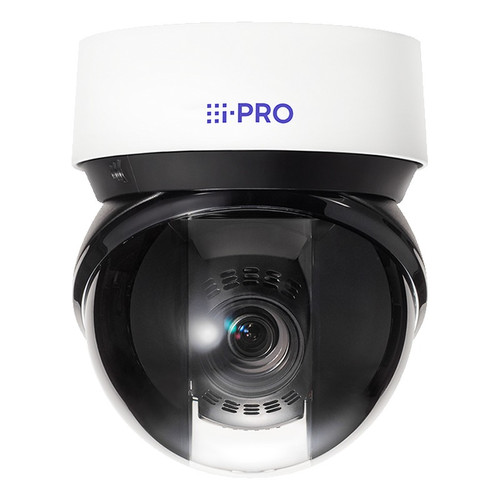
The Hanwha is physically larger and heavier: ø184.9×318.8mm at 5,600g (12.34 lb). The i-PRO is significantly more compact: ø167mm×205mm at approximately 3.0 kg (without attachment). The Hanwha includes an integrated wiper and lens heater for precipitation environments; no wiper or lens heater is specified for the i-PRO. The Hanwha is constructed of aluminum and polycarbonate; the i-PRO uses aluminum die-cast, stainless steel, and polycarbonate with a tamper-resistant enclosure designation. The Hanwha also adds NEMA 4X and IEC 63000 environmental certifications not listed for the i-PRO.
Which fits your VMS and analytics better?
Both cameras support ONVIF Profiles G, M, S, and T, and both carry H.265/H.264/MJPEG compression with CBR/VBR control and SRTP/HTTPS/802.1X security. The Hanwha supports unicast up to 20 users and multicast up to 128 users across up to 10 streaming profiles, with SUNAPI and Wisenet SDK support alongside ONVIF. The i-PRO supports up to 14 simultaneous users and includes Ambarella CV22 SoC disclosure. Both support SNMPv1/v2c/v3, MQTT, NTCIP, and IPv4/IPv6.
On analytics, the Hanwha classifies Person, Face, Vehicle (with sub-type: car/bus/truck/motorcycle/bicycle), and License Plate, with AI auto-tracking for person and vehicle, virtual line crossing, virtual area loitering, and 32 privacy masks (quadrangle + mosaic). The i-PRO detects AI motion, face, people, vehicle, and includes AI Sound Classification for gunshot, yell, vehicle horn, and glass break — a unique audio-event analytics layer not present on the Hanwha. The Hanwha provides dual microSD card slots for up to 1TB edge storage (512GB×2) with SD card encryption and TPM 2.0 (FIPS 140-2 Level 2). The i-PRO supports a single microSD/SDHC/SDXC card (up to 512GB). The Hanwha does not list a dedicated 3.5mm audio I/O in its published specs; the i-PRO provides both 3.5mm audio input and output jacks plus 3 alarm I/O terminals.
Which should you choose: the C8303RW or the X66600-Z3S?
Our take: The XNP-C8303RW is the stronger choice when long-range IR illumination, precipitation resilience, and high-density edge storage are priorities. Its Wise IR covers 200m versus the i-PRO's specified 20–30m — a critical gap for large perimeter sites where lighting infrastructure is absent. It also ships with an integrated wiper and lens heater that the i-PRO does not specify, and offers dual microSD slots for up to 1TB of encrypted on-board storage compared to the i-PRO's single card slot. The i-PRO WV-X66600-Z3S is better suited when a compact, lighter form factor (3.0kg vs 5.6kg) matters for pole or parapet loads, when AI Sound Classification (gunshot, glass break, yell, vehicle horn) is a site requirement, when the higher specified dynamic range ceiling (132dB vs 120dB) is a priority, or when native audio I/O is needed without add-on hardware. Platform choice — Wisenet VMS versus i-PRO's own ecosystem — should also drive the final decision.
Side-by-Side Comparison
Spec-for-spec, from manufacturer data.
| Specification | Hanwha C8303RW | i-PRO X66600-Z3S |
|---|---|---|
| Resolution | 6MP (3328×1872) | 6MP (3328×1872) |
| Image Sensor | 1/2.8" CMOS | Approx. 1/2.8-type CMOS |
| Focal Length / Optical Zoom | 5–150mm, 30x optical (digital 32x, total 960x) | 4.5–135mm, 30x optical (extra zoom up to 78x at 720p) |
| Max Aperture (Wide / Tele) | F1.6 (Wide) / F4.56 (Tele) | F1.8 (Wide) / F4.7 (Tele) |
| Min. Illumination | 0.1 Lux color / 0 Lux IR | 0.1 Lux (BW, 50IRE, F1.8, 1/30s) |
| IR Illumination Range | 200m (656ft) Wise IR | Approx. 20–30m (per datasheet summary) |
| Wide Dynamic Range | Extreme WDR 120dB | Super Dynamic max. 132dB (Level 31) |
| Max Frame Rate | 60fps capable; 30fps @ 6MP | 30fps |
| DORI Identify — Tele | 348.2m (1,142.5ft) | 305.0m (1,000.8ft) |
| Pan Speed (Preset) | Max 500°/sec | 700°/sec |
| Tilt Speed (Preset) | Max 350°/sec | 500°/sec |
| Power Input / PoE Class | PoE++ 802.3bt Class 6; max 46W | PoE++ 802.3bt Class 6; 37.8W |
| Operating Temperature | -40°C to +55°C | -50°C to +60°C (power-on: -30°C to +60°C) |
| IP / IK Rating | IP66 / IK10 / NEMA 4X | IP66 / IK10 |
| Edge Storage | Dual microSD up to 1TB (512GB×2), encrypted | Single microSDXC up to 512GB |
| Audio I/O | Not specified in supplied specs | 3.5mm stereo in + mono out; AI sound classification |
| Integrated Wiper / Lens Heater | Yes (wiper + lens heater) | Not specified |
| Dimensions / Weight | ø184.9×318.8mm / 5,600g | ø167×205mm / approx. 3,000g (without attachment) |
| Video Compression | H.265 / H.264 / MJPEG | H.265 / H.264 / MJPEG |
| ONVIF Profiles | G / M / S / T | G / M / S / T |
| Security | TPM 2.0 (FIPS 140-2 Level 2), Secure boot, Signed firmware | Signed firmware; HTTPS; 802.1X |
| Warranty | 3 years | 5 years |
Frequently Asked Questions
Which should you choose: the C8303RW or the X66600-Z3S?
The XNP-C8303RW is the stronger choice when long-range IR illumination, precipitation resilience, and high-density edge storage are priorities. Its Wise IR covers 200m versus the i-PRO's specified 20–30m — a critical gap for large perimeter sites where lighting infrastructure is absent. It also ships with an integrated wiper and lens heater that the i-PRO does not specify, and offers dual microSD slots for up to 1TB of encrypted on-board storage compared to the i-PRO's single card slot. The i-PRO WV-X66600-Z3S is better suited when a compact, lighter form factor (3.0kg vs 5.6kg) matters for pole or parapet loads, when AI Sound Classification (gunshot, glass break, yell, vehicle horn) is a site requirement, when the higher specified dynamic range ceiling (132dB vs 120dB) is a priority, or when native audio I/O is needed without add-on hardware. Platform choice — Wisenet VMS versus i-PRO's own ecosystem — should also drive the final decision.
Is the XNP-C8303RW or the WV-X66600-Z3S better for low-light and night coverage?
Both cameras specify 0.1 Lux minimum illumination (color), but the Hanwha XNP-C8303RW's Wise IR system illuminates to 200m (656ft), while the i-PRO WV-X66600-Z3S specifies approximately 20–30m of IR range per its datasheet. For sites without external lighting, the Hanwha provides substantially greater night-time IR coverage at range.
Which camera is easier to install on a lightweight pole or parapet mount?
The i-PRO WV-X66600-Z3S is significantly lighter at approximately 3.0kg, versus the Hanwha XNP-C8303RW at 5,600g (5.6kg). The i-PRO is also more compact (ø167mm×205mm vs ø184.9×318.8mm). For weight-sensitive mounting structures, the i-PRO imposes less structural load. Note that the Hanwha's additional mass partly reflects its integrated wiper motor and dual SD card assembly.
Does either camera support audio detection or sound-based alerts?
Yes — the i-PRO WV-X66600-Z3S includes AI Sound Classification that can trigger alerts on gunshot, yell, vehicle horn, and glass break events, plus 3.5mm audio input and output jacks. The Hanwha XNP-C8303RW's published specifications do not list equivalent AI sound classification or a dedicated audio I/O jack; alarm audio output is noted as a partially listed feature in its alarm events spec, but no audio input specification is provided in the supplied data.
Get a Second Opinion on Your Camera Choice
Share your site layout, coverage goals, and budget. Our team will validate the camera selection, flag anything we would change, and recommend products that match the use case.