
Hanwha C8011R vs Hanwha QNV-8010R: Specification Comparison
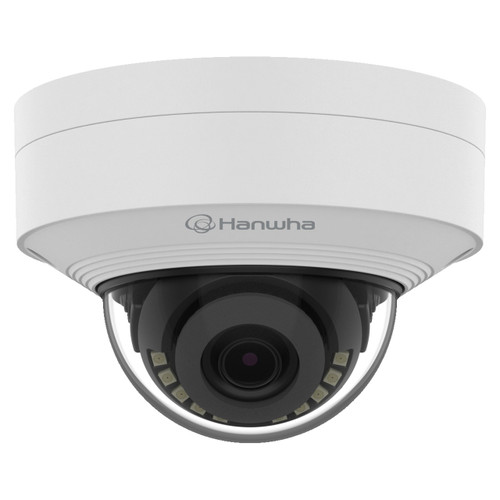
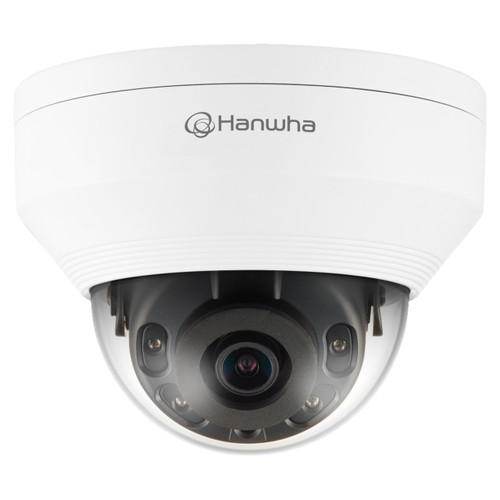
Both the Hanwha QNV-C8011R and QNV-8010R are wired, fixed-lens, 5MP outdoor vandal-resistant dome cameras sharing the same 1/2.8" CMOS sensor and 2592×1944 resolution. They occupy the same product category and resolution class, making them direct cross-shop candidates for installers evaluating a standard fixed dome for perimeter, parking, or facility coverage. The key differentiators fall across AI analytics capability, on-board memory, low-light sensitivity, lens geometry, and supported streaming profiles.
In This Guide
How do the imaging specs compare?
Both cameras deliver 5MP at 30fps with 120dB WDR, Auto ICR day/night, and 850nm IR rated to 20m. The QNV-C8011R uses a 3.0mm F1.6 fixed lens yielding H:100°/V:73°/D:129°, while the QNV-8010R uses a 2.8mm F2.0 lens producing a slightly wider H:105°/V:77°/D:136°. The wider aperture advantage goes to the C8011R (F1.6 vs F2.0), which directly affects light-gathering and minimum illumination: the C8011R is rated at 0.03 Lux color / 0 Lux IR, compared to the QNV-8010R at 0.15 Lux color / 0 Lux IR — a 5× improvement in minimum color illumination.
Digital noise reduction differs meaningfully: the C8011R implements SSNRv plus AI-based WiseNR II, whereas the QNV-8010R uses SSNR only. Smart codec compression also diverges — the C8011R supports WiseStream III (AI-based) versus WiseStream II on the QNV-8010R. DORI detection distances also favor the C8011R slightly: Detect 43.5m vs 40.0m, Observe 17.5m vs 16.0m, Recognize 8.7m vs 8.0m, Identify 4.3m vs 4.0m. Lens minimum object distance is specified at 0.5m for the C8011R; this value is not provided for the QNV-8010R.
What about installation and environment?
Both cameras are rated IP66 and IK10, are PoE Class 3 (IEEE 802.3af), and are finished in RAL9003 white aluminum. The C8011R carries an additional NEMA4X rating not listed for the QNV-8010R. Operating temperature range is wider on the C8011R at -40°C to +55°C versus -30°C to +55°C for the QNV-8010R, a meaningful advantage for cold-climate deployments. The C8011R also specifies 0–95% RH non-condensing humidity tolerance; the QNV-8010R is rated 0–90% RH.
Physical dimensions differ: the C8011R measures ø110×77mm and weighs 522g (1.15 lb), while the QNV-8010R is slightly larger at ø120.3×91.7mm and slightly lighter at 510g (1.12 lb). The C8011R's installation video out is Micro USB Type B at 1280×720; the QNV-8010R uses CVBS composite at 720×480(N)/720×576(P). Maximum PoE draw is 8.5W for the C8011R versus 7.5W for the QNV-8010R, though typical draw is lower on the C8011R (4.9W typical vs 5.80W typical). The C8011R lists compatible accessories SBD-110GP1 conduit adapter, SBP-120HMW hanging mount, and SBV-140BW backbox; the QNV-8010R lists SBP-122HMW and SBV-120GW — accessories are not cross-compatible.
Which fits your VMS and analytics better?
The QNV-C8011R supports ONVIF Profile S/G/T/M, while the QNV-8010R supports ONVIF Profile S/G/T plus Wisenet Open Platform. Both support SUNAPI. The C8011R adds Profile M, which is required for metadata streaming in modern analytics-capable VMS platforms. Streaming profiles differ substantially: the C8011R supports up to 5 simultaneous profiles with unicast up to 20 users; the QNV-8010R supports up to 3 profiles with unicast limited to 6 users. The C8011R also adds SRTP and CDP to its protocol stack versus the QNV-8010R.
Analytics capability is a primary differentiator. The C8011R provides AI-engine-based analytics including classified object detection (person/vehicle with vehicle sub-type: car/bus/truck/motorcycle/bicycle), virtual line crossing with direction, virtual area with loitering, plus business intelligence functions — people counting, vehicle counting, queue management, and heatmap. It supports 8 motion detection zones (8-point polygonal) and 32 privacy masking zones (4-point quadrangle). The QNV-8010R offers motion detection, tampering, defocus detection, virtual area (intrusion/enter/exit), and virtual line crossing — no AI classification, no counting, no heatmap. Privacy masking is limited to 6 rectangular zones and motion detection to 4 polygonal zones. The C8011R also carries 2GB RAM / 1GB Flash versus 512MB RAM / 256MB Flash on the QNV-8010R, and supports edge storage up to 256GB microSD versus 128GB. Alarm I/O is present on the QNV-8010R (1 input / 1 output); the C8011R does not list alarm I/O in its specifications. Neither camera lists a built-in microphone or audio I/O in the provided specifications.
Which should you choose: the C8011R or the QNV-8010R?
Our take: The QNV-C8011R is the stronger choice when AI-driven analytics, higher concurrency, or cold-climate operation are priorities. Concretely: its minimum color illumination is 0.03 Lux versus 0.15 Lux on the QNV-8010R — a 5× low-light advantage driven by its F1.6 versus F2.0 aperture; it supports up to 5 streaming profiles and 20 unicast users versus 3 profiles and 6 users; and its operating temperature floor extends to -40°C versus -30°C. On-board memory (2GB RAM / 256GB SD) and AI analytics — people counting, vehicle counting, queue management, and heatmap — are exclusive to the C8011R. The QNV-8010R's advantage is its hardware alarm I/O (1 in / 1 out), Wisenet Open Platform support, and lower typical PoE draw (5.80W typical versus 4.9W). Specify the QNV-8010R where hardwired alarm I/O or Wisenet Open Platform app integration is required and AI analytics are handled upstream by the VMS.
Side-by-Side Comparison
Spec-for-spec, from manufacturer data.
| Specification | Hanwha C8011R | Hanwha QNV-8010R |
|---|---|---|
| Resolution | 2592×1944 (5MP) | 2592×1944 (5MP) |
| Image Sensor | 1/2.8" CMOS | 1/2.8" CMOS |
| Focal Length | 3.0mm fixed | 2.8mm fixed |
| Max Aperture | F1.6 | F2.0 |
| Horizontal FOV | 100° | 105° |
| Min Illumination (Color) | 0.03 Lux | 0.15 Lux |
| Min Illumination (IR) | 0 Lux | 0 Lux |
| IR Range | 20m (850nm) | 20m (850nm) |
| Wide Dynamic Range | 120dB | 120dB |
| Max Frame Rate | 30fps @ 5MP | 30fps @ 5MP |
| Video Compression | H.265 / H.264 / MJPEG | H.265 / H.264 / MJPEG |
| Smart Codec | WiseStream III (AI-based) | WiseStream II |
| Streaming Profiles / Unicast Users | 5 profiles / 20 users | 3 profiles / 6 users |
| ONVIF Profiles | S / G / T / M | S / G / T |
| AI Analytics | People/vehicle counting, heatmap, queue mgmt, object classification | — |
| Standard Analytics | Motion detection, virtual line/area | Motion detection, tampering, defocus, virtual line/area |
| Alarm I/O | — | 1 input / 1 output |
| Edge Storage (Max) | 256GB microSD | 128GB microSD |
| RAM / Flash | 2GB RAM / 1GB Flash | 512MB RAM / 256MB Flash |
| IP Rating | IP66 | IP66 |
| Impact Rating | IK10 | IK10 |
| Additional Enclosure Rating | NEMA4X | — |
| Operating Temperature | -40°C to +55°C | -30°C to +55°C |
| Operating Humidity | 0–95% RH | 0–90% RH |
| Power Input / PoE Class | PoE 802.3af / Class 3 | PoE 802.3af / Class 3 |
| Power (Max / Typical) | 8.5W max / 4.9W typical | 7.5W max / 5.80W typical |
| Dimensions | ø110×77mm | ø120.3×91.7mm |
| Weight | 522g (1.15 lb) | 510g (1.12 lb) |
| Warranty | 3-year | 3-year |
Frequently Asked Questions
Which should you choose: the C8011R or the QNV-8010R?
The QNV-C8011R is the stronger choice when AI-driven analytics, higher concurrency, or cold-climate operation are priorities. Concretely: its minimum color illumination is 0.03 Lux versus 0.15 Lux on the QNV-8010R — a 5× low-light advantage driven by its F1.6 versus F2.0 aperture; it supports up to 5 streaming profiles and 20 unicast users versus 3 profiles and 6 users; and its operating temperature floor extends to -40°C versus -30°C. On-board memory (2GB RAM / 256GB SD) and AI analytics — people counting, vehicle counting, queue management, and heatmap — are exclusive to the C8011R. The QNV-8010R's advantage is its hardware alarm I/O (1 in / 1 out), Wisenet Open Platform support, and lower typical PoE draw (5.80W typical versus 4.9W). Specify the QNV-8010R where hardwired alarm I/O or Wisenet Open Platform app integration is required and AI analytics are handled upstream by the VMS.
Is the QNV-C8011R or QNV-8010R better for low-light color imaging?
The QNV-C8011R is rated at 0.03 Lux minimum color illumination versus 0.15 Lux for the QNV-8010R, a 5× difference. This stems from the C8011R's F1.6 aperture compared to the QNV-8010R's F2.0. Both cameras switch to 0 Lux sensitivity in IR mode. If color image quality in dim ambient light is a requirement, the C8011R has a measurable specification advantage.
Does either camera include on-board AI analytics, or do I need a VMS to handle that?
The QNV-C8011R includes on-camera AI analytics: classified object detection (person/vehicle with vehicle sub-types), virtual line crossing, virtual area events, people counting, vehicle counting, queue management, and heatmap. These run on the camera's AI engine without requiring VMS-side processing. The QNV-8010R provides standard video analytics — motion detection, tampering, defocus, virtual line, and virtual area — but does not include AI classification, counting, or heatmap per the provided specifications.
Which camera should I choose if I need hardwired alarm inputs and outputs?
The QNV-8010R specifies 1 alarm input and 1 alarm output, enabling direct integration with door contacts, sirens, or relay devices. The QNV-C8011R's specifications do not list any alarm I/O. If your installation requires a dry-contact alarm trigger or relay output without a separate I/O module, the QNV-8010R is the appropriate choice.
Get a Second Opinion on Your Camera Choice
Share your site layout, coverage goals, and budget. Our team will validate the camera selection, flag anything we would change, and recommend products that match the use case.