
Hanwha C7083RVD vs i-PRO X35402-F2L: Specification Comparison
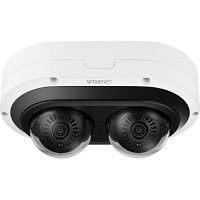
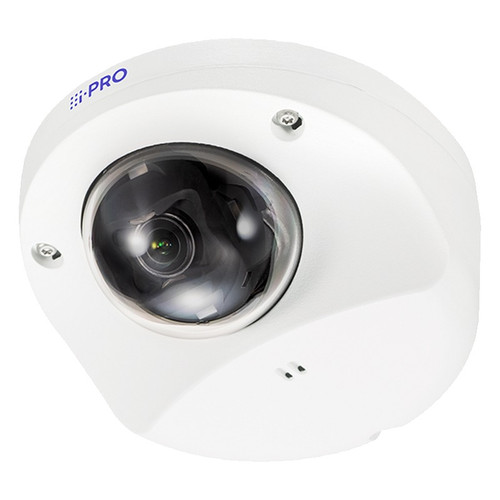
Both the Hanwha PNM-C7083RVD and the i-PRO WV-X35402-F2L are 4MP outdoor-rated IP dome cameras targeting commercial and light-industrial installations. The Hanwha is a dual-sensor motorized varifocal model delivering two independent 2MP streams, while the i-PRO is a compact fixed-lens dome with a 2.4mm wide-angle optic and certified rail/vehicle credentials. Despite sharing a 4MP headline resolution and IP66/IK10 ratings, they serve meaningfully different deployment profiles — wide-area dual-view coverage versus compact fixed-angle transit or corridor use.
In This Guide
How do the imaging specs compare?
The Hanwha PNM-C7083RVD uses two 1/2.8" CMOS sensors, each producing 1920×1080 at 30fps, with a 3–6mm motorized varifocal lens (2× optical zoom, F2.2 wide/F3.1 tele) providing a horizontal field of view that narrows from 107° to 56°. Its minimum illumination is 0.035 lux in color mode, dropping to 0 lux with IR active. IR range is stated at 15m typical and up to 25m based on scene. Wide dynamic range is rated at 120dB (extremeWDR). The i-PRO WV-X35402-F2L uses a single 1/2.8" CMOS sensor delivering up to 2560×1440 (4MP combined in one stream) at 25/30fps through a fixed 2.4mm lens at F2.1, yielding a 121° horizontal field of view (16:9). Minimum illumination is 0.07 lux color and 0.06 lux B&W, with IR range at 14m (30IRE) or 10m (50IRE). Dynamic range reaches 132dB maximum with Super Dynamic enabled at level 31.
In low-light sensitivity the Hanwha's 0.035 lux color threshold is approximately half the i-PRO's 0.07 lux, giving the Hanwha an edge in dim scenes before IR activates. However the i-PRO's 132dB Super Dynamic range exceeds the Hanwha's 120dB extremeWDR by 12dB — a meaningful difference in high-contrast backlit environments. The Hanwha's motorized varifocal lens allows field-of-view adjustment post-install (3–6mm, 2× zoom), whereas the i-PRO's 2.4mm fixed lens is set at installation and cannot be adjusted. DORI detection distances are broadly comparable: Hanwha wide detect 28.4m vs i-PRO 29.0m at 25PPM.
What about installation and environment?
Both cameras carry IP66 and IK10 ratings and are NEMA 4X compliant, making them equivalently rated for outdoor dust/water ingress and vandal resistance by spec. Operating temperature ranges are nearly identical: Hanwha -40°C to +55°C vs i-PRO -40°C to +60°C, giving the i-PRO a 5°C upper margin advantage. The i-PRO additionally holds EN50155, JIS E 5006, IEC62236, and EN50121 certifications for railway and vehicle applications — specs not listed for the Hanwha. Wind resistance of up to 40m/s (~89 mph) is specified for the i-PRO; no equivalent wind-resistance figure is provided in the Hanwha spec sheet.
Power requirements differ substantially. The Hanwha requires PoE+ (IEEE 802.3at, Class 4) at up to 20W typical 15.5W, meaning the switch or injector must support the higher 802.3at standard. The i-PRO draws a maximum of 8.6W on standard PoE (IEEE 802.3af, Class 0), requiring no PoE+ infrastructure. The Hanwha's dual-sensor dome body measures 215×135×93.2mm and weighs 1,330g. The i-PRO is substantially more compact at 109×53×119mm and approximately 475g — less than half the weight — relevant when mounting on pan/tilt arms or in confined spaces. The Hanwha pan/tilt/rotate range is 0–355°/0–78°/0–180°; the i-PRO adjusts -45° to +45° pan, 0° to +90° tilt, -90° to +90° yaw.
Which fits your VMS and analytics better?
The Hanwha PNM-C7083RVD supports ONVIF Profile S and T, Hanwha SUNAPI (HTTP API), and an open platform, with streaming at up to 5 profiles per channel across two channels (10 Unicast users). Edge storage supports microSD/SDHC/SDXC up to 512GB in one slot. Security includes TPM 2.0 at FIPS 140-2 Level 2, 802.1X (EAP-TLS/LEAP/PEAP), HTTPS, Digest authentication, and IP filtering. AI analytics cover person, face, vehicle, and license plate classification with attributes (car/bus/truck/motorcycle/bicycle), plus virtual line and virtual area (loitering) events. Audio input and output require the optional SPM-4210 I/O box — not built in. Alarm I/O similarly requires the optional accessory.
The i-PRO WV-X35402-F2L supports ONVIF Profile G, M, S, and T — the addition of Profile G (recording) and Profile M (metadata/analytics) gives it broader VMS compatibility out of the box. It supports up to 14 simultaneous users. Security reaches FIPS 140-2 Level 3 via NXP EdgeLock SE050F secure element, a step above the Hanwha's Level 2 implementation, and includes brute-force protection and SFTP/MQTT protocol support not listed for the Hanwha. Edge storage is also up to 512GB microSDXC. AI analytics include face, people, vehicle, mask/non-mask, and occupancy detection, plus AI Sound Classification (gunshot, yell, vehicle horn, glass break). A built-in microphone is included; no external I/O accessory is required for audio detection. No alarm input/output terminals are specified.
Which should you choose: the C7083RVD or the X35402-F2L?
Our take: The PNM-C7083RVD is the stronger choice when a single outdoor mounting point must cover two independently aimed fields of view with adjustable focal length and deep AI attribute classification including license plate and vehicle type. Key spec deltas: the Hanwha's motorized 3–6mm varifocal lens versus the i-PRO's fixed 2.4mm; Hanwha low-light color sensitivity of 0.035 lux versus the i-PRO's 0.07 lux; and Hanwha PoE+ at up to 20W versus i-PRO standard PoE at 8.6W — meaning existing 802.3af switch ports cannot power the Hanwha. Conversely, the WV-X35402-F2L is the correct choice for transit, rail, or vehicle installations where EN50155/EN50121 certification is a procurement requirement, where FIPS 140-2 Level 3 security compliance is mandated, or where lightweight compact form (475g vs 1,330g) and standard PoE infrastructure matter. The i-PRO also ships with a built-in microphone and ONVIF Profile G/M coverage without any optional accessories.
Side-by-Side Comparison
Spec-for-spec, from manufacturer data.
| Specification | Hanwha C7083RVD | i-PRO X35402-F2L |
|---|---|---|
| Resolution | 4MP (dual 2×2MP / 1920×1080 per sensor) | 4MP (single sensor / up to 2560×1440) |
| Image Sensor | 1/2.8" CMOS × 2 channels | 1/2.8" CMOS × 1 channel |
| Lens / Focal Length | 3–6mm motorized varifocal (2× zoom) | 2.4mm fixed |
| Max Aperture | F2.2 (wide) / F3.1 (tele) | F2.1 |
| Horizontal Field of View | 107°–56° (wide to tele) | 121° (16:9) |
| Min. Illumination (Color) | 0.035 lux | 0.07 lux |
| Min. Illumination (B&W / IR) | 0 lux (IR on) | 0.06 lux (B&W) |
| IR Range | 15m typical / 25m scene-dependent | 14m (30IRE) / 10m (50IRE) |
| Wide Dynamic Range | 120dB (extremeWDR) | 132dB max (Super Dynamic level 31) |
| Max Frame Rate | 30fps @ 2MP per channel | 25/30fps |
| Video Compression | H.265 / H.264 / MJPEG | H.265 / H.264 / JPEG |
| ONVIF Profiles | S, T | G, M, S, T |
| AI Analytics | Person, Face, Vehicle (type+attributes), License Plate, Virtual Line/Area | Face, People, Vehicle, Mask, Occupancy, Sound Classification |
| Audio | Via optional SPM-4210 I/O box only | Built-in microphone (no accessory required) |
| Edge Storage | microSD/SDHC/SDXC up to 512GB (1 slot) | microSDXC up to 512GB |
| IP / Impact Rating | IP66 / IP67 / NEMA 4X / IK10 | IP66 / NEMA 4X / IK10 |
| Operating Temperature | -40°C to +55°C | -40°C to +60°C |
| Power Input / PoE Class | PoE+ IEEE 802.3at Class 4 / max 20W | PoE IEEE 802.3af Class 0 / max 8.6W |
| Security Certification | FIPS 140-2 Level 2 (TPM 2.0) | FIPS 140-2 Level 3 (NXP EdgeLock SE050F) |
| Rail / Vehicle Certification | — | EN50155, JIS E 5006, IEC62236, EN50121 |
| Dimensions (W×H×D) | 215×93.2×135mm (8.46"×3.67"×5.31") | 109×53×119mm (4.3"×2.1"×4.7") |
| Weight | 1,330g (2.93 lbs) | approx. 475g (1.05 lbs) |
| Warranty | 3 years | 5 years |
Frequently Asked Questions
Which should you choose: the C7083RVD or the X35402-F2L?
The PNM-C7083RVD is the stronger choice when a single outdoor mounting point must cover two independently aimed fields of view with adjustable focal length and deep AI attribute classification including license plate and vehicle type. Key spec deltas: the Hanwha's motorized 3–6mm varifocal lens versus the i-PRO's fixed 2.4mm; Hanwha low-light color sensitivity of 0.035 lux versus the i-PRO's 0.07 lux; and Hanwha PoE+ at up to 20W versus i-PRO standard PoE at 8.6W — meaning existing 802.3af switch ports cannot power the Hanwha. Conversely, the WV-X35402-F2L is the correct choice for transit, rail, or vehicle installations where EN50155/EN50121 certification is a procurement requirement, where FIPS 140-2 Level 3 security compliance is mandated, or where lightweight compact form (475g vs 1,330g) and standard PoE infrastructure matter. The i-PRO also ships with a built-in microphone and ONVIF Profile G/M coverage without any optional accessories.
Is the PNM-C7083RVD or WV-X35402-F2L better for low-light performance?
By minimum illumination spec, the Hanwha PNM-C7083RVD has a lower color threshold (0.035 lux) versus the i-PRO's 0.07 lux, indicating greater sensitivity before IR activates. IR range also favors the Hanwha at up to 25m scene-dependent versus the i-PRO's 14m at 30IRE. However, the i-PRO's Super Dynamic WDR reaches 132dB versus the Hanwha's 120dB, so in high-contrast backlit scenes the i-PRO's wider dynamic range may recover shadow and highlight detail more effectively.
Can I power both cameras from a standard 802.3af PoE switch?
No. The Hanwha PNM-C7083RVD requires PoE+ (IEEE 802.3at, Class 4) at up to 20W; a standard 802.3af port will not supply sufficient power. The i-PRO WV-X35402-F2L draws a maximum of 8.6W and is compliant with IEEE 802.3af, so it can be powered from any standard PoE port without a PoE+ upgrade.
Which camera is certified for rail or vehicle deployments?
Only the i-PRO WV-X35402-F2L carries explicit railway and vehicle certifications: EN50155, JIS E 5006, IEC62236, and EN50121. It also specifies wind resistance up to 40m/s. The Hanwha PNM-C7083RVD does not list any of these certifications in its provided specifications.
Get a Second Opinion on Your Camera Choice
Share your site layout, coverage goals, and budget. Our team will validate the camera selection, flag anything we would change, and recommend products that match the use case.