
Hanwha C7083RVD vs Hanwha QNV-7082R: Specification Comparison
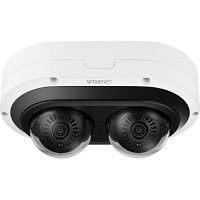
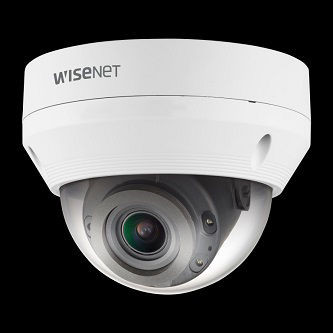
Both the Hanwha PNM-C7083RVD and the QNV-7082R are outdoor IP dome cameras in the 4MP resolution class, each featuring motorized varifocal lenses, IR illumination, 120dB WDR, and IK10 vandal resistance. The C7083RVD is a dual-sensor (2×2MP) model with PoE+ and AI-driven analytics, while the QNV-7082R is a single-sensor 4MP camera powered by standard PoE. Installers cross-shopping these two will want to weigh sensor architecture, AI analytics depth, power budget, lens range, and network integration profile.
In This Guide
How do the imaging specs compare?
The C7083RVD uses two 1/2.8" CMOS sensors, each delivering 2MP (1920×1080), for a combined 4MP output across a dual-channel architecture with 5 streaming profiles per channel. Its motorized varifocal lens spans 3–6mm (2× zoom) with a Fixed IRIS aperture of F2.2 (Wide) to F3.1 (Tele), yielding horizontal fields of view from 107° to 56°. Minimum illumination is 0.035 Lux color / 0 Lux IR with IR reach specified at 15m typical and 25m scene-dependent. The QNV-7082R uses a single 1/3" CMOS sensor at 2560×1440 resolution, with a 3.2–10mm (3.1×) DC auto-iris lens offering F1.6 (Wide) to F2.9 (Tele) and a horizontal field of view of 98.6° (Wide) to 30.8° (Tele). Its minimum illumination is 0.1 Lux color / 0 Lux IR, with IR range specified at 30m.
The C7083RVD's extremeWDR is rated at 120dB and employs WiseNR II (AI-based) plus SSNR V for noise reduction, while the QNV-7082R's WDR is also rated 120dB but uses the older SSNR (without AI enhancement). The QNV-7082R's longer zoom range (3.1× vs 2×) and wider maximum aperture (F1.6 vs F2.2) give it an optical advantage at distance and in marginal light. On DORI metrics, the QNV-7082R's Tele Detect reaches 129m vs the C7083RVD's 72.2m, reflecting the longer zoom. The C7083RVD's dual-sensor architecture and wider FOV in Wide mode make it better suited for broad-area coverage where two overlapping zones are needed.
What about installation and environment?
Both cameras share IP66 and IK10 ratings and an operating temperature range of -40°C to +55°C. The C7083RVD adds IP67 and NEMA 4X certifications, providing a higher level of water ingress protection and suitability for washdown or harsh industrial environments. It is powered exclusively by PoE+ (IEEE 802.3at, Class 4), drawing up to 20W typical 15.5W, which requires a PoE+ capable switch or injector. The QNV-7082R accepts either PoE (IEEE 802.3af, Class 3, max 11.4W) or 12VDC, giving installers more power-source flexibility, particularly in retrofits with existing 12VDC infrastructure or standard PoE switches.
The C7083RVD is significantly larger and heavier: 215×135×93.2mm and 1,330g versus the QNV-7082R's Ø137×106.1mm and 710g. The C7083RVD includes a micro USB Type B video-out port (1280×720) for installation alignment, while the QNV-7082R provides CVBS analog video out. The C7083RVD uses a 1/2" (M20) conduit entry; the QNV-7082R uses 3/4" (M25). Alarm I/O on the C7083RVD requires the optional SPM-4210 I/O box; the QNV-7082R has 1 alarm input and 1 alarm output built in. Both mount to common Hanwha dome accessories but use different hanging mount models (SBP-215HMW vs SBP-301HMW2).
Which fits your VMS and analytics better?
The C7083RVD supports ONVIF Profile S and T, while the QNV-7082R supports ONVIF Profile S, G, and T—Profile G adds NVR-based recording control, which can simplify edge storage management on compatible VMS platforms. Both expose Hanwha's SUNAPI (HTTP API) and support H.265/H.264/MJPEG compression with CBR/VBR control. The C7083RVD streams up to 10 unicast users with 5 profiles per channel; the QNV-7082R supports 6 unicast users and up to 3 profiles total. Both include WiseStream II for smart bitrate reduction; the C7083RVD additionally supports WiseStream III.
Analytics depth is a significant differentiator. The C7083RVD runs an AI engine classifying Person, Face, Vehicle, and License Plate, with attribute detection (vehicle type: car, bus, truck, motorcycle, bicycle), Bestshot, object detection, virtual line (crossing/direction), and virtual area (loitering and more). The QNV-7082R offers rule-based analytics: defocus detection, directional detection, motion detection, enter/exit, tampering, and virtual line—no AI object classification. For audio, both have line-level audio input; the QNV-7082R adds G.711/G.726 audio compression and has a defined audio output path listed as 'None' in spec; the C7083RVD's audio I/O also requires the optional SPM-4210. Edge storage maxes at 512GB microSD on the C7083RVD versus 128GB on the QNV-7082R. The C7083RVD carries 2GB RAM / 512MB Flash versus 512MB RAM / 256MB Flash on the QNV-7082R, reflecting its heavier AI compute load. Security posture is stronger on the C7083RVD with TPM 2.0 (FIPS 140-2 Level 2) and device certificate pre-installed, while the QNV-7082R relies on HTTPS, digest auth, IP filtering, and 802.1X without hardware-backed TPM.
Which should you choose: the C7083RVD or the QNV-7082R?
Our take: The C7083RVD is the stronger choice when AI-driven object classification, dual-zone wide-area coverage, or hardened security (TPM 2.0 / NEMA 4X / IP67) are priorities. Its AI engine classifies Person, Face, Vehicle, and License Plate—capabilities absent from the QNV-7082R—and its dual 1/2.8" sensor architecture covers broader scenes simultaneously. It also supports up to 512GB edge storage versus 128GB, and adds WiseStream III for further bandwidth efficiency. However, the QNV-7082R's 3.1× motorized zoom (vs 2×) reaches 129m DORI Detect vs 72.2m, its wider F1.6 aperture and 0.1 Lux (vs 0.035 Lux) sensitivity are spec'd differently but its 30m IR outreaches the C7083RVD's 25m, and it accepts standard PoE (Class 3, 11.4W) alongside 12VDC, reducing switch infrastructure requirements. Choose the QNV-7082R for single-zone long-range coverage on existing PoE or 12VDC infrastructure; choose the C7083RVD where AI analytics, dual-sensor coverage, or washdown-rated enclosures are required.
Side-by-Side Comparison
Spec-for-spec, from manufacturer data.
| Specification | Hanwha C7083RVD | Hanwha QNV-7082R |
|---|---|---|
| Resolution | 4MP dual (2×2MP / 1920×1080 per ch) | 4MP single (2560×1440) |
| Image Sensor | 1/2.8" CMOS × 2 | 1/3" CMOS × 1 |
| Lens / Focal Length | 3–6mm (2×) motorized varifocal, Fixed IRIS | 3.2–10mm (3.1×) motorized varifocal, DC auto iris |
| Max Aperture | F2.2 (Wide) / F3.1 (Tele) | F1.6 (Wide) / F2.9 (Tele) |
| Min Illumination | 0.035 Lux color / 0 Lux IR | 0.1 Lux color / 0 Lux IR |
| IR Range | 15m typical / 25m scene-dependent | 30m |
| WDR | extremeWDR 120dB | 120dB |
| Max Frame Rate | 30fps @ 2MP per channel | 30fps @ 2560×1440 |
| Video Compression | H.265 / H.264 (Main/Baseline/High) / MJPEG | H.265 / H.264 (Main/High) / MJPEG |
| IP Rating | IP66 / IP67 / NEMA 4X | IP66 |
| IK / Impact Rating | IK10 | IK10 |
| Operating Temperature | -40°C to +55°C | -40°C to +55°C |
| Power Input / PoE Class | PoE+ IEEE 802.3at Class 4 / max 20W | PoE IEEE 802.3af Class 3 / max 11.4W; or 12VDC |
| Edge Storage | microSD / SDHC / SDXC up to 512GB | microSD / SDHC / SDXC up to 128GB |
| Audio I/O | Via optional SPM-4210 I/O box | Line in built-in; audio out — not specified |
| Alarm I/O | Via optional SPM-4210 I/O box | 1 input / 1 output built-in |
| AI / Analytics | Person, Face, Vehicle, License Plate; vehicle attributes; virtual line/area; Bestshot | Defocus, directional, motion, enter/exit, tampering, virtual line (rule-based only) |
| ONVIF Profiles | Profile S / T | Profile S / G / T |
| Security | TPM 2.0 (FIPS 140-2 L2), HTTPS, 802.1X, device certificate | HTTPS, digest auth, IP filtering, 802.1X (no TPM) |
| RAM / Flash | 2GB RAM / 512MB Flash | 512MB RAM / 256MB Flash |
| Dimensions | 215×135×93.2mm (8.46"×5.31"×3.67") | Ø137×106.1mm (Ø5.39"×4.18") |
| Weight | 1,330g | 710g (1.57 lb) |
| Warranty | 3 years | 3 years |
Frequently Asked Questions
Which should you choose: the C7083RVD or the QNV-7082R?
The C7083RVD is the stronger choice when AI-driven object classification, dual-zone wide-area coverage, or hardened security (TPM 2.0 / NEMA 4X / IP67) are priorities. Its AI engine classifies Person, Face, Vehicle, and License Plate—capabilities absent from the QNV-7082R—and its dual 1/2.8" sensor architecture covers broader scenes simultaneously. It also supports up to 512GB edge storage versus 128GB, and adds WiseStream III for further bandwidth efficiency. However, the QNV-7082R's 3.1× motorized zoom (vs 2×) reaches 129m DORI Detect vs 72.2m, its wider F1.6 aperture and 0.1 Lux (vs 0.035 Lux) sensitivity are spec'd differently but its 30m IR outreaches the C7083RVD's 25m, and it accepts standard PoE (Class 3, 11.4W) alongside 12VDC, reducing switch infrastructure requirements. Choose the QNV-7082R for single-zone long-range coverage on existing PoE or 12VDC infrastructure; choose the C7083RVD where AI analytics, dual-sensor coverage, or washdown-rated enclosures are required.
Is the C7083RVD or QNV-7082R better for low-light performance?
Per spec, the C7083RVD has a lower minimum color illumination (0.035 Lux vs 0.1 Lux), indicating better sensitivity in dim conditions. Both reach 0 Lux with IR active. The QNV-7082R's IR range is specified at 30m versus the C7083RVD's 25m (scene-dependent). The QNV-7082R also has a wider maximum aperture (F1.6 vs F2.2 in Wide), which passes more light to the sensor. Neither spec sheet provides SNR or sensitivity curves, so a side-by-side lab test would be needed to declare a definitive low-light winner.
Can I power the QNV-7082R from a standard PoE switch, and do I need a PoE+ switch for the C7083RVD?
Yes. The QNV-7082R is rated for standard PoE (IEEE 802.3af, Class 3, max 11.4W) and also accepts 12VDC, so it works with any standard PoE switch or a 12VDC supply. The C7083RVD requires PoE+ (IEEE 802.3at, Class 4, up to 20W), so you must use a PoE+-capable switch or injector. Using a standard PoE switch with the C7083RVD is not supported per its spec.
Does either camera support license plate or person detection built in?
Only the C7083RVD includes AI-based object classification covering Person, Face, Vehicle, and License Plate, plus vehicle attribute detection (car, bus, truck, motorcycle, bicycle). The QNV-7082R provides rule-based analytics (virtual line, enter/exit, directional detection, tampering) but does not include AI object classification, license plate detection, or person/vehicle differentiation per the provided specifications.
Get a Second Opinion on Your Camera Choice
Share your site layout, coverage goals, and budget. Our team will validate the camera selection, flag anything we would change, and recommend products that match the use case.