
Hanwha C7083R vs i-PRO S35402-F2LG: Specification Comparison
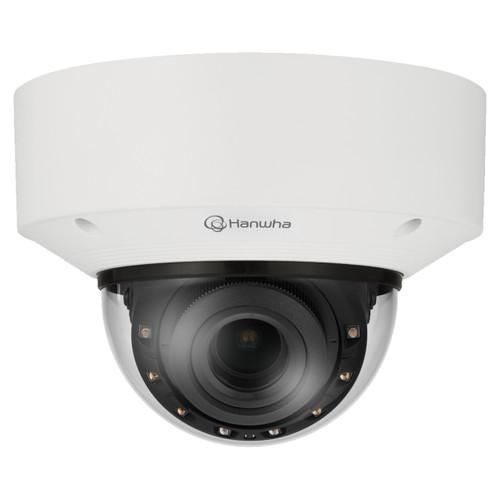
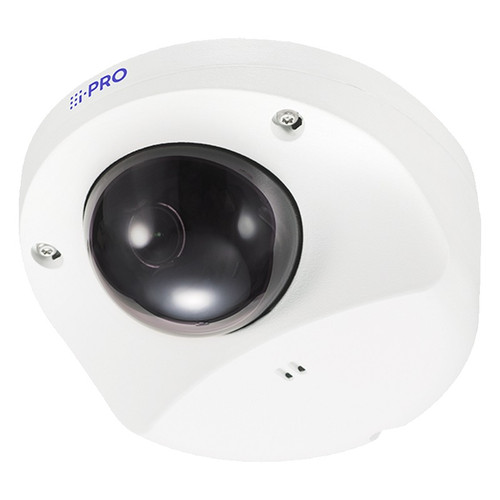
Both the Hanwha XNV-C7083R and the i-PRO WV-S35402-F2LG are 4MP outdoor vandal-resistant dome cameras rated IP66/IK10, targeting the same installation tier: perimeter and general surveillance on a single PoE drop. The Hanwha brings a motorized varifocal lens, longer IR throw, and a higher frame rate, while the i-PRO offers a wider fixed field of view, a lighter form factor, and a notably higher WDR ceiling. This comparison covers imaging performance, installation fit, and VMS/analytics integration to help integrators choose the right unit for a given deployment.
In This Guide
How do the imaging specs compare?
The XNV-C7083R uses a 1/2.8" progressive CMOS sensor and outputs 2592×1520 at up to 60 fps, doubling the frame rate of the WV-S35402-F2LG, which is rated at 25/30 fps at its maximum 2560×1440 resolution. The Hanwha's motorized varifocal lens spans 2.8–10 mm (3.6× zoom, F1.4 wide) versus the i-PRO's fixed 2.4 mm (F2.1) lens; the fixed lens delivers a wider 121° horizontal field of view compared to the Hanwha's 110° at the wide end, but the Hanwha can narrow to tele for detail work without a physical lens swap. Low-light color sensitivity favors the Hanwha significantly: 0.038 lux versus 0.19 lux (30 IRE) for the i-PRO.
IR performance is substantially different: the XNV-C7083R's WiseIR reaches 40 m (131 ft) at 0 lux, while the WV-S35402-F2LG's IR LED is rated to 14 m (high) / 10 m (medium). DORI figures reflect this — at the Detect threshold the Hanwha reaches 36.3 m (wide) to 193.5 m (tele) versus 29.0 m for the i-PRO. On WDR, the i-PRO's Super Dynamic tops out at 132 dB (level 31) against the Hanwha's extremeWDR rated at 120 dB, giving the i-PRO a 12 dB edge in high-contrast scenes. The i-PRO specs a fixed focal length only; no optical zoom is listed. Digital Noise Reduction is present on both, with the Hanwha citing an AI-assisted WiseNR II engine and the i-PRO offering a 0–255 adjustable DNR level.
What about installation and environment?
Both cameras share IP66, NEMA 4X, and IK10 ratings, making either suitable for outdoor vandal-exposed mounting. Operating temperature ranges are nearly identical: −40 °C to +55 °C for the Hanwha versus −40 °C to +50 °C for the i-PRO, a 5 °C advantage for the Hanwha at the upper end. The XNV-C7083R is powered by PoE (IEEE 802.3af, Class 3, 12.95 W max) or 12 VDC; the WV-S35402-F2LG is PoE only (Class 0 per product data, IEEE 802.3af, 8.6 W max), so the i-PRO draws less power and needs no secondary power run.
Form factor differs considerably. The Hanwha is a full-size dome: ø160×118 mm, 1,450 g, with pan 0–360°, tilt −45° to +75°, and rotate 0–355° adjustment ranges plus conduit knockout options (1/2" / M20) and a listed optional hanging mount (SBP-167HMW). The i-PRO is a compact dome: 109×53×119 mm, approximately 475 g — roughly one-third the weight — with pan ±45° and tilt 0–90° adjustment. The i-PRO also specifies a wind resistance rating of up to 40 m/s (~89 mph); the Hanwha does not list a wind resistance figure. The Hanwha's enclosure is aluminum with a hard-coated dome bubble; the i-PRO is aluminum die-cast.
Which fits your VMS and analytics better?
Both cameras support ONVIF Profile G/M/S/T. The Hanwha also adds SUNAPI and Wisenet API support. Protocol stacks are broadly similar (IPv4/IPv6, HTTPS/SSL, MQTT, SNMPv1/v2c/v3, SRTP); the i-PRO additionally lists SFTP. The Hanwha supports up to 20 unicast users and up to 10 stream profiles with 3 virtual channels; the i-PRO supports up to 14 simultaneous users. Security features on the Hanwha include 802.1X (EAP-TLS/LEAP/PEAP), pre-installed device certificate, and IP filtering; the i-PRO lists 802.1X and signed firmware. Smart codec on the Hanwha is WiseStream II/III; the i-PRO does not specify an equivalent bandwidth-reduction codec by name.
On-board AI analytics differ in scope. The Hanwha classifies person, face, vehicle (with sub-type: car/bus/truck/motorcycle/bicycle), and license plate, and adds business intelligence functions — people counting, queue management, and heatmap — plus virtual line and virtual area trip events, with 8-zone polygonal motion detection. The i-PRO provides AI Motion, Face, People, Vehicle, Non-Mask detection, occupancy detection, and AI sound classification (gunshot, yell, vehicle horn, glass break), with 4-area VMD and 1-area scene change detection. Audio: the Hanwha has a configurable mic/line-in input (2.5 VDC supply) and a line-out; the i-PRO specifies audio detection and AI sound classification but the product fields indicate a built-in mic only (no line-out listed). Both support microSD/SDHC/SDXC up to 512 GB for edge storage.
Which should you choose: the C7083R or the S35402-F2LG?
Our take: The XNV-C7083R is the stronger choice when IR range, frame rate, or remote zoom flexibility are the deciding factors. Its 40 m IR throw is nearly 3× the i-PRO's 14 m high setting, its 60 fps capture rate doubles the i-PRO's 30 fps ceiling, and its 3.6× motorized varifocal lens (2.8–10 mm) lets installers adjust coverage remotely without a ladder — the WV-S35402-F2LG offers a fixed 2.4 mm lens only. The i-PRO counters with a higher rated WDR ceiling (132 dB vs. 120 dB), a significantly lighter and more compact form factor (475 g vs. 1,450 g), lower power draw (8.6 W vs. 12.95 W), AI sound classification absent from the Hanwha, and a longer stated warranty (5 years vs. 3 years). Choose the i-PRO where mounting weight, acoustic AI, or superior WDR in near-daylight high-contrast scenes take priority and IR range beyond 14 m is not required.
Side-by-Side Comparison
Spec-for-spec, from manufacturer data.
| Specification | Hanwha C7083R | i-PRO S35402-F2LG |
|---|---|---|
| Resolution | 2592×1520 (4MP) | 2560×1440 (4MP, 16:9) / 2048×1536 (4:3) |
| Image Sensor | 1/2.8" progressive CMOS | Approx. 1/2.8" type CMOS |
| Lens / Focal Length | 2.8–10 mm motorized varifocal (3.6×), F1.4–F3.0 | 2.4 mm fixed, F2.1 |
| Horizontal Field of View | 110° (wide end) | 121° |
| Min. Illumination (Color) | 0.038 lux | 0.19 lux @ 30 IRE / 0.27 lux @ 50 IRE |
| Min. Illumination (B&W / IR) | 0 lux (IR) | 0.16 lux B&W; 0 lux (with IR) |
| IR Range | 40 m (131 ft) — WiseIR | 14 m (high) / 10 m (medium) |
| Wide Dynamic Range | 120 dB (extremeWDR) | 132 dB max (Super Dynamic, level 31) |
| Max Frame Rate | 60 fps @ 4MP | 25/30 fps |
| Video Compression | H.265, H.264 (Main/Baseline/High), MJPEG | H.265, H.264, MJPEG |
| IP / NEMA Rating | IP66 / IP67, NEMA 4X | IP66, NEMA 4X |
| Impact Rating | IK10 | IK10 |
| Operating Temperature | −40 °C to +55 °C | −40 °C to +50 °C |
| Power Input / PoE Class | PoE IEEE 802.3af Class 3 or 12 VDC; 12.95 W max | PoE IEEE 802.3af (Class 0 per spec); 8.6 W max |
| Edge Storage | microSD/SDHC/SDXC up to 512 GB (1 slot) | microSDXC/SDHC/SD up to 512 GB (option) |
| Audio | Mic in / Line in; Line out | Built-in mic; audio detection; AI sound classification |
| Dimensions / Weight | ø160×118 mm / 1,450 g | 109×53×119 mm / approx. 475 g |
| Warranty | 3-year | 5-year |
Frequently Asked Questions
Which should you choose: the C7083R or the S35402-F2LG?
The XNV-C7083R is the stronger choice when IR range, frame rate, or remote zoom flexibility are the deciding factors. Its 40 m IR throw is nearly 3× the i-PRO's 14 m high setting, its 60 fps capture rate doubles the i-PRO's 30 fps ceiling, and its 3.6× motorized varifocal lens (2.8–10 mm) lets installers adjust coverage remotely without a ladder — the WV-S35402-F2LG offers a fixed 2.4 mm lens only. The i-PRO counters with a higher rated WDR ceiling (132 dB vs. 120 dB), a significantly lighter and more compact form factor (475 g vs. 1,450 g), lower power draw (8.6 W vs. 12.95 W), AI sound classification absent from the Hanwha, and a longer stated warranty (5 years vs. 3 years). Choose the i-PRO where mounting weight, acoustic AI, or superior WDR in near-daylight high-contrast scenes take priority and IR range beyond 14 m is not required.
Is the XNV-C7083R or WV-S35402-F2LG better for low-light and IR coverage?
The XNV-C7083R has a clear advantage in both metrics. Its color minimum illumination is 0.038 lux versus 0.19 lux (30 IRE) for the WV-S35402-F2LG, and its WiseIR range reaches 40 m (131 ft) at 0 lux compared to 14 m (high) / 10 m (medium) for the i-PRO. For scenes requiring IR coverage beyond roughly 14 m, the Hanwha is the only option of the two.
Which camera handles extreme backlight and high-contrast scenes better?
Based on rated WDR figures, the WV-S35402-F2LG has a higher ceiling: 132 dB (Super Dynamic, level 31) versus 120 dB (extremeWDR) for the XNV-C7083R. If the primary challenge is strong backlight — such as entry doors facing bright sky — the i-PRO's 12 dB higher WDR rating is a meaningful spec advantage, though real-world performance depends on scene conditions not captured by a single dB rating.
Can I reuse the same PoE switch port for both cameras without upgrading infrastructure?
Both cameras are IEEE 802.3af PoE compatible. The WV-S35402-F2LG draws a maximum of 8.6 W (PoE Class 0 per product data), while the XNV-C7083R draws up to 12.95 W (PoE Class 3). A standard 802.3af port delivers up to 15.4 W, so either camera fits within that budget. However, if you are budgeting switch port power allocation across many ports, the i-PRO's lower draw provides more headroom per port.
Get a Second Opinion on Your Camera Choice
Share your site layout, coverage goals, and budget. Our team will validate the camera selection, flag anything we would change, and recommend products that match the use case.