
Hanwha C12083RVD vs i-PRO X22700-V2L: Specification Comparison
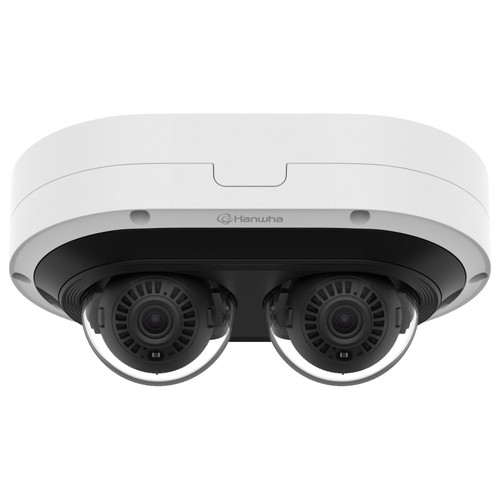
Both the Hanwha PNM-C12083RVD and the i-PRO WV-X22700-V2L are 12MP fixed-lens outdoor/indoor dome cameras powered by PoE+, targeted at installers who need high-resolution AI-driven video in a compact dome housing. The Hanwha is a dual-sensor 2×6MP outdoor unit with a 1.9× motorized varifocal and IR to 25 m, while the i-PRO is a single-sensor 12MP 4K indoor dome with a 2.0× motorized varifocal and IR to 70 m. This comparison covers imaging, installation environment, and platform integration across both models.

In This Guide
How do the imaging specs compare?
The Hanwha PNM-C12083RVD uses two 1/2.8" CMOS sensors, each delivering 6MP (3328×1872) at up to 15 fps, for a combined 12MP field of view split across two channels. Its motorized varifocal lens spans 3.54–6.69 mm (1.9× zoom) with a maximum aperture of F1.67 (Wide) / F2.64 (Tele), and minimum illumination is rated at 0.16 lux color / 0 lux with IR. Dynamic range reaches 120 dB via Hanwha's extremeWDR. IR illumination is specified at 15 m typical and 25 m scene-dependent. The i-PRO WV-X22700-V2L uses a single approx. 1/1.8" CMOS sensor producing 12MP natively at 30 fps, with a 4.3–8.6 mm motorized varifocal (2.0× optical, extendable to 12× digital at reduced resolution) and a maximum aperture of F1.5 (Wide) / F2.4 (Tele). Minimum illumination is 0.03 lux in B&W with IR, and Super Dynamic WDR reaches 132 dB at maximum level. IR range is rated at 70 m.
Frame rate is a clear differentiator: the i-PRO runs at 30 fps versus the Hanwha's 15 fps, which matters in scenes with fast-moving subjects. The i-PRO also has a notably lower minimum illumination (0.03 lux vs. 0.16 lux) and longer IR range (70 m vs. 25 m), giving it a decisive low-light and long-range advantage. The Hanwha counters with a wider angular field at the wide end (96° H vs. 101° H i-PRO—comparable) but covers two independent channels simultaneously, which is architecturally different: it provides two 6MP streams rather than one 12MP stream. DORI detection distance at the Tele end is close: Hanwha 153.1 m vs. i-PRO 157.5 m (both at 25 ppm). The i-PRO additionally includes an image stabilizer (gyro-based, 30 fps) and fog compensation; neither spec is listed for the Hanwha.
What about installation and environment?
The Hanwha PNM-C12083RVD is rated IP66/IP67 and NEMA 4X, with IK10 vandal resistance, and is specified for outdoor use from −40°C to +55°C. It draws up to 21 W (typical 16.5 W) over PoE+ (IEEE 802.3at, Class 4), includes a metal-shielded RJ-45 (10/100/1000BASE-T), and weighs 1,330 g in an aluminum housing measuring 215×135×93.2 mm. Conduit compatibility covers 1/2" (M20), single/double gang, 4" octagon, and 4" square boxes. The i-PRO WV-X22700-V2L is rated IP67 and IK10 but carries an indoor environment rating per its specs, with an operating range of −10°C to +50°C (0°C lower bound when powered). It draws 14.0 W over PoE+ (Class 4) or 14.2 W on DC 12 V, and the RJ-45 is specified as 10BASE-T/100BASE-TX only (no Gigabit Ethernet stated). It weighs approximately 820 g in a compact ø129.5 mm × 102.5 mm aluminum/PC housing.
For outdoor or extreme-temperature deployments, the Hanwha's −40°C lower bound and explicit NEMA 4X / outdoor rating are significant advantages. The i-PRO's indoor designation and +0°C lower operating limit (when powered) make it unsuitable for unheated exterior enclosures without supplemental heating. The Hanwha's alarm I/O requires the optional SPM-4210 accessory box; the i-PRO has 3× alarm inputs, 1× alarm output, and 1× AUX output built in, simplifying wiring for door contacts or external devices.
Which fits your VMS and analytics better?
Both cameras support ONVIF and H.265/H.264/MJPEG compression with CBR/VBR bitrate control and multicast streaming. The Hanwha supports ONVIF Profile S/T and Hanwha's SUNAPI (HTTP API) open platform; the i-PRO supports ONVIF Profile G/S/T/M, including Profile G for on-camera recording and Profile M for metadata. The i-PRO also adds SFTP, MQTT, and SRTP to its protocol list, plus G.726, G.711, and AAC-LC audio compression with a built-in 3.5 mm stereo audio input/output and AI sound classification (Gunshot, Yell, Vehicle Horn, Glass Break). The Hanwha requires the optional SPM-4210 I/O box for audio in and out. Edge storage on both supports microSD/SDHC/SDXC up to 512 GB (1 slot each).
AI analytics on the Hanwha include object detection for Person, Face, Vehicle, and License Plate, plus vehicle-type classification (Car, Bus, Truck, Motorcycle, Bicycle) and BestShot. The i-PRO covers AI Video Motion, Face, People, and Vehicle Detection, plus scene change detection, audio detection, and AI sound classification—but does not list license plate or vehicle-type classification in the provided specs. The i-PRO is confirmed to support signed firmware and secure boot; the Hanwha lists TPM 2.0 (FIPS 140-2 Level 2) and 802.1X (EAP-TLS/LEAP/PEAP). The i-PRO specifies FIPS 140-2 Level 3. The i-PRO supports up to 14 simultaneous users; the Hanwha specifies 10 unicast users per channel.
Which should you choose: the C12083RVD or the X22700-V2L?
Our take: The i-PRO WV-X22700-V2L is the stronger choice when maximum low-light performance, longer IR range, and higher frame rate are the primary requirements in a controlled indoor or sheltered installation. Its 0.03 lux minimum illumination versus the Hanwha's 0.16 lux, 70 m IR versus 25 m, and 30 fps versus 15 fps represent concrete, spec-backed advantages for fast-moving scenes or long-corridor coverage. It also ships with built-in alarm I/O and audio ports, eliminating the optional SPM-4210 accessory the Hanwha requires. The Hanwha PNM-C12083RVD is the better fit when outdoor deployment is required—its −40°C operating floor and NEMA 4X / IP66/IP67 outdoor rating far exceed the i-PRO's −10°C lower bound and indoor designation—and when dual-channel simultaneous viewing or license plate / vehicle-type AI classification are project requirements. Buyers on a Wisenet VMS will also benefit from the Hanwha's SUNAPI integration. Warrant period: i-PRO is 5 years; Hanwha is 3 years.
Side-by-Side Comparison
Spec-for-spec, from manufacturer data.
| Specification | Hanwha C12083RVD | i-PRO X22700-V2L |
|---|---|---|
| Resolution | 12MP total (2× 6MP / 3328×1872 per channel) | 12MP (3840×2160 native 4K) |
| Image Sensor | 1/2.8" CMOS × 2 channels | Approx. 1/1.8" CMOS (single sensor) |
| Max Frame Rate | 15 fps @ 6MP | 30 fps @ 12MP |
| Lens / Focal Length | 3.54–6.69 mm motorized varifocal (1.9× optical) | 4.3–8.6 mm motorized varifocal (2.0× optical, up to 12× digital) |
| Max Aperture | F1.67 (Wide) / F2.64 (Tele) | F1.5 (Wide) / F2.4 (Tele) |
| Min. Illumination | 0.16 lux color / 0 lux (IR on) | 0.03 lux B&W (IR on) |
| IR Range | 15 m typical / 25 m scene-dependent | 70 m |
| WDR | 120 dB (extremeWDR) | 132 dB (Super Dynamic, Level 31) |
| IP Rating | IP66 / IP67 | IP67 |
| IK / Impact Rating | IK10 | IK10 |
| Operating Temperature | −40°C to +55°C | −10°C to +50°C (0°C lower when powered) |
| Environment Rating | Outdoor (NEMA 4X) | Indoor |
| Power Input / PoE Class | PoE+ (IEEE 802.3at, Class 4) — max 21 W | PoE+ (IEEE 802.3at, Class 4) — 14.0 W |
| Edge Storage | microSD/SDHC/SDXC, 1 slot, max 512 GB | microSD/SDHC/SDXC, 1 slot, max 512 GB |
| Audio (built-in) | — (requires optional SPM-4210 I/O box) | 3.5 mm stereo in + 3.5 mm stereo out (built-in) |
| ONVIF Profile | Profile S / T | Profile G / S / T / M |
| AI Analytics | Person, Face, Vehicle, License Plate, Vehicle-type classification (Car, Bus, Truck, Motorcycle, Bicycle), BestShot | AI Video Motion, Face, People, Vehicle Detection, AI Sound Classification (Gunshot, Yell, Vehicle Horn, Glass Break) |
| Alarm I/O (built-in) | — (requires optional SPM-4210 I/O box) | 3× Alarm IN, 1× Alarm OUT, 1× AUX OUT |
| Security / Encryption | TPM 2.0 (FIPS 140-2 Level 2), 802.1X (EAP-TLS/LEAP/PEAP) | FIPS 140-2 Level 3, HTTPS, signed firmware, secure boot |
| Dimensions | 215 × 135 × 93.2 mm (8.46" × 5.31" × 3.67") | ø129.5 mm × 102.5 mm H (ø5-3/32" × 4-1/32" H) |
| Weight | 1,330 g | Approx. 820 g |
| Warranty | 3 years | 5 years |
Frequently Asked Questions
Which should you choose: the C12083RVD or the X22700-V2L?
The i-PRO WV-X22700-V2L is the stronger choice when maximum low-light performance, longer IR range, and higher frame rate are the primary requirements in a controlled indoor or sheltered installation. Its 0.03 lux minimum illumination versus the Hanwha's 0.16 lux, 70 m IR versus 25 m, and 30 fps versus 15 fps represent concrete, spec-backed advantages for fast-moving scenes or long-corridor coverage. It also ships with built-in alarm I/O and audio ports, eliminating the optional SPM-4210 accessory the Hanwha requires. The Hanwha PNM-C12083RVD is the better fit when outdoor deployment is required—its −40°C operating floor and NEMA 4X / IP66/IP67 outdoor rating far exceed the i-PRO's −10°C lower bound and indoor designation—and when dual-channel simultaneous viewing or license plate / vehicle-type AI classification are project requirements. Buyers on a Wisenet VMS will also benefit from the Hanwha's SUNAPI integration. Warrant period: i-PRO is 5 years; Hanwha is 3 years.
Is the C12083RVD or X22700-V2L better for low-light performance?
Based on the provided specs, the i-PRO X22700-V2L has a clear low-light advantage: its minimum illumination is 0.03 lux (B&W with IR) versus the Hanwha C12083RVD's 0.16 lux color / 0 lux with IR active. The i-PRO also has a longer IR range of 70 m compared to the Hanwha's 15–25 m. Additionally, the i-PRO's Super Dynamic WDR reaches 132 dB versus the Hanwha's 120 dB extremeWDR.
Can either camera be installed outdoors without an enclosure?
The Hanwha C12083RVD is rated for outdoor use with IP66/IP67, NEMA 4X, and an operating range of −40°C to +55°C—it is designed for direct outdoor installation. The i-PRO X22700-V2L carries an IP67 ingress rating and IK10 impact rating, but its spec sheet designates it as an indoor camera with an operating range of −10°C to +50°C (lower bound 0°C when powered). Installing the i-PRO outdoors in unheated or sub-zero environments is outside its stated operating specification.
Does either camera include built-in audio without accessories?
Yes—the i-PRO X22700-V2L includes a built-in 3.5 mm stereo audio input and a 3.5 mm stereo audio output with support for G.726, G.711, and AAC-LC compression, plus AI sound classification (Gunshot, Yell, Vehicle Horn, Glass Break), all without additional hardware. The Hanwha C12083RVD requires the optional SPM-4210 I/O box for both audio input and audio output; neither is available natively on the camera body.
Get a Second Opinion on Your Camera Choice
Share your site layout, coverage goals, and budget. Our team will validate the camera selection, flag anything we would change, and recommend products that match the use case.