
Hanwha C12083RVD vs Hanwha PNM-12082RVD: Specification Comparison
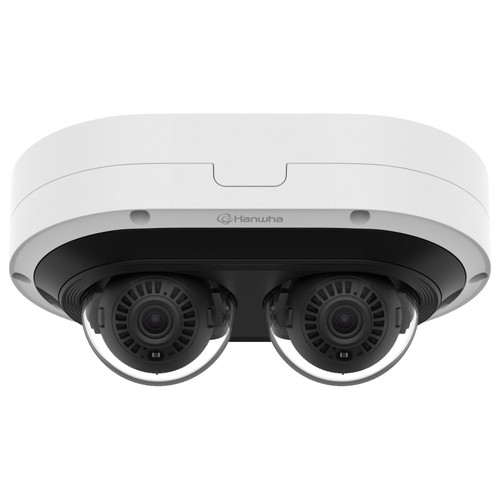
Both the Hanwha PNM-C12083RVD and the Hanwha PNM-12082RVD are 12MP dual-sensor outdoor dome cameras sharing the same physical chassis, lens, sensor count, and resolution class. Both target installers who need simultaneous dual-zone coverage from a single PoE+ drop. The comparison centers on differences in AI analytics engine, noise reduction generation, privacy masking depth, streaming capacity, and power draw — the practical deltas that drive model selection for a given site.

In This Guide
How do the imaging specs compare?
Both cameras use two 1/2.8" CMOS sensors delivering 6MP (3328×1872) per channel at 15fps, with identical minimum illumination of 0.16 lux color and 0 lux IR, and the same 3.54–6.69mm (1.9×) motorized varifocal lens with F1.67 (wide) to F2.64 (tele) aperture. IR range is identically specified at 15m (49ft) typical and 25m (82ft) scene-dependent on both models. DORI distances are identical across all four levels: Detect 59.9m wide / 153.1m tele, Identify 6.0m wide / 15.3m tele.
The C12083RVD specifies WDR as extremeWDR at 120dB, and its noise reduction is listed as WiseNR II (AI-engine-based) plus SSNR V. The PNM-12082RVD also specifies extremeWDR at 120dB; however, its noise reduction is listed as WiseNR (without the AI-based 'II' designation) plus SSNR V. The C12083RVD adds AI-based object detection (Person, Face, Vehicle, License Plate) and vehicle-type classification (Car, Bus, Truck, Motorcycle, Bicycle) with BestShot support. The PNM-12082RVD lists rule-based analytics events (Defocus detection, Motion detection, Tampering, Virtual line, Virtual area/Loitering). The C12083RVD's backlight compensation list includes BLC, WDR, and SSDR; the PNM-12082RVD adds HLC (Highlight Compensation) and Defog to its list.
What about installation and environment?
Both cameras share an identical physical footprint: 215mm W × 135mm D × 93.2mm H (8.46" × 5.31" × 3.67"), 1,330g, white aluminum housing with hard-coated dome bubble, RAL9003 finish, and the same conduit/gangbox compatibility (1/2" M20; single, double, 4" octagon, 4" square). Both carry IP66/IP67, NEMA 4X, and IK10 ratings with identical operating range of −40°C to +55°C and storage range of −50°C to +60°C.
Power is where they diverge meaningfully. The C12083RVD draws PoE+ (802.3at, Class 4) at up to 21W typical 16.5W. The PNM-12082RVD draws PoE+ (802.3at, Class 4) at up to 18.3W typical 13.5W — a 2.7W lower typical draw that matters on switch-port budget calculations for large deployments. Both require PoE+; neither will operate on standard 802.3af. Mounting accessory SBP-215HMW is listed for both. Both RAM and flash are specified at 4GB RAM / 512MB Flash for the C12083RVD; the PNM-12082RVD spec lists 4GB RAM separately and 512MB storage separately, consistent with the same configuration.
Which fits your VMS and analytics better?
Both cameras support ONVIF Profile S/T, SUNAPI (HTTP API), and Open Platform, with identical protocol stacks and identical security credentials: TPM 2.0 (FIPS 140-2 Level 2), 802.1X (EAP-TLS/LEAP/PEAP), and Hanwha Techwin Root CA pre-installed device certificate. Edge storage is identical: one microSD/SDHC/SDXC slot, max 512GB. Video compression (H.265/H.264 Main/Baseline/High, MJPEG) and bitrate control (CBR/VBR) are the same on both.
Streaming capacity differs: the C12083RVD supports Unicast for up to 10 users with 5 profiles per channel, while the PNM-12082RVD supports Unicast for up to 20 users with up to 10 profiles total — a meaningful advantage for multi-client VMS environments or sites requiring more simultaneous stream consumers. Smart codec on the C12083RVD is listed as WiseStream II/III with manual 5-area; the PNM-12082RVD lists WiseStream II with manual 5-area only. Privacy masking on the C12083RVD is 6 zones (quadrangle, Gray/Black/White); the PNM-12082RVD offers 32 zones (4-point quadrangle) with six color options plus Mosaic — a clear advantage for privacy-sensitive deployments. Audio and alarm I/O on both require the optional SPM-4210 I/O accessory box.
Which should you choose: the C12083RVD or the PNM-12082RVD?
Our take: The C12083RVD is the stronger choice when AI-based classification at the edge — Person, Face, Vehicle, License Plate, and vehicle-type — is a site requirement, as the PNM-12082RVD offers only rule-based analytics (Virtual line, Loitering, Tampering) without that classification layer. Conversely, the PNM-12082RVD is the correct selection when the deployment demands higher concurrent stream capacity (20 vs. 10 unicast users), more privacy mask zones (32 vs. 6), additional color options including Mosaic masking, HLC and Defog backlight controls absent on the C12083RVD, or a lower PoE+ budget (13.5W typical vs. 16.5W). Both cameras deliver identical resolution, IR range, WDR (120dB), enclosure ratings (IP66/IP67, NEMA4X, IK10), and operating temperature (−40°C to +55°C). Platform choice is the deciding variable: AI-metadata-dependent VMS workflows favor the C12083RVD; high-density multi-client or privacy-sensitive sites favor the PNM-12082RVD.
Side-by-Side Comparison
Spec-for-spec, from manufacturer data.
| Specification | Hanwha C12083RVD | Hanwha PNM-12082RVD |
|---|---|---|
| Total Resolution | 12MP (2 × 6MP) | 12MP (2 × 6MP) |
| Per-Sensor Resolution | 6MP (3328×1872) | 6MP (3328×1872) |
| Image Sensor | 1/2.8" CMOS × 2CH | 1/2.8" CMOS × 2CH |
| Lens / Focal Length | 3.54–6.69mm motorized varifocal (1.9×) | 3.54–6.69mm motorized varifocal (1.9×) |
| Max Aperture | F1.67 (Wide) – F2.64 (Tele) | F1.67 (Wide) – F2.64 (Tele) |
| Min. Illumination | 0.16 lux color / 0 lux IR | 0.16 lux color / 0 lux IR |
| IR Range | 15m typical; 25m scene-dependent | 15m typical; 25m scene-dependent |
| Wide Dynamic Range | extremeWDR 120dB | extremeWDR 120dB |
| Noise Reduction | WiseNR II (AI-based) + SSNR V | WiseNR + SSNR V |
| Backlight / Image Controls | BLC, WDR, SSDR | BLC, HLC, WDR, SSDR, Defog |
| Edge Analytics | AI: Person, Face, Vehicle, License Plate, vehicle-type classification, BestShot | Rule-based: Defocus, Motion, Tampering, Virtual line, Virtual area (Loitering/Enter/Exit) |
| Privacy Masking | 6 zones, quadrangle, Gray/Black/White | 32 zones, 4-pt quadrangle, 6 colors + Mosaic |
| Max Frame Rate | 15fps @ 6MP per channel | 15fps @ 6MP per channel |
| Unicast Streaming / Profiles | 10 users; 5 profiles per channel | 20 users; up to 10 profiles total |
| Smart Codec | WiseStream II/III | WiseStream II |
| Video Compression | H.265/H.264 (Main/Baseline/High), MJPEG | H.265/H.264 (Main/Baseline/High), MJPEG |
| IP / Impact Rating | IP66/IP67, NEMA 4X, IK10 | IP66/IP67, NEMA 4X, IK10 |
| Operating Temperature | −40°C to +55°C | −40°C to +55°C |
| Power Input / PoE Class | PoE+ (802.3at), Class 4 | PoE+ (802.3at), Class 4 |
| Max / Typical Power Draw | 21W max / 16.5W typical | 18.3W max / 13.5W typical |
| Edge Storage | microSD/SDHC/SDXC, 1 slot, max 512GB | microSD/SDHC/SDXC, 1 slot, max 512GB |
| Audio I/O | Via optional SPM-4210 I/O box | Via optional SPM-4210 I/O box |
| ONVIF | Profile S/T | Profile S/T |
| Security | TPM 2.0 (FIPS 140-2 L2), 802.1X, device cert | TPM 2.0 (FIPS 140-2 L2), 802.1X, device cert |
| Dimensions (W×D×H) | 215×135×93.2mm (8.46"×5.31"×3.67") | 215×135×93.2mm (8.46"×5.31"×3.67") |
| Weight | 1,330g | 1,330g |
| Warranty | 3-year | 3-year |
Frequently Asked Questions
Which should you choose: the C12083RVD or the PNM-12082RVD?
The C12083RVD is the stronger choice when AI-based classification at the edge — Person, Face, Vehicle, License Plate, and vehicle-type — is a site requirement, as the PNM-12082RVD offers only rule-based analytics (Virtual line, Loitering, Tampering) without that classification layer. Conversely, the PNM-12082RVD is the correct selection when the deployment demands higher concurrent stream capacity (20 vs. 10 unicast users), more privacy mask zones (32 vs. 6), additional color options including Mosaic masking, HLC and Defog backlight controls absent on the C12083RVD, or a lower PoE+ budget (13.5W typical vs. 16.5W). Both cameras deliver identical resolution, IR range, WDR (120dB), enclosure ratings (IP66/IP67, NEMA4X, IK10), and operating temperature (−40°C to +55°C). Platform choice is the deciding variable: AI-metadata-dependent VMS workflows favor the C12083RVD; high-density multi-client or privacy-sensitive sites favor the PNM-12082RVD.
Is the PNM-C12083RVD or PNM-12082RVD better for low-light performance?
Based on the provided specifications, both cameras are identical in low-light performance: minimum illumination is 0.16 lux color and 0 lux IR on both models, IR range is 15m typical and 25m scene-dependent on both, and both use the same 1/2.8" CMOS dual-sensor array. No low-light advantage for either model can be derived from the supplied specs.
Can either camera run on a standard PoE switch without PoE+?
No. Both the PNM-C12083RVD and PNM-12082RVD are specified as PoE+ (IEEE 802.3at, Class 4) only. The C12083RVD draws up to 21W (16.5W typical) and the PNM-12082RVD up to 18.3W (13.5W typical) — both exceed the 15.4W ceiling of standard 802.3af. A PoE+ capable switch or injector is required for either model.
Which model supports more privacy masking zones — the C12083RVD or PNM-12082RVD?
The PNM-12082RVD supports significantly more: 32 privacy mask zones with four-point quadrangle shape, six color options (Grey, Green, Red, Blue, Black, White), and Mosaic masking. The PNM-C12083RVD is limited to 6 zones (quadrangle) in Gray, Black, or White only, with no Mosaic option specified. For sites with regulatory privacy-masking requirements covering multiple windows or doorways, the PNM-12082RVD provides substantially greater flexibility.
Get a Second Opinion on Your Camera Choice
Share your site layout, coverage goals, and budget. Our team will validate the camera selection, flag anything we would change, and recommend products that match the use case.