
ACTi B76A vs Hanwha C12083RVD: Specification Comparison
Both the ACTi B76A and Hanwha PNM-C12083RVD are 12MP outdoor IP cameras aimed at commercial and industrial deployments, but they approach that resolution very differently: the B76A delivers 12MP via a single fixed-focal hemispheric lens for 360°×180° panoramic coverage, while the C12083RVD splits 12MP across two 6MP motorized varifocal sensors in a conventional dome housing. Buyers choosing between them are typically weighing full-scene situational awareness against directed, adjustable-zoom coverage on a shared PoE+ budget.
In This Guide
How do the imaging specs compare?
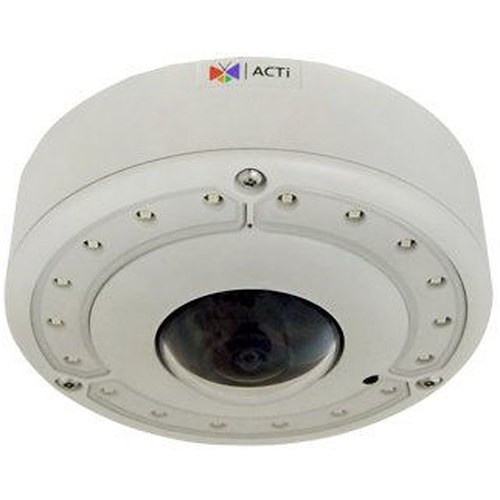
The ACTi B76A uses a single 1/1.7-inch sensor at 12MP (up to 4000×3000 at 18 fps or 2048×2048 at 30 fps) with a fixed 1.65mm board-mount lens producing a full hemispheric 360°×180° field of view. WDR is rated at 130dB, minimum illumination is 0.003 lux color (0 lux B/W with IR on), and built-in 850nm IR covers up to 20m. Compression is H.264 (Baseline/Main/High) and MJPEG only — H.265 is not listed for this model.
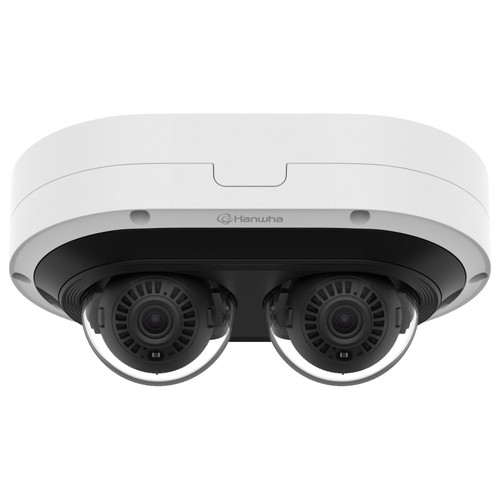
The Hanwha PNM-C12083RVD uses two 1/2.8-inch CMOS sensors, each at 6MP (3328×1872), capped at 15fps per channel. The motorized varifocal lens runs 3.54–6.69mm (1.9× zoom, F1.67 wide to F2.64 tele) with horizontal FoV of 96°–47°, giving adjustable but non-panoramic coverage. WDR is rated extremeWDR at 120dB. Minimum illumination is 0.16 lux color / 0 lux IR, notably higher (less sensitive in ambient light) than the B76A's 0.003 lux. IR reach is 15m typical, 25m scene-dependent. The C12083RVD supports H.265/H.264/MJPEG and adds WiseStream II/III smart codec plus hardware-backed TPM 2.0 security.
What about installation and environment?
The B76A carries IP68 (continuous submersion), IK10, NEMA 4X, and UL 60950-1 listings, making it one of the more hardened ratings in this class — IP68 exceeds the C12083RVD's IP66/IP67 for true submersion scenarios. Both are IK10 and NEMA 4X rated. Operating temperature range for the B76A is -40°C to +50°C; the C12083RVD extends slightly higher to +55°C. Power for the B76A is PoE Class 3 (802.3af/at) or DC 12V; the C12083RVD requires PoE+ Class 4 at up to 21W typical 16.5W, demanding a Class 4-capable switch or injector.
The B76A ships with a 2m cable tail and supports wall, pole, pendant, corner, and rack mounting. It weighs 936g. The C12083RVD is a 215×135×93.2mm aluminum dome weighing 1330g, compatible with 1/2-inch conduit (M20) and standard single/double/4-inch gangboxes; an optional SBP-215HMW hanging mount is listed. Audio I/O and alarm I/O on the C12083RVD require the optional SPM-4210 accessory box — neither is built in.
Which fits your VMS and analytics better?
The B76A is ONVIF Profile S, G, T, Q, and M compliant (M via future firmware) and supports VMD and People Counting as on-board analytics. It includes a built-in microphone plus line-in and line-out — native audio without additional hardware. No on-board edge storage slot is listed in the provided specs.
The C12083RVD supports ONVIF Profile S/T plus Hanwha's SUNAPI (HTTP API) and Open Platform. Analytics are AI-engine-based and substantially richer: person, face, vehicle, license plate detection, vehicle-type classification (car, bus, truck, motorcycle, bicycle), BestShot support, and 8-zone polygonal motion detection. On-board edge storage supports microSD/SDHC/SDXC up to 512GB (1 slot). The camera carries 4GB RAM and 512MB flash. Audio and alarm I/O require the optional SPM-4210 box. Security credentials include TPM 2.0 (FIPS 140-2 level 2), 802.1X (EAP-TLS/LEAP/PEAP), and device certificate pre-installed.
Which should you choose: the B76A or the C12083RVD?
Our take: The B76A is the stronger choice when the installation goal is eliminating blind spots with a single camera — its 360°×180° hemispheric view, IP68 submersion rating, 130dB WDR, and 0.003 lux color sensitivity (versus 0.16 lux on the C12083RVD) favor washdown-rated industrial or perimeter sites where ambient light is scarce and full-scene coverage matters more than directional zoom. The C12083RVD is the stronger choice when the site needs AI-driven object classification, adjustable coverage via the 1.9× motorized varifocal lens, 512GB on-board edge storage, or a hardened cyber-security posture (TPM 2.0, FIPS 140-2). Note the C12083RVD's 15fps cap versus the B76A's 30fps at 2048×2048, the C12083RVD's higher power draw (Class 4, up to 21W versus Class 3), and that native audio on the C12083RVD requires the optional SPM-4210 I/O box. Choose based on scene geometry and analytics requirements.
Side-by-Side Comparison
Spec-for-spec, from manufacturer data.
| Specification | ACTi B76A | Hanwha C12083RVD |
|---|---|---|
| Product Type | Hemispheric Dome (360°×180°) | Dual-sensor Varifocal Dome (2×6MP) |
| Total Resolution | 12MP (single sensor) | 12MP (2 × 6MP sensors, 3328×1872 each) |
| Image Sensor | 1/1.7-inch CMOS | 1/2.8-inch CMOS × 2 |
| Lens / Focal Length | 1.65mm fixed (board mount) | 3.54–6.69mm motorized varifocal (1.9×), F1.67–F2.64 |
| Min. Illumination | 0.003 lux color; 0 lux B/W (IR on) | 0.16 lux color; 0 lux IR |
| IR Range | 20m (850nm) | 15m typical; 25m scene-dependent |
| WDR | 130dB | extremeWDR 120dB |
| Max Frame Rate | 30fps @ 2048×2048; 18fps @ 4000×3000 | 15fps @ 6MP per channel |
| Video Compression | H.264 (Baseline/Main/High); MJPEG | H.265/H.264 (Main/Baseline/High); MJPEG; WiseStream II/III |
| IP Rating | IP68 | IP66/IP67 |
| IK / Impact Rating | IK10 | IK10 |
| NEMA Rating | NEMA 4X | NEMA 4X |
| Operating Temperature | -40°C to +50°C | -40°C to +55°C |
| Power Input / PoE Class | PoE Class 3 (802.3af/at) or DC 12V | PoE+ Class 4 (802.3at); max 21W, typical 16.5W |
| Edge Storage | — | microSD/SDHC/SDXC up to 512GB (1 slot) |
| Audio | Built-in mic; line-in; line-out (native) | Via optional SPM-4210 I/O box only |
| On-board Analytics | VMD; People Counting | AI: Person/Face/Vehicle/LPR; vehicle-type classification; BestShot; 8-zone polygonal motion |
| ONVIF | Profile S, G, T, Q, M (M via firmware) | Profile S, T; SUNAPI; Open Platform |
| Security / Cyber | — | TPM 2.0 (FIPS 140-2 L2); 802.1X; device certificate |
| Weight | 936g (2.064 lb) | 1330g |
| Certifications | CE-B; FCC-B; EAC; CB; UL 60950-1; IP68; IK10; NEMA 4X | UL 62368-1; FCC Class A; CE/UKCA; IP66/67; IK10; NEMA 4X; VCCI; RCM |
| Warranty | — | 3-year warranty |
Frequently Asked Questions
Which should you choose: the B76A or the C12083RVD?
The B76A is the stronger choice when the installation goal is eliminating blind spots with a single camera — its 360°×180° hemispheric view, IP68 submersion rating, 130dB WDR, and 0.003 lux color sensitivity (versus 0.16 lux on the C12083RVD) favor washdown-rated industrial or perimeter sites where ambient light is scarce and full-scene coverage matters more than directional zoom. The C12083RVD is the stronger choice when the site needs AI-driven object classification, adjustable coverage via the 1.9× motorized varifocal lens, 512GB on-board edge storage, or a hardened cyber-security posture (TPM 2.0, FIPS 140-2). Note the C12083RVD's 15fps cap versus the B76A's 30fps at 2048×2048, the C12083RVD's higher power draw (Class 4, up to 21W versus Class 3), and that native audio on the C12083RVD requires the optional SPM-4210 I/O box. Choose based on scene geometry and analytics requirements.
Is the B76A or PNM-C12083RVD better for low-light performance?
Based on the provided specs, the B76A has a significantly lower minimum illumination of 0.003 lux color (0 lux B/W with IR on) compared to the C12083RVD's 0.16 lux color (0 lux IR). The B76A's IR also covers 20m versus the C12083RVD's 15m typical (25m scene-dependent), so on minimum-illumination figures alone the B76A holds the advantage in near-dark environments.
Does either camera require a special PoE switch?
The C12083RVD requires PoE+ Class 4 (IEEE 802.3at) at up to 21W, so your switch or injector must support Class 4 output. The B76A is specified as PoE Class 3 (IEEE 802.3af/at) and also accepts DC 12V, giving it more flexibility with existing infrastructure that may not deliver full Class 4 budget per port.
Which camera has stronger AI analytics on board?
The C12083RVD's AI engine detects persons, faces, vehicles, and license plates, classifies vehicle type (car, bus, truck, motorcycle, bicycle), and supports BestShot. The B76A is listed with VMD (Video Motion Detection) and People Counting only. If AI-class object detection or license-plate recognition is a project requirement, the C12083RVD is the only option of the two that provides it per the supplied specifications.
Get a Second Opinion on Your Camera Choice
Share your site layout, coverage goals, and budget. Our team will validate the camera selection, flag anything we would change, and recommend products that match the use case.