
Digital Watchdog VA583WTIR vs Hanwha PNM-9085RQZ1: Specification Comparison
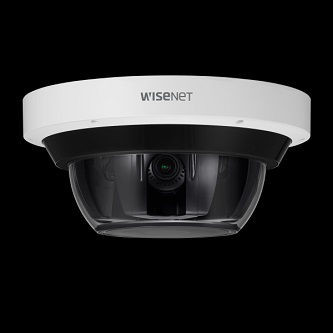
Both the Digital Watchdog DWC-VA583WTIR and the Hanwha PNM-9085RQZ1 are outdoor-rated, vandal-resistant IP cameras in the 5MP resolution class, but they serve meaningfully different deployment scenarios. The DW unit is a single-sensor coax-and-IP hybrid turret with PTZ-style varifocal control, while the Hanwha is a quad-sensor, four-channel motorized varifocal dome delivering 20MP aggregate coverage from one housing. Buyers cross-shopping these should weigh single-scene zoom flexibility against multi-direction simultaneous coverage from a single drop point.

In This Guide
How do the imaging specs compare?
The DWC-VA583WTIR uses a single 1/2.8" 5MP CMOS sensor (2608×1960 active pixels) with a motorized 2.7–13.5mm varifocal lens providing a 5× optical zoom range and a horizontal field of view of 85°–32°. It achieves 0.08 lux in color and 0.0 lux in B/W (Star-Light), with 80-foot Smart IR and 120dB True WDR. The PNM-9085RQZ1 mounts four independent 1/1.8" 5MP sensors (2560×1920 per channel) with 4.13–9.4mm motorized varifocal lenses (2.3× zoom, F1.92 wide). Its minimum illumination is 0.11 lux color / 0 lux IR, with 98-foot IR range and 120dB WDR (SSDR). The DW sensor is physically smaller (1/2.8" vs 1/1.8") which typically disadvantages low-light performance; the Hanwha's larger 1/1.8" sensors have a rated color minimum of 0.11 lux versus the DW's 0.08 lux—a marginal difference in rated numbers, though sensor size favors the Hanwha in practice.
On lens versatility, the DWC-VA583WTIR's 5× zoom range (2.7–13.5mm) gives substantially more reach for a single scene compared to the Hanwha's 2.3× (4.13–9.4mm). The Hanwha compensates with four independent channels: each lens covers H 87.58° / V 64.58° at wide, and DORI analytics report detection to 53.4m wide / 151.5m tele per channel. The DW specifies P-iris and auto-focus on its single lens; the Hanwha lists DC auto iris with simple focus. Frame rate: the DW lists variable (no explicit maximum stated in specs); the Hanwha specifies 30fps per channel. The Hanwha supports H.265/H.264/MJPEG with CBR/VBR and WiseStream II smart codec; the DW spec sheet does not list video compression formats or codecs.
What about installation and environment?
Both cameras carry IP66 and IK10 ratings and white aluminum housings. The Hanwha adds NEMA 4X certification, which the DW does not specify. Operating temperature range differs significantly: the DWC-VA583WTIR is rated −20°C to +50°C (−4°F to +122°F), while the PNM-9085RQZ1 is rated −40°C to +55°C (−40°F to +131°F), giving it a 20°C cold-weather advantage relevant to northern or high-altitude deployments. The Hanwha also specifies a storage temperature down to −50°C.
Power requirements diverge substantially. The DWC-VA583WTIR accepts 24VAC or 12VDC and draws a maximum of 6.27W; the product page also notes PoE, but the formal spec lists 24VAC/12VDC as power requirements—installers should confirm PoE compliance from the datasheet before planning infrastructure. The PNM-9085RQZ1 requires HPoE (IEEE 802.3bt Class 6 / Type 3, PoE++) or 12VDC, with a maximum draw of 45W—a direct consequence of powering four sensors, IR arrays, and motorized lenses from one cable. A PoE++ (802.3bt) switch port or injector is mandatory for the Hanwha. The DW turret measures 125×122mm and weighs 0.72kg; the Hanwha dome is Ø315×145.9mm and weighs 5.2kg (11.5lb), requiring appropriate structural mounting. The Hanwha specifies a compatible hanging mount (SBP-317HMW) and 3/4" conduit knockout; the DW notes mounting accessories are optional and sold separately.
Which fits your VMS and analytics better?
The Hanwha PNM-9085RQZ1 provides explicit ONVIF Profile S/T compliance, SUNAPI (HTTP API), and Wisenet open platform support. It streams up to 10 configurable profiles, supports unicast (20 users) and multicast, and lists an extensive protocol stack including IPv4/IPv6, HTTPS/SSL, 802.1X (EAP-TLS, EAP-LEAP), SNMPv1/v2c/v3, and more. On-board analytics include defocus detection, directional detection, fog detection, face detection, appear/disappear, enter/exit, loitering, tampering, virtual line, and audio detection. It has 1 alarm input and 1 alarm output, built-in audio in (mic/line selectable) and line out, and four microSD card slots supporting up to 256GB each (1TB total on-board edge storage across channels). The DW spec lists no ONVIF compliance, no listed video compression standard, no protocol stack, no alarm I/O, no audio, and no edge storage—none of these capabilities are documented in the provided specifications.
The DWC-VA583WTIR does specify camera control via Pelco C and UTC protocols, 24 programmable privacy zones, and motion detection. It supports CVBS, 960H, HD-Analog, HD-CVI, HD-TVI, and HD over Coax signal outputs in addition to presumably IP output—making it a hybrid analog/IP camera suited for mixed or coax-based infrastructure upgrades. The Hanwha is a pure IP camera. Buyers running a Wisenet VMS or requiring deep analytics, edge recording redundancy, or IP-native protocol depth will find the Hanwha far more capable on integration; buyers migrating from coax or running legacy analog systems may find the DW's hybrid output set uniquely useful.
Which should you choose: the VA583WTIR or the PNM-9085RQZ1?
Our take: The PNM-9085RQZ1 is the stronger choice when the deployment demands multi-direction simultaneous 5MP coverage, deep IP integration, cold-weather reliability, or robust on-board analytics from a single cable drop. Three concrete spec deltas illustrate the gap: the Hanwha delivers four independent 1/1.8" 5MP channels (20MP aggregate) versus the DW's single 1/2.8" sensor; it operates to −40°C versus the DW's −20°C floor; and it provides 1TB of distributed edge storage across four microSD slots, ONVIF S/T, 802.1X security, and a full analytics suite—none of which are documented in the DW's spec sheet. The DWC-VA583WTIR is the appropriate choice when the infrastructure is coax-based or hybrid analog/IP, when a 5× varifocal zoom range on a single scene is required, when PoE++ switch capacity is unavailable, or when budget and weight constraints favor a lightweight 0.72kg turret over a 5.2kg dome requiring 45W HPoE.
Side-by-Side Comparison
Spec-for-spec, from manufacturer data.
| Specification | Digital Watchdog VA583WTIR | Hanwha PNM-9085RQZ1 |
|---|---|---|
| Resolution (per channel) | 5MP (2608×1960) | 5MP (2560×1920) × 4 channels |
| Image Sensor | 1/2.8" CMOS | 1/1.8" CMOS × 4 |
| Lens / Focal Length | 2.7–13.5mm motorized varifocal, P-iris, 5× zoom | 4.13–9.4mm motorized varifocal, DC auto iris, 2.3× zoom |
| Horizontal FOV | 85°–32° | 87.58° (wide) per channel |
| Min. Illumination (Color) | 0.08 lux | 0.11 lux |
| Min. Illumination (B/W / IR) | 0.0 lux (B/W) | 0 lux (IR) |
| IR Range | 80 ft (24m) Smart IR | 98 ft (30m) |
| Wide Dynamic Range | 120dB True WDR | 120dB WDR (SSDR) |
| Max Frame Rate | Variable (not specified) | 30fps per channel |
| Video Compression | Not specified | H.265 / H.264 / MJPEG |
| IP Rating | IP66 | IP66, NEMA 4X |
| IK / Impact Rating | IK10 | IK10 |
| Operating Temperature | −20°C to +50°C (−4°F to +122°F) | −40°C to +55°C (−40°F to +131°F) |
| Power Input / PoE Class | 24VAC / 12VDC; max 6.27W | HPoE IEEE 802.3bt Class 6 / 12VDC; max 45W |
| ONVIF | Not specified | ONVIF Profile S/T |
| Edge Storage | Not specified | 4× microSD/SDHC/SDXC up to 256GB each |
| Alarm I/O | Not specified | 1 input / 1 output |
| Audio | Not specified | Audio in (mic/line selectable) + line out |
| Hybrid Coax Output | CVBS, 960H, HD-CVI, HD-TVI, HD-Analog | — |
| Dimensions | Ø125×122mm | Ø315×145.9mm |
| Weight | 0.72kg (1.58lb) | 5.2kg (11.5lb) |
| Warranty | 5 years | 3 years |
Frequently Asked Questions
Which should you choose: the VA583WTIR or the PNM-9085RQZ1?
The PNM-9085RQZ1 is the stronger choice when the deployment demands multi-direction simultaneous 5MP coverage, deep IP integration, cold-weather reliability, or robust on-board analytics from a single cable drop. Three concrete spec deltas illustrate the gap: the Hanwha delivers four independent 1/1.8" 5MP channels (20MP aggregate) versus the DW's single 1/2.8" sensor; it operates to −40°C versus the DW's −20°C floor; and it provides 1TB of distributed edge storage across four microSD slots, ONVIF S/T, 802.1X security, and a full analytics suite—none of which are documented in the DW's spec sheet. The DWC-VA583WTIR is the appropriate choice when the infrastructure is coax-based or hybrid analog/IP, when a 5× varifocal zoom range on a single scene is required, when PoE++ switch capacity is unavailable, or when budget and weight constraints favor a lightweight 0.72kg turret over a 5.2kg dome requiring 45W HPoE.
Is the DWC-VA583WTIR or PNM-9085RQZ1 better for low-light performance?
The DWC-VA583WTIR specifies 0.08 lux color / 0.0 lux B/W with Star-Light technology and 80-foot Smart IR. The PNM-9085RQZ1 specifies 0.11 lux color / 0 lux IR per channel with 98-foot IR range and larger 1/1.8" sensors. Both reach 0 lux in IR mode. The Hanwha's physically larger sensor (1/1.8" vs 1/2.8") typically captures more light per pixel; however, the DW's rated color lux floor is numerically lower at 0.08 vs 0.11. Buyers should evaluate both cameras in their actual lighting conditions rather than relying solely on rated lux minimums.
Can I power the PNM-9085RQZ1 from a standard PoE switch?
No. The PNM-9085RQZ1 requires HPoE per IEEE 802.3bt (Class 6, Type 3—also called PoE++), which delivers up to 60W per port, and its maximum draw is 45W. Standard 802.3af (15.4W) and 802.3at/PoE+ (30W) switches cannot supply sufficient power. A PoE++ (802.3bt) switch port or a compatible HPoE injector is required. The DWC-VA583WTIR draws a maximum of 6.27W, which is compatible with standard 802.3af PoE—though installers should verify PoE compliance from the product datasheet, as the formal spec sheet lists 24VAC/12VDC as primary power inputs.
Does the DWC-VA583WTIR support ONVIF or work with third-party VMS platforms?
The provided specifications for the DWC-VA583WTIR do not list ONVIF compliance, a protocol stack, or any specific VMS compatibility. It does specify Pelco C and UTC camera control protocols and hybrid coax signal outputs (CVBS, 960H, HD-CVI, HD-TVI, HD-Analog). Buyers requiring confirmed ONVIF support should consult the product datasheet or contact Digital Watchdog directly before specifying this camera for an IP VMS environment. The Hanwha PNM-9085RQZ1 explicitly supports ONVIF Profile S/T and SUNAPI.
Get a Second Opinion on Your Camera Choice
Share your site layout, coverage goals, and budget. Our team will validate the camera selection, flag anything we would change, and recommend products that match the use case.