
Digital Watchdog V4283WD vs Digital Watchdog V6263WTIR: Specification Comparison
Both the Digital Watchdog DWC-V4283WD and DWC-V6263WTIR are 2MP (1080p) analog-over-coax vandal dome cameras sharing the same 1/3" CMOS sensor, 2.8–12mm vari-focal lens range, and IK10 impact rating. They serve the same installer market: analog HD retrofits and new coax runs requiring outdoor-rated, low-light domes. This comparison focuses on the meaningful differences between the two: IP ingress protection, IR range, power consumption, temperature floor, motorization method, and integration capabilities.
In This Guide
How do the imaging specs compare?
Both cameras share an identical imaging core: a 2.1MP 1/3" progressive-scan CMOS sensor producing 1944 × 1092 active pixels, a 2.8–12mm vari-focal lens covering 91°–28° HFOV, True WDR at 100dB, Smart DNR 3D noise reduction, Star-Light Sense-Up (x2–x32), and a color minimum illumination of 0.03 lux. Both support 50Hz and 60Hz operation and identical shutter speeds of 1/30 to 1/30000.
The key imaging divergence is IR range and lens drive. The V6263WTIR specifies a 100-foot (30m) Smart IR range; the V4283WD's spec sheet lists only 'up to 10m (typical)' IR range — a tenfold difference in rated IR reach. The V6263WTIR also adds a 0.0 lux (B/W) minimum illumination figure, reflecting active IR fill at that distance. The V4283WD, by contrast, lists an auto-focus motorized zoom lens with P-iris control, while the V6263WTIR lists only P-iris with a vari-focal lens but does not specify motorized auto-focus in its core spec block. VFOV differs slightly: 46.8°–19.6° (V4283WD) vs. 47.8°–18.7° (V6263WTIR).
What about installation and environment?
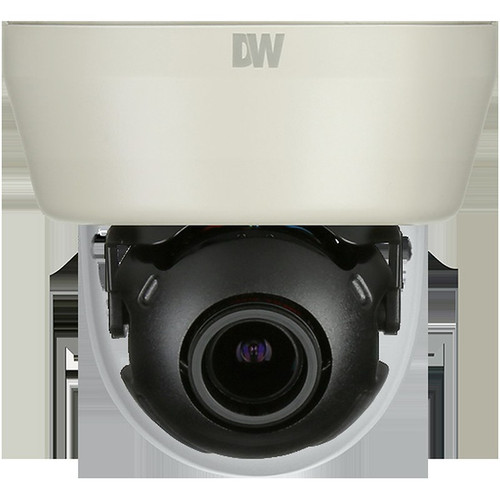
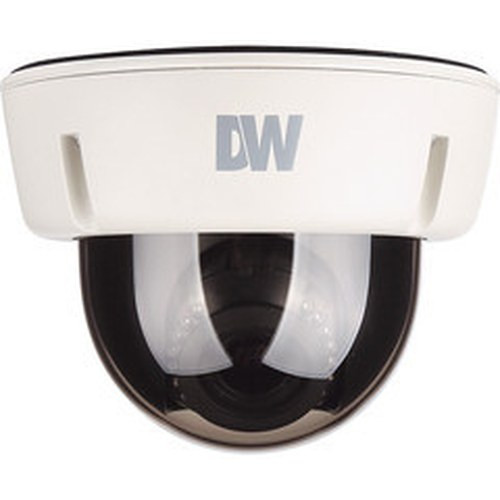
The V4283WD carries an IP68 rating (continuous submersion rated) versus the V6263WTIR's IP66 (high-pressure water jet rated). For exposed outdoor installations subject to flooding, pooling, or direct water ingress, IP68 provides a higher protection margin. Both are IK10 vandal-rated aluminum die-cast housings in ivory. The V4283WD is physically larger (139 × 121.8mm, 0.93kg) than the V6263WTIR (145 × 108.3mm, 0.75kg). The V4283WD's maximum power draw is 2.3W versus the V6263WTIR's 4.35W — a meaningful difference for PoE budget planning on multi-camera switches.
Temperature range separates the two in cold climates: the V4283WD is rated to −40°F (−40°C), while the V6263WTIR's lower limit is −4°F (−20°C). For installations in unheated northern enclosures, parking structures, or cold-storage perimeters, the V4283WD's −40°C floor is a significant operational advantage. Both cameras accept 24V AC; the V6263WTIR additionally lists 12V DC as an accepted input, offering more power-source flexibility on the bench or in mixed-voltage installations.
Which fits your VMS and analytics better?
The V4283WD's spec data explicitly lists ONVIF compliance, H.264 and MJPEG compression, two-way audio with a built-in microphone, and microSD on-board storage — all confirmed in the provided specifications. The V6263WTIR's spec data does not include entries for ONVIF, video compression format, audio, or on-board storage; those capabilities are not confirmed from the specs provided and must be verified against Digital Watchdog's datasheet before assuming parity.
Both cameras list identical analog signal technology support (CVBS, 960H, HD-CVI, HD-TVI) with Pelco C and Pelco D control via UTP. The V4283WD additionally lists HD-Analog in its signal technology field; the V6263WTIR lists 'HD over Coax' in place of a discrete HD-Analog entry — effectively the same coax ecosystem but labeled differently. Both support 16 programmable privacy masks, motion detection, de-fog, DRC, and BLC.
Which should you choose: the V4283WD or the V6263WTIR?
Our take: The V4283WD is the stronger choice when cold-climate operation, IP68 flood-resistance, confirmed ONVIF/audio/edge-storage integration, or PoE power budget economy are the deciding factors. Spec-for-spec: the V4283WD operates to −40°C versus the V6263WTIR's −20°C floor; its IP68 rating exceeds the V6263WTIR's IP66 for submersion scenarios; and its maximum power draw of 2.3W is nearly half the V6263WTIR's 4.35W, directly reducing per-port PoE switch load. The V6263WTIR is the stronger choice when IR range is the primary concern — its rated 100-foot Smart IR reach is approximately ten times the V4283WD's spec'd 10m IR range — and when 12V DC power-source flexibility or slightly lighter weight (0.75kg vs. 0.93kg) matters. Buyers on analog HD coax retrofits with long dark corridors or parking structures should weigh the V6263WTIR's IR advantage; cold-environment, wet, or IP-network-integrated deployments favor the V4283WD.
Side-by-Side Comparison
Spec-for-spec, from manufacturer data.
| Specification | Digital Watchdog V4283WD | Digital Watchdog V6263WTIR |
|---|---|---|
| Max Resolution | 2.1MP / 1080p (1944 × 1092) | 2.1MP / 1080p (1944 × 1092) |
| Image Sensor | 1/3" CMOS, progressive scan | 1/3" CMOS, progressive scan |
| Lens / Focal Length | 2.8–12mm vari-focal, motorized auto-focus, P-iris | 2.8–12mm vari-focal, P-iris (motorized auto-focus not spec'd) |
| HFOV | 91° – 28° | 91° – 28° |
| Min Illumination | 0.03 lux (color) | 0.03 lux (color) / 0.0 lux (B/W) |
| IR Range | Up to 10m typical | 100 ft (30m) Smart IR |
| WDR | True WDR 100dB | True WDR 100dB |
| Signal Technology | CVBS, 960H, HD-Analog, HD-CVI, HD-TVI, HD-Coax | CVBS, 960H, HD-CVI, HD-TVI, HD over Coax |
| IP Rating | IP68 | IP66 |
| IK / Vandal Rating | IK10 | IK10 |
| Operating Temperature | −40°C to +50°C (−40°F to 122°F) | −20°C to +50°C (−4°F to 122°F) |
| Power Input | 24V AC | 12V DC / 24V AC |
| Max Power Draw | 2.3W | 4.35W |
| ONVIF | Yes | — (not spec'd) |
| Audio | Two-way; built-in mic | — (not spec'd) |
| Edge Storage | microSD | — (not spec'd) |
| Dimensions (H × W) | 139 × 121.8mm (5.47" × 4.79") | 145 × 108.3mm (5.7" × 4.26") |
| Weight | 0.93 kg (2.05 lbs) | 0.75 kg (1.65 lbs) |
| Warranty | 5 Year | 5 Year |
Frequently Asked Questions
Which should you choose: the V4283WD or the V6263WTIR?
The V4283WD is the stronger choice when cold-climate operation, IP68 flood-resistance, confirmed ONVIF/audio/edge-storage integration, or PoE power budget economy are the deciding factors. Spec-for-spec: the V4283WD operates to −40°C versus the V6263WTIR's −20°C floor; its IP68 rating exceeds the V6263WTIR's IP66 for submersion scenarios; and its maximum power draw of 2.3W is nearly half the V6263WTIR's 4.35W, directly reducing per-port PoE switch load. The V6263WTIR is the stronger choice when IR range is the primary concern — its rated 100-foot Smart IR reach is approximately ten times the V4283WD's spec'd 10m IR range — and when 12V DC power-source flexibility or slightly lighter weight (0.75kg vs. 0.93kg) matters. Buyers on analog HD coax retrofits with long dark corridors or parking structures should weigh the V6263WTIR's IR advantage; cold-environment, wet, or IP-network-integrated deployments favor the V4283WD.
Is the V4283WD or V6263WTIR better for low-light and night vision coverage?
Both cameras share the same 0.03 lux color minimum and x2–x32 Star-Light Sense-Up, so near-darkness sensitivity is equivalent. However, the V6263WTIR's Smart IR is spec'd at 100 feet (30m), while the V4283WD's IR is rated at up to 10m typical. For covering longer distances in total darkness using active IR, the V6263WTIR has a clear spec advantage. The V4283WD also adds a 0.0 lux (B/W) figure for IR-active operation, but the V4283WD spec sheet does not list a 0.0 lux figure.
Which camera is better suited for harsh outdoor environments — extreme cold or wet locations?
The V4283WD wins on both counts from the provided specs. Its operating temperature floor is −40°C versus the V6263WTIR's −20°C, making it suitable for unheated northern enclosures. Its IP68 ingress rating (continuous submersion) also exceeds the V6263WTIR's IP66 (jet-water resistant), so it is the better choice for locations prone to flooding or direct water exposure. Both are IK10 vandal-rated.
Does the V6263WTIR support ONVIF, audio, or on-board storage like the V4283WD?
From the specifications provided, only the V4283WD explicitly lists ONVIF compliance, H.264/MJPEG compression, two-way audio with a built-in microphone, and microSD on-board storage. The V6263WTIR's provided spec data does not include entries for any of these capabilities. Installers requiring confirmed ONVIF interoperability or edge audio and storage should verify directly against Digital Watchdog's V6263WTIR datasheet before specifying the camera for an IP-integrated or VMS-driven deployment.
Get a Second Opinion on Your Camera Choice
Share your site layout, coverage goals, and budget. Our team will validate the camera selection, flag anything we would change, and recommend products that match the use case.