
Digital Watchdog DWC-MF5Wi4TWDMP vs Digital Watchdog DWC-VSDG04Mi: Specification Comparison
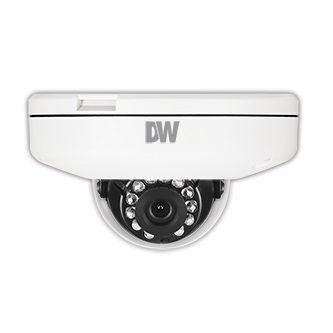
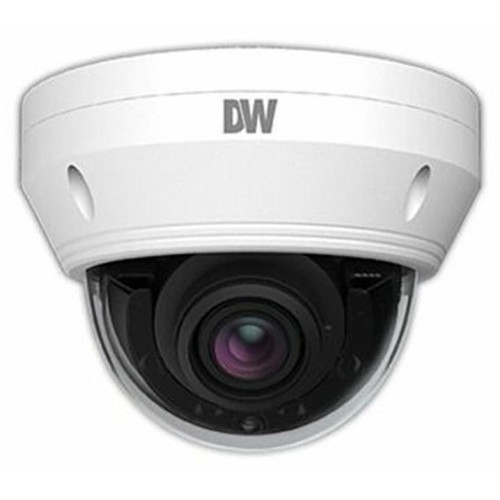
Both the Digital Watchdog DWC-MF5Wi4TWDMP and DWC-VSDG04Mi are 4MP outdoor vandal dome cameras from the same manufacturer, sharing the same resolution class, PoE power delivery, IK10 impact rating, and aluminum die-cast housing. A buyer selecting between them is weighing a fixed-lens, compact-footprint entry-level dome against a motorized varifocal, analytics-equipped dome with extended IR and richer feature sets — a common cross-shop scenario for perimeter and parking lot deployments where post-install lens adjustment and advanced detection may or may not be required.
In This Guide
How do the imaging specs compare?
Both cameras resolve 4MP, but differ in sensor size and pixel array. The DWC-MF5Wi4TWDMP uses a 1/2.8" CMOS sensor at 2688×1520, while the DWC-VSDG04Mi uses a 1/3" CMOS sensor at 2560×1440. The larger 1/2.8" sensor in the MF5Wi4TWDMP collects more light per pixel on paper, yet the VSDG04Mi's specified minimum color illumination is 0.005 lux versus 0.16 lux for the MF5Wi4TWDMP — a 32× difference in rated low-light sensitivity. The VSDG04Mi also adds True WDR at 120dB; the MF5Wi4TWDMP provides no WDR specification in the supplied data.
Lens and IR range diverge significantly. The MF5Wi4TWDMP ships with a fixed 4.0mm lens providing a fixed 82.3° horizontal FOV and Smart IR to 50 feet. The VSDG04Mi carries a motorized varifocal 2.8–12mm lens with autofocus, covering 92°–31° HFOV, and Smart IR rated to 164 feet — more than three times the IR distance. The VSDG04Mi also lists de-fog capability; the MF5Wi4TWDMP does not.
What about installation and environment?
Both cameras are rated IK10 for vandal resistance and use aluminum die-cast housing. The MF5Wi4TWDMP carries an IP66 ingress rating (protected against powerful water jets); the VSDG04Mi is rated IP67 (protected against temporary immersion up to 1 meter). Operating temperature range also favors the VSDG04Mi: -22°F to 140°F (-30°C to 60°C) versus -4°F to 122°F (-20°C to 50°C) for the MF5Wi4TWDMP, a meaningful difference for extreme-climate installations.
Power input for both is PoE; the MF5Wi4TWDMP is specified as PoE Class 3. The VSDG04Mi lists a maximum draw of 7.5W via PoE or DC12V (625mA) but does not state a PoE class in the supplied specifications. Physical footprint differs: the MF5Wi4TWDMP is listed at 14.96"×10.55"×1.77" and 0.92 lbs, while the VSDG04Mi is 5.55"×3.93" (141×100mm) and 1.94 lbs — note the MF5Wi4TWDMP dimensions appear atypically large for a dome camera and may reflect packaging; buyers should verify actual camera body dimensions from the datasheet before specifying junction box or mount.
Which fits your VMS and analytics better?
Both cameras are ONVIF conformant and compatible with Digital Watchdog's own VMS. The VSDG04Mi additionally lists compatibility with any ONVIF-conformant CMS and with DW Spectrum® IPVMS by name. The MF5Wi4TWDMP lists DMP as its VMS designation in the supplied data; whether this extends to full ONVIF Profile S/G/T conformance at the same level is not clarified in the provided specifications.
The VSDG04Mi carries onboard edge analytics — line crossing, perimeter intrusion, and tampering detection — plus 8 programmable privacy masks, built-in microphone, 1 audio in/1 audio out, email and FTP event notifications, and a micro SD/SDHC/SDXC slot supporting up to 1TB for local recording. The MF5Wi4TWDMP specifies none of these capabilities in the provided data: no edge analytics, no audio I/O, no onboard storage, and no event notification outputs are listed. For deployments requiring standalone edge recording, audio, or rule-based alerts without relying solely on the VMS, the VSDG04Mi is the only option of the two based on available specifications.
Which should you choose: the DWC-MF5Wi4TWDMP or the DWC-VSDG04Mi?
Our take: The DWC-VSDG04Mi is the stronger choice when coverage flexibility, low-light performance, and edge intelligence are required. Spec-for-spec, it delivers a 32× lower minimum color illumination rating (0.005 lux vs. 0.16 lux), more than triple the IR range (164 ft vs. 50 ft), and a motorized 2.8–12mm varifocal lens versus a fixed 4.0mm — allowing field-of-view adjustment post-installation without a lens swap. It also adds True WDR at 120dB, built-in analytics (line crossing, perimeter intrusion, tampering), onboard storage up to 1TB, audio I/O, and a wider operating temperature range (-22°F to 140°F vs. -4°F to 122°F). The DWC-MF5Wi4TWDMP suits budget-constrained installs with fixed, predictable sight lines where a 50-foot IR envelope is sufficient, no edge analytics are needed, and the VMS handles all recording — particularly where PoE Class 3 compatibility with an existing switch inventory is a constraint.
Side-by-Side Comparison
Spec-for-spec, from manufacturer data.
| Specification | Digital Watchdog DWC-MF5Wi4TWDMP | Digital Watchdog DWC-VSDG04Mi |
|---|---|---|
| Resolution | 4MP (2688 × 1520) | 4MP (2560 × 1440) |
| Image Sensor | 1/2.8" CMOS | 1/3" CMOS |
| Lens / Focal Length | Fixed 4.0mm | Motorized varifocal 2.8–12mm with autofocus |
| Horizontal FOV | 82.3° (fixed) | 92°–31° (variable) |
| Min. Illumination (color) | 0.16 lux | 0.005 lux |
| Min. Illumination (B/W) | 0.0 lux | 0.0 lux |
| IR Range | 50 ft (Smart IR™) | 164 ft (Smart IR™) |
| Wide Dynamic Range | — | True WDR 120dB |
| Video Compression | H.264 / H.265 | H.264 / H.265 / MJPEG |
| IP Rating | IP66 | IP67 |
| IK / Impact Rating | IK10 | IK10 |
| Operating Temperature | -4°F to 122°F (-20°C to 50°C) | -22°F to 140°F (-30°C to 60°C) |
| Power Input / PoE Class | PoE (Class 3) | PoE or DC12V; max 7.5W (PoE class not specified) |
| Edge Storage | — | Micro SD/SDHC/SDXC up to 1TB |
| Audio | — | 1 audio in / 1 audio out / built-in mic |
| Edge Analytics | — | Line crossing, perimeter intrusion, tampering detection |
| Privacy Masks | — | 8 programmable |
| Weight | 0.92 lbs | 1.94 lbs |
| Warranty | 5 years | 5 years |
Frequently Asked Questions
Which should you choose: the DWC-MF5Wi4TWDMP or the DWC-VSDG04Mi?
The DWC-VSDG04Mi is the stronger choice when coverage flexibility, low-light performance, and edge intelligence are required. Spec-for-spec, it delivers a 32× lower minimum color illumination rating (0.005 lux vs. 0.16 lux), more than triple the IR range (164 ft vs. 50 ft), and a motorized 2.8–12mm varifocal lens versus a fixed 4.0mm — allowing field-of-view adjustment post-installation without a lens swap. It also adds True WDR at 120dB, built-in analytics (line crossing, perimeter intrusion, tampering), onboard storage up to 1TB, audio I/O, and a wider operating temperature range (-22°F to 140°F vs. -4°F to 122°F). The DWC-MF5Wi4TWDMP suits budget-constrained installs with fixed, predictable sight lines where a 50-foot IR envelope is sufficient, no edge analytics are needed, and the VMS handles all recording — particularly where PoE Class 3 compatibility with an existing switch inventory is a constraint.
Is the DWC-MF5Wi4TWDMP or DWC-VSDG04Mi better for low-light performance?
Based on the supplied specifications, the DWC-VSDG04Mi is rated for significantly better low-light performance: its minimum color illumination is 0.005 lux versus 0.16 lux for the DWC-MF5Wi4TWDMP — a 32× difference. The VSDG04Mi also has a longer Smart IR range of 164 feet compared to 50 feet on the MF5Wi4TWDMP, and adds True WDR at 120dB, which the MF5Wi4TWDMP does not list.
Can I adjust the lens in the field on either of these cameras?
Only the DWC-VSDG04Mi supports field lens adjustment. It uses a motorized varifocal 2.8–12mm lens with autofocus, covering a horizontal field of view from 92° down to 31°. The DWC-MF5Wi4TWDMP has a fixed 4.0mm lens with a fixed 82.3° HFOV; the field of view cannot be changed without a lens replacement, which is not supported on fixed-lens models.
Does either camera support onboard storage or edge recording without a VMS?
Yes — the DWC-VSDG04Mi includes a micro SD/SDHC/SDXC card slot supporting up to 1TB, enabling local edge recording independent of a VMS. The DWC-MF5Wi4TWDMP does not list any onboard storage capability in the provided specifications, making it dependent on a networked recorder or VMS for all video retention.
Get a Second Opinion on Your Camera Choice
Share your site layout, coverage goals, and budget. Our team will validate the camera selection, flag anything we would change, and recommend products that match the use case.