
Digital Watchdog D3853WTIRW vs Digital Watchdog D4883WTIRW: Specification Comparison
Both the DWC-D3853WTIRW and DWC-D4883WTIRW are Digital Watchdog 8MP (3864×2176) Star-Light indoor dome IP cameras sharing the same 1/1.8" CMOS sensor and 120dB True WDR engine. Buyers evaluating indoor 4K dome cameras for commercial or enterprise installations will encounter these two as natural cross-shop candidates. The key differentiators are lens type, IR range, built-in audio, power topology, and physical footprint — all of which carry real-world consequences for installation flexibility and site suitability.
In This Guide
How do the imaging specs compare?
Both cameras share an identical 4K 1/1.8" CMOS progressive-scan sensor resolving 3864×2176 active pixels, the same maximum resolution modes (4K, 4MP, 1080p, 4K at 15fps), and an identical 120dB True WDR with Smart DNR™ 3D digital noise reduction. Day/night switching, BLC, de-fog, DRC, gamma (0.45), and Star-Light sense-up (x2–x32, disabled at 4K) are spec-identical. Minimum scene illumination diverges slightly: the D3853WTIRW specifies 0.10 lux in color / 0.0 lux B/W, while the D4883WTIRW edges it at 0.09 lux in color / 0.0 lux B/W — a marginal advantage on paper.
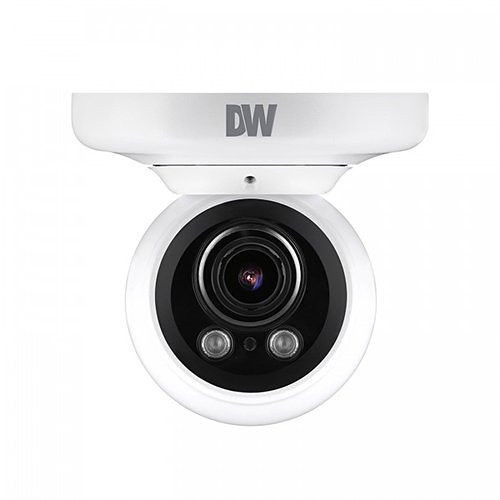
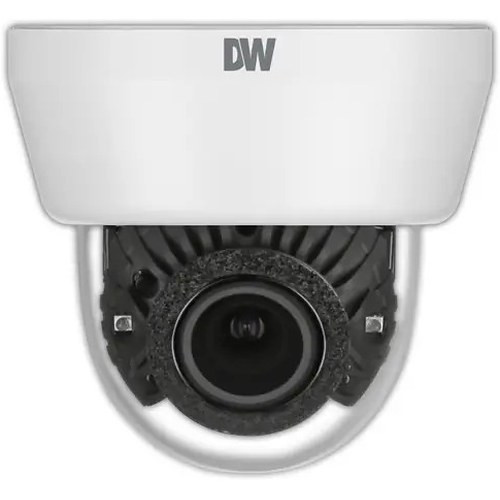
The lens is where the two cameras diverge most meaningfully. The D3853WTIRW uses a fixed 2.8mm lens delivering a wide 106.5° horizontal / 59.1° vertical field of view — useful for open lobbies, retail floors, or corridors where a wide angle is predetermined. The D4883WTIRW pairs a motorized varifocal 3.6–10mm lens with auto-focus and P-iris control, yielding an adjustable 98.4°–45.7° HFOV / 54.6°–25.9° VFOV. This flexibility lets installers dial in framing post-mount. IR range trades off inversely: the D3853WTIRW reaches 100 feet with Smart IR™, while the D4883WTIRW is rated at 70 feet — a 30% reduction attributable in part to the narrower minimum aperture of the varifocal optic.
What about installation and environment?
Both cameras are rated IP66, carry indoor dome housings in white plastic, and share the same operating temperature range of -4°F to 122°F (-20°C to 50°C) and humidity tolerance of 10–90% non-condensing. Neither spec sheet lists an IK impact rating. Mounting accessories are sold separately for both models. The D3853WTIRW is physically larger (4.72" H × 3.51" W / 120 × 89.4mm) and heavier (0.66 lbs / 0.3kg). The D4883WTIRW is more compact (4.24" H × 3.9" W / 107.8 × 99.1mm) and lighter (0.55 lbs / 0.25kg), and its housing uses Digital Watchdog's Snapit™ quick-connect system.
Power topology differs materially. The D3853WTIRW is specified as PoE (12V DC, 3.0W max) — a single-cable installation. The D4883WTIRW lists a higher 7.15W max draw, with power requirements listed as 24V AC in the structured specs and 12VDC / PoE noted in additional attributes; buyers should confirm PoE class compatibility with their switch infrastructure given the higher wattage. The D4883WTIRW's motorized varifocal lens does consume additional power during zoom/focus operations, which likely accounts for the elevated max-power figure.
Which fits your VMS and analytics better?
Neither camera's spec sheet lists explicit ONVIF profile compliance, supported VMS integrations, video compression codecs (H.264/H.265/MJPEG), or on-board SD card storage. Buyers should request firmware documentation or Digital Watchdog's VMAX IP integration matrix to confirm VMS compatibility. Both cameras support UTC (Up-the-Coax) control and offer a CVBS test video output for analog-loop installation verification — useful during commissioning. Both list the same analog signal compatibility (CVBS, 960H, HD-Analog, HD-CVI, HD-TVI), though these are noted in the specs and may reflect legacy labeling rather than active analog output on the IP models; verify with the manufacturer.
Audio is a meaningful differentiator: the D4883WTIRW includes a built-in microphone (1 mic in, 50Hz–10KHz frequency response, -38dB ±2dB sensitivity), enabling audio capture without an external device — relevant for two-way intercoms, audio-triggered recording, or compliance environments. The D3853WTIRW has no audio specification listed. Privacy masking (24 programmable zones), motion detection, mirror/flip, and sharpness controls are identical across both. No edge analytics capabilities (e.g., line crossing, intrusion, face detection) are documented in the provided specs for either model.
Which should you choose: the D3853WTIRW or the D4883WTIRW?
Our take: The D3853WTIRW is the stronger choice when wide-area coverage from a fixed mount, longer IR throw, and clean single-cable PoE installation are the priorities. Its 2.8mm fixed lens delivers a 106.5° horizontal field of view — 7.1° wider than the D4883WTIRW's maximum angle — and its 100-foot Smart IR range exceeds the D4883WTIRW's 70-foot rating by 30 feet, a meaningful gap in larger rooms or long corridors. Its 3.0W max draw is also well within standard 802.3af PoE budgets, simplifying switch selection. Conversely, the D4883WTIRW is the right choice when post-mount framing adjustment is required: its motorized 3.6–10mm varifocal lens with auto-focus and P-iris lets installers tighten or widen the scene without physically repositioning the camera. It also adds a built-in microphone — absent on the D3853WTIRW — which matters for audio-inclusive recording or alert workflows. Choose the D3853WTIRW for wide fixed coverage on standard PoE infrastructure; choose the D4883WTIRW when lens flexibility or audio capture are non-negotiable site requirements.
Side-by-Side Comparison
Spec-for-spec, from manufacturer data.
| Specification | Digital Watchdog D3853WTIRW | Digital Watchdog D4883WTIRW |
|---|---|---|
| Resolution | 8MP (3864 × 2176) | 8MP (3864 × 2176) |
| Image Sensor | 4K 1/1.8" CMOS | 4K 1/1.8" CMOS |
| Scanning System | Progressive scan | Progressive scan |
| Lens Type | Fixed 2.8mm | Motorized varifocal 3.6–10mm |
| Advanced Lens Features | — | Auto-focus, motorized zoom, P-iris |
| Horizontal FOV | 106.5° | 98.4° ~ 45.7° |
| Vertical FOV | 59.1° | 54.6° ~ 25.9° |
| Min. Illumination (Color / B/W) | 0.10 lux / 0.0 lux | 0.09 lux / 0.0 lux |
| IR Range | 100 ft Smart IR™ | 70 ft Smart IR™ |
| Wide Dynamic Range | 120dB True WDR | 120dB True WDR |
| 3D Noise Reduction | Smart DNR™ | Smart DNR™ |
| Audio | — | Built-in mic (50Hz–10KHz, -38dB ±2dB) |
| IP Rating | IP66 | IP66 |
| Operating Temperature | -4°F to 122°F (-20°C to 50°C) | -4°F to 122°F (-20°C to 50°C) |
| Power Input / Max Draw | 12V DC / PoE, 3.0W max | 24V AC / 12VDC, 7.15W max |
| Privacy Zones | 24 programmable | 24 programmable |
| Housing | Indoor Dome, White Plastic | Indoor Dome, White Plastic, Snapit™ |
| Dimensions (H × W) | 4.72" × 3.51" (120 × 89.4mm) | 4.24" × 3.9" (107.8 × 99.1mm) |
| Weight | 0.66 lbs (0.3kg) | 0.55 lbs (0.25kg) |
| Warranty | 5 Year | 5 Year |
Frequently Asked Questions
Which should you choose: the D3853WTIRW or the D4883WTIRW?
The D3853WTIRW is the stronger choice when wide-area coverage from a fixed mount, longer IR throw, and clean single-cable PoE installation are the priorities. Its 2.8mm fixed lens delivers a 106.5° horizontal field of view — 7.1° wider than the D4883WTIRW's maximum angle — and its 100-foot Smart IR range exceeds the D4883WTIRW's 70-foot rating by 30 feet, a meaningful gap in larger rooms or long corridors. Its 3.0W max draw is also well within standard 802.3af PoE budgets, simplifying switch selection. Conversely, the D4883WTIRW is the right choice when post-mount framing adjustment is required: its motorized 3.6–10mm varifocal lens with auto-focus and P-iris lets installers tighten or widen the scene without physically repositioning the camera. It also adds a built-in microphone — absent on the D3853WTIRW — which matters for audio-inclusive recording or alert workflows. Choose the D3853WTIRW for wide fixed coverage on standard PoE infrastructure; choose the D4883WTIRW when lens flexibility or audio capture are non-negotiable site requirements.
Is the D3853WTIRW or D4883WTIRW better for low-light performance?
Per the provided specs, both cameras are extremely close. The D4883WTIRW specifies 0.09 lux in color vs. the D3853WTIRW's 0.10 lux — a 0.01 lux difference that is unlikely to be perceptible in real-world deployment. Both reach 0.0 lux in B/W mode and share the same Star-Light x2–x32 sense-up range. The D3853WTIRW's 100-foot IR range (vs. 70 feet on the D4883WTIRW) gives it a practical low-light advantage in larger spaces where IR throw matters more than the marginal lux delta.
Can I use either camera on a standard PoE switch?
The D3853WTIRW draws a maximum of 3.0W and is specified as PoE-powered, placing it well within 802.3af (15.4W budget) without issue. The D4883WTIRW lists a maximum of 7.15W; its structured specs cite 24V AC as the primary power requirement while additional attributes reference 12VDC and PoE. Buyers should confirm the exact PoE class and whether the motorized lens draw falls within the switch port's budget before deploying on a standard af switch — consult Digital Watchdog's datasheet or technical support for definitive PoE class confirmation.
Does either camera support built-in audio recording?
Only the D4883WTIRW includes audio capability per the provided specifications: it has a built-in microphone with a 50Hz–10KHz frequency response and -38dB ±2dB sensitivity. The D3853WTIRW has no audio input or output listed in its specs. If audio capture or audio-triggered recording is a requirement for your deployment, the D4883WTIRW is the only option of the two.
Get a Second Opinion on Your Camera Choice
Share your site layout, coverage goals, and budget. Our team will validate the camera selection, flag anything we would change, and recommend products that match the use case.