
Datalogic HD3100 vs CipherLab A8001RSC00025: Specification Comparison
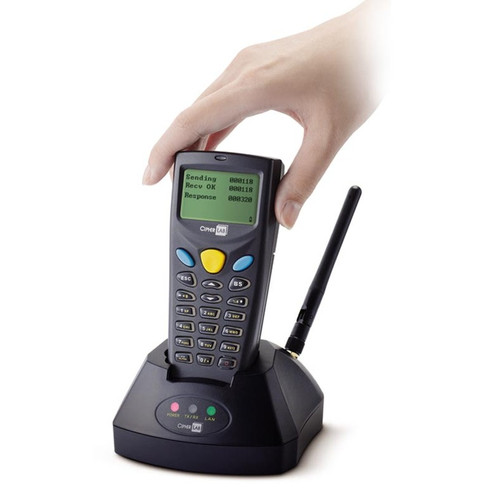
Both the Datalogic Heron HD3100 (SKU HD3130-WHK1B) and the CipherLab A8001RSC00025 are handheld 1D barcode scanners targeting retail and warehouse environments. However, they represent fundamentally different deployment architectures: the HD3100 is a corded, real-time scan-and-transmit scanner relying on a live USB or RS-232 host connection, while the CipherLab A8001RSC00025 is a batch-mode device with onboard CPU, RAM, display, and 100-hour battery designed to collect and store scans locally before syncing. A buyer cross-shopping these would be choosing between tethered real-time POS and untethered batch data collection.

In This Guide
- Which scanner delivers faster real-time capture and what scan technology does each use?
- Which device is better suited for mobile, untethered, or harsh-environment use?
- How do the two scanners connect to host systems, and what warranty protection does each carry?
- Which should you choose: the HD3100 or the A8001RSC00025?
- Side-by-Side Specs
- FAQ
Which scanner delivers faster real-time capture and what scan technology does each use?
The Datalogic HD3100 uses a 1D linear imager rated at 270 reads per second and provides a Green Spot good-read indicator for immediate operator feedback. Its corded design means every scan is transmitted to the host in real time with no local buffering required.
The CipherLab A8001RSC00025 uses a 1D laser scan engine. No scan rate in reads-per-second is specified in the provided specs. Its architecture is batch-oriented: scans are stored in 2MB of onboard RAM and transferred to a host later via USB or IrDA serial (115.2 Kbps). Real-time throughput to a host system is therefore not a meaningful metric for this device.
Which device is better suited for mobile, untethered, or harsh-environment use?
The CipherLab A8001RSC00025 is purpose-built for untethered mobility. It carries a 100-hour battery life rating and passes a drop test of 1.2 m (4 ft) on concrete across all sides (5 drops per side). It also includes a 100×64 LCD display with LED backlight and runs CipherLab's proprietary cOS on a 16-bit CPU, making it a self-contained data collection terminal.
The Datalogic HD3100 is a corded scanner with no battery and no display. It is rated IP40, which provides basic dust protection and limited splash resistance but no defined drop rating is stated in the provided specs. At 113 g it is lightweight for a countertop or fixed-workstation role, but it is not designed for mobile or ruggedized field deployment.
How do the two scanners connect to host systems, and what warranty protection does each carry?
The Datalogic HD3100 connects via USB or RS-232, both of which are standard live-host interfaces broadly supported by POS and inventory software. It carries a 5-Year Limited Warranty, which is notably long for a scanner in this class.
The CipherLab A8001RSC00025 connects via USB (for sync) and IrDA serial at up to 115.2 Kbps. Communication is described as batch and serial, meaning data is uploaded after collection rather than streamed continuously. The device carries a 2-Year Warranty. No IP rating is specified in the provided specs for the CipherLab unit.
Which should you choose: the HD3100 or the A8001RSC00025?
Our take: The HD3100 is the stronger choice when a buyer needs a high-throughput, always-connected scanner at a fixed POS or receiving station: it posts 270 reads per second versus no published scan rate for the CipherLab, connects live via USB or RS-232, and carries a 5-year warranty versus the CipherLab's 2 years. Conversely, the A8001RSC00025 is the appropriate selection for mobile, off-network batch collection: it offers a 100-hour battery, a 1.2 m drop rating on concrete (no equivalent drop spec exists for the HD3100), and 2 MB of onboard storage with its own display and OS. Buyers should choose the HD3100 for tethered, real-time retail POS or warehouse receiving; the A8001RSC00025 for inventory walks, field data collection, or any workflow where a live host connection is not continuously available.
Side-by-Side Comparison
Spec-for-spec, from manufacturer data.
| Specification | Datalogic HD3100 | CipherLab A8001RSC00025 |
|---|---|---|
| Product Type | Handheld Corded Barcode Scanner | Handheld Batch Barcode Scanner |
| Scan Engine | 1D Linear Imager | 1D Laser |
| Scan Rate | 270 reads/sec | — |
| Connectivity | USB, RS-232 | USB, IrDA Serial (115.2 Kbps) |
| Data Transfer Mode | Real-time (live host) | Batch (store-and-upload) |
| Battery Life | — (corded, no battery) | 100 hours |
| Onboard Memory | — | 2 MB RAM |
| Display | — | 100×64 LCD with LED backlight |
| CPU / OS | — | 16-bit CPU / CipherLab cOS |
| Drop Rating | — | 1.2 m (4 ft) concrete, 5 drops/side |
| IP Rating | IP40 | — |
| Weight | 113 g (0.25 lb) | — |
| Dimensions | 61 × 132 × 76 mm | — |
| Good-Read Indicator | Green Spot | — |
| Warranty | 5-Year Limited | 2-Year |
| Form Factor | Corded handheld | Cordless handheld terminal |
Frequently Asked Questions
Which should you choose: the HD3100 or the A8001RSC00025?
The HD3100 is the stronger choice when a buyer needs a high-throughput, always-connected scanner at a fixed POS or receiving station: it posts 270 reads per second versus no published scan rate for the CipherLab, connects live via USB or RS-232, and carries a 5-year warranty versus the CipherLab's 2 years. Conversely, the A8001RSC00025 is the appropriate selection for mobile, off-network batch collection: it offers a 100-hour battery, a 1.2 m drop rating on concrete (no equivalent drop spec exists for the HD3100), and 2 MB of onboard storage with its own display and OS. Buyers should choose the HD3100 for tethered, real-time retail POS or warehouse receiving; the A8001RSC00025 for inventory walks, field data collection, or any workflow where a live host connection is not continuously available.
Is the HD3100 or A8001RSC00025 better for a retail checkout counter?
The HD3100 is the better fit for a checkout counter. It connects live via USB or RS-232 at 270 reads per second and provides immediate Green Spot feedback to the operator, which is exactly what a high-volume POS lane requires. The A8001RSC00025 is a batch device that stores scans locally and uploads later — it is not designed for real-time transaction processing at a register.
Can the A8001RSC00025 work without being plugged into a computer?
Yes. The A8001RSC00025 is specifically designed for untethered operation. Its 100-hour battery and 2 MB of onboard RAM allow it to capture and store scans independently. Data is then transferred to a host via USB or IrDA serial when the operator returns to a sync station. The HD3100 has no battery and requires a continuous host connection to operate.
Which scanner is more durable for warehouse or field use?
The A8001RSC00025 is the more ruggedized option based on available specs: it is rated for 1.2 m (4 ft) concrete drops on all sides. The HD3100 carries an IP40 rating for basic dust and splash resistance, but no drop rating is stated in the provided specifications. For mobile warehouse or field environments where drops are likely, the CipherLab unit has a documented mechanical durability advantage.
More Barcode Scanner Comparisons
- Datalogic PM9100-910RB vs CipherLab A1000ACBU0001
- Datalogic PM9100-910RB vs CipherLab A1000ACWU0001
- Datalogic PM9100-910RB vs Zebra LI2208-SR7U2100AZW
- Datalogic PM9100-910RB vs CipherLab A8001RSC00025
- Datalogic PM9100-910RB vs Datalogic PM9100-D910RB
- Datalogic PM9100-910RB vs Datalogic QBT2500-BK
Barcode Scanner Buying Guides
Get a Second Opinion on Your Camera Choice
Share your site layout, coverage goals, and budget. Our team will validate the camera selection, flag anything we would change, and recommend products that match the use case.