
Axis M4318-PLVE vs i-PRO X4573LM: Specification Comparison
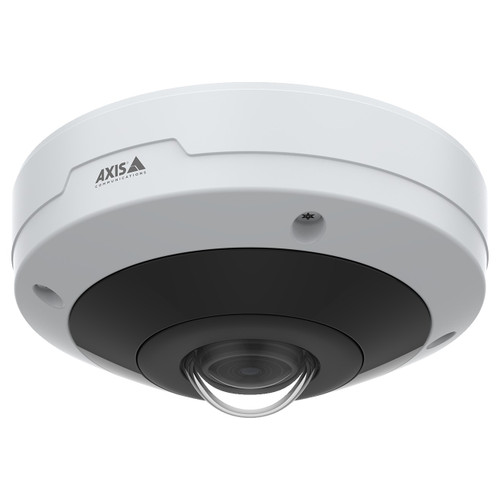
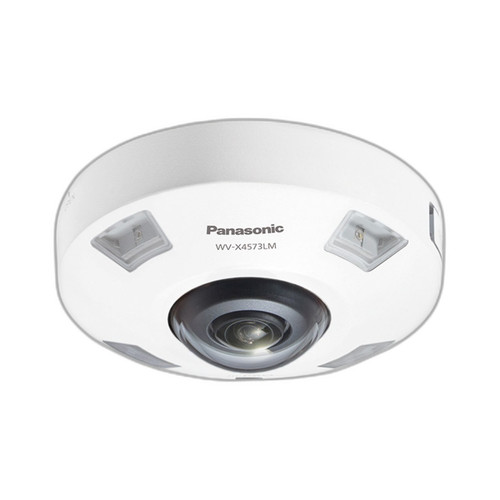
Both the Axis M4318-PLVE and the i-PRO WV-X4573LM are 12MP outdoor-rated fisheye/panoramic dome cameras delivering 2992×2992 resolution at 30fps over PoE. They occupy the same resolution class and camera type — single-unit wide-area coverage without PTZ mechanics — making them a legitimate cross-shop for installers evaluating perimeter, lobby, or large-area surveillance with minimal camera counts. The comparison covers imaging performance, installation environment, and VMS/analytics integration based strictly on published specifications.
In This Guide
How do the imaging specs compare?
Both cameras share a 12MP 2992×2992 CMOS sensor and 30fps maximum frame rate, but diverge meaningfully on lens, low-light, and WDR. The Axis M4318-PLVE uses a 1.2mm fixed stereographic lens covering 182° H × 182° V, while the i-PRO WV-X4573LM uses a 1.4mm F1.9 lens covering an unspecified but functionally hemispheric FOV (the i-PRO bullet states 183°). The wider aperture on the i-PRO (F1.9) is a low-light advantage in hardware, but the minimum illumination figures tell a different story: the i-PRO reaches 0.02 lx color / 0.003 lx B/W (at F1.9, maximum shutter 16/30s, AGC 11), versus the Axis at 0.19 lux color. On raw minimum-illumination numbers the i-PRO achieves a lower threshold, though the i-PRO figure is measured under maximum shutter and AGC conditions that may introduce motion blur.
For dynamic range, the Axis M4318-PLVE specifies Forensic WDR — Axis's marketing name for its multi-exposure WDR — while the i-PRO WV-X4573LM specifies 84 dB max (adjustable 0–31 levels), a concrete dB figure. The Axis spec does not publish a dB value for WDR in the provided data, so a direct dB-to-dB comparison cannot be made. IR illumination differs substantially: the Axis uses OptimizedIR (850nm) with Lightfinder, while the i-PRO specifies IR LED with a 10m maximum irradiation distance — the Axis spec does not state an IR range distance for direct comparison. The Axis also includes its Zipstream codec-level bandwidth reduction technology; the i-PRO spec references H.265 Smart Coding with an approximate 50% storage reduction versus H.264.
What about installation and environment?
Both cameras carry identical IP66 and IK10 ratings, making them equally suited to direct weather exposure and 50J mechanical impact resistance. The i-PRO confirms IK10 (50J compliant) explicitly. The Axis M4318-PLVE specifies an operating temperature range of -40 to 50°C — the i-PRO WV-X4573LM spec does not include an operating temperature range in the provided data, so cold-climate suitability cannot be confirmed for the i-PRO from the available information.
Power requirements differ: the Axis M4318-PLVE is specified as PoE+ (802.3at), while the i-PRO WV-X4573LM draws 13W and is specified as standard PoE (802.3af, max 15.4W). This is a meaningful infrastructure consideration — the Axis requires an 802.3at-capable switch port, whereas the i-PRO will run on a standard 802.3af port. Both ship in white dome housings. The Axis lists pendant, corner, recessed, and rack mount options; the i-PRO lists wall and ceiling mounts. The Axis also notes PVC-free, BFR/CFR-free construction per JEDEC/ECA standards for sustainability compliance. The i-PRO carries NDAA compliance certification, which the Axis spec does not mention in the provided data.
Which fits your VMS and analytics better?
Both cameras support ONVIF: the Axis M4318-PLVE supports ONVIF Profile G, M, S, and T; the i-PRO WV-X4573LM supports ONVIF Profile G, S, and T — the i-PRO lacks Profile M in the provided spec data. Both cameras support H.265 and H.264 compression. The Axis additionally supports Zipstream for further bandwidth reduction. For on-board storage, the Axis specifies microSD/microSDHC/microSDXC support; the i-PRO spec does not reference local/edge storage in the provided data.
On analytics, the Axis M4318-PLVE includes a dedicated DLPU (Deep Learning Processing Unit) enabling Object Analytics and multi-view dewarping outputs (quadview, corridor, corner, and additional crops from a single stream). It also supports VAPIX open API integration. The i-PRO WV-X4573LM includes VMD (Video Motion Detection) and i-VMD (Intelligent VMD, Type 8) with a bundled license. The i-PRO also includes an audio input for an external microphone; the Axis spec references audio and I/O connectivity via Portcast technology. The Axis spec lists 2048MB RAM and 8192MB Flash onboard, supporting more compute-intensive edge applications; i-PRO memory specs are not provided in the available data.
Which should you choose: the M4318-PLVE or the X4573LM?
Our take: The M4318-PLVE is the stronger choice when edge analytics depth, cold-climate deployment, and on-board storage are priorities. Key spec deltas: the Axis operates from -40°C (the i-PRO operating temperature is not specified in the provided data), includes DLPU-driven Object Analytics and multi-view dewarping versus the i-PRO's VMD/i-VMD, and explicitly supports microSD edge storage where the i-PRO does not list local storage in its spec. The i-PRO WV-X4573LM holds advantages in three areas: its 802.3af PoE compatibility (13W) avoids the PoE+ switch requirement of the Axis, its minimum illumination reaches 0.02 lx color / 0.003 lx B/W versus the Axis's 0.19 lux, and it carries NDAA compliance certification which the Axis spec does not confirm. Installations requiring NDAA-compliant hardware or constrained to 802.3af infrastructure should favour the i-PRO; deployments needing deep analytics, edge recording, or verified sub-zero temperature ratings should favour the Axis.
Side-by-Side Comparison
Spec-for-spec, from manufacturer data.
| Specification | Axis M4318-PLVE | i-PRO X4573LM |
|---|---|---|
| Resolution | 12MP (2992×2992) | 12MP (2992×2992) |
| Camera Type | Multi-Sensor Panoramic Dome | Fisheye Panoramic Dome |
| Image Sensor | 1/2.3" CMOS | 1/2-inch type CMOS |
| Focal Length | 1.2 mm fixed stereographic | 1.4 mm, F1.9 max aperture |
| Horizontal / Vertical FOV | 182° H × 182° V | Not specified (183° hemispheric per bullet) |
| Min Illumination (Color) | 0.19 lux | 0.02 lx (F1.9, max shutter 16/30s, AGC 11) |
| Min Illumination (B/W) | — | 0.003 lx (F1.9, max shutter 16/30s, AGC 11) |
| IR Range | Not specified (OptimizedIR 850nm) | 10 m (33 ft) |
| WDR | Forensic WDR (dB value not specified) | 84 dB max (adjustable 0–31 levels) |
| Max Frame Rate | 25/30 fps | 30 fps |
| Video Compression | H.265, H.264, Zipstream | H.265, H.264 |
| IP Rating | IP66 | IP66 |
| IK / Impact Rating | IK10 | IK10 (50J compliant) |
| Operating Temperature | -40 to 50 °C | Not specified |
| Power Input / PoE Class | PoE+ (802.3at) | PoE (802.3af), 13W |
| ONVIF Profiles | Profile G, M, S, T | Profile G, S, T |
| Edge Storage | microSD / microSDHC / microSDXC | — |
| Audio | Audio and I/O via Portcast technology | Audio input for microphone |
| Edge Analytics | DLPU; Object Analytics; multi-view dewarping | VMD; i-VMD Type 8 (bundled license) |
| NDAA Compliance | — | Yes |
| Sustainability | BFR/CFR free, PVC free | — |
| Warranty | 5-Year | Not specified |
Frequently Asked Questions
Which should you choose: the M4318-PLVE or the X4573LM?
The M4318-PLVE is the stronger choice when edge analytics depth, cold-climate deployment, and on-board storage are priorities. Key spec deltas: the Axis operates from -40°C (the i-PRO operating temperature is not specified in the provided data), includes DLPU-driven Object Analytics and multi-view dewarping versus the i-PRO's VMD/i-VMD, and explicitly supports microSD edge storage where the i-PRO does not list local storage in its spec. The i-PRO WV-X4573LM holds advantages in three areas: its 802.3af PoE compatibility (13W) avoids the PoE+ switch requirement of the Axis, its minimum illumination reaches 0.02 lx color / 0.003 lx B/W versus the Axis's 0.19 lux, and it carries NDAA compliance certification which the Axis spec does not confirm. Installations requiring NDAA-compliant hardware or constrained to 802.3af infrastructure should favour the i-PRO; deployments needing deep analytics, edge recording, or verified sub-zero temperature ratings should favour the Axis.
Is the Axis M4318-PLVE or i-PRO WV-X4573LM better for low-light performance?
On minimum illumination figures, the i-PRO WV-X4573LM reaches 0.02 lx color and 0.003 lx B/W (at F1.9, maximum shutter 16/30s, AGC 11), compared to the Axis M4318-PLVE at 0.19 lux. The i-PRO's F1.9 aperture and lower lux threshold give it a measurable low-light advantage on paper, though the i-PRO figure is measured under maximum shutter speed and AGC settings that may introduce motion blur in practice. The Axis supplements its IR with OptimizedIR (850nm) and Lightfinder technology; the i-PRO specifies IR LED with a 10m maximum irradiation distance, while the Axis does not state an IR distance in the provided spec.
Can I power both cameras from a standard 802.3af PoE switch?
No. The Axis M4318-PLVE requires PoE+ (802.3at), which delivers up to 30W and requires a compatible switch port. The i-PRO WV-X4573LM draws 13W and is specified as 802.3af-compatible, meaning it will run on a standard PoE switch without an upgrade. If your existing switch infrastructure is 802.3af-only, the i-PRO WV-X4573LM will connect without additional hardware, while the Axis M4318-PLVE will require an 802.3at-capable switch or midspan injector.
Which camera is better for installations requiring NDAA compliance?
The i-PRO WV-X4573LM specifies NDAA compliance in the provided data. The Axis M4318-PLVE spec does not mention NDAA compliance in the information provided, so this cannot be confirmed from the available specifications alone. Buyers with federal, state, or contractor requirements for NDAA-compliant hardware should verify Axis's current NDAA status through Axis's official documentation before specifying the M4318-PLVE.
Get a Second Opinion on Your Camera Choice
Share your site layout, coverage goals, and budget. Our team will validate the camera selection, flag anything we would change, and recommend products that match the use case.