
APC by Schneider Electric BV400XU vs Vertiv PUL-400LVT: Specification Comparison
Both the APC BV400XU and Vertiv PUL-400LVT are 400VA standby UPS units aimed at light-duty power protection for small electronics, network equipment, and security devices. The BV400XU targets 220V/European-market installations with flexible industrial mounting, while the PUL-400LVT is a 120V North American unit built around a Lithium-Ion battery. This comparison evaluates the three axes most critical to UPS buyers: power delivery and efficiency, battery technology and runtime support, and environmental/installation suitability.
In This Guide
- How do the BV400XU and PUL-400LVT compare on power delivery, efficiency, and output quality?
- How do the BV400XU and PUL-400LVT differ in battery technology, recharge time, and service life?
- Which unit is better suited to specific installation environments, operating conditions, and regulatory requirements?
- Which should you choose: the BV400XU or the PUL-400LVT?
- Side-by-Side Specs
- FAQ
How do the BV400XU and PUL-400LVT compare on power delivery, efficiency, and output quality?
Both units are rated 400VA, but their output wattage differs slightly: the BV400XU delivers 220W, while the PUL-400LVT is specified at 240W — a 20W advantage for the Vertiv. The PUL-400LVT also carries a documented efficiency rating of greater than 95% at full load; no efficiency figure is provided in the BV400XU spec sheet, so direct comparison on that dimension is not possible.
The BV400XU specifies a Sine waveform output; the PUL-400LVT's waveform type is not stated in the provided specs. The BV400XU includes a 300J surge energy rating with a 6ms response time. No surge energy rating or response time is listed for the PUL-400LVT.
The BV400XU operates on 92–139V input, marking it as a 110/120V-range or 230V-nominal unit depending on market. The PUL-400LVT is explicitly rated for 120VAC input and 120VAC output, confirming it is a North American topology.
How do the BV400XU and PUL-400LVT differ in battery technology, recharge time, and service life?
This is a significant differentiator. The PUL-400LVT uses a Lithium-Ion battery, which is explicitly stated in its general description. The BV400XU uses a conventional sealed lead-acid (VRLA) chemistry — inferred from its 78Ah capacity rating and 8-hour recharge time, characteristics not associated with Li-Ion. The BV400XU spec states a maximum battery life of 5 years; no battery life or replacement cycle figure is provided for the PUL-400LVT.
The BV400XU requires 8 hours for a full recharge. No recharge time is specified for the PUL-400LVT. Lithium-Ion batteries generally offer faster recharge, longer cycle life, and lighter weight, but those advantages cannot be claimed here beyond what the provided specs state.
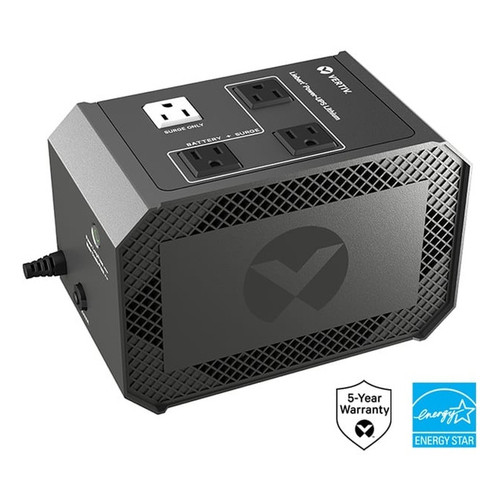
The PUL-400LVT's weight is documented at 5.05 lbs; no weight figure is provided for the BV400XU. The Li-Ion construction of the PUL-400LVT likely contributes to its compact 5.43 × 4.72 × 8.26 in footprint, though dimensions for the BV400XU are not specified.
Which unit is better suited to specific installation environments, operating conditions, and regulatory requirements?
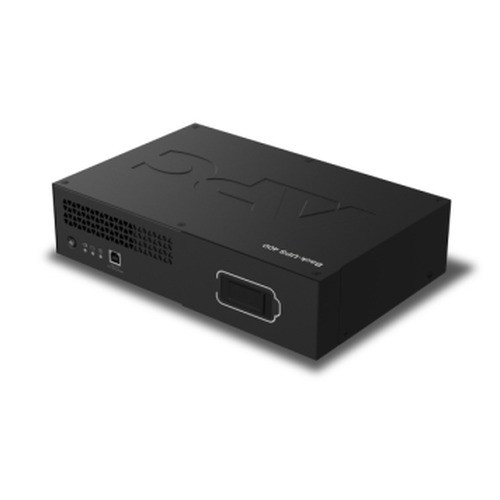
The BV400XU is described as a low-profile industrial unit with flexible mounting, suggesting it is designed for rack, wall, or DIN-rail deployment in industrial or commercial security infrastructure. It supports an operating temperature range of 0–50°C and a storage range of -15–50°C. No mounting options or form-factor details are given for the PUL-400LVT beyond its physical dimensions.
The PUL-400LVT carries a narrower operating temperature range of 0–40°C (32–104°F), which may be a constraint in warmer industrial environments where the BV400XU's 50°C ceiling applies. The BV400XU's 10°C upper-temperature advantage is a documented spec delta.
Regulatory listings heavily favor the PUL-400LVT for North American deployments: it is certified to Energy Star 2.0, cTUVus (UL 1778 5th Ed / CSA 22.2 No.107.3:2014 3rd Ed), and FCC Part 15 Class B. The BV400XU lists no certifications in the provided specs. The BV400XU input voltage range (92–139V) and 220W/230V-nominal output confirm it is NOT a 120V North American product; deploying it on a 120VAC circuit would be outside its specified operating parameters.
Which should you choose: the BV400XU or the PUL-400LVT?
Our take: The BV400XU is the stronger choice when the installation is on a 220–230V circuit, requires industrial flexible mounting, or must sustain higher ambient temperatures up to 50°C. The PUL-400LVT is the correct selection for any standard 120VAC North American installation. The two units are voltage-incompatible: the BV400XU is a 220V-output product; the PUL-400LVT is a 120VAC product. Beyond voltage, the PUL-400LVT posts a 240W load capacity versus the BV400XU's 220W, and declares greater-than-95% efficiency at full load — a figure absent from the BV400XU spec sheet. The PUL-400LVT's Lithium-Ion battery also avoids the BV400XU's 8-hour recharge penalty. Conversely, the BV400XU operates to 50°C versus the PUL-400LVT's 40°C ceiling and includes a documented 300J surge rating and 6ms response time not present in the Vertiv spec. Buyers should select primarily by supply voltage, then weigh battery chemistry preference and thermal environment.
Side-by-Side Comparison
Spec-for-spec, from manufacturer data.
| Specification | APC by Schneider Electric BV400XU | Vertiv PUL-400LVT |
|---|---|---|
| VA Rating | 400 VA | 400 VA |
| Output Power (Watts) | 220 W | 240 W |
| Topology | Standby (Sine output stated) | Standby |
| Waveform | Sine | — |
| Input Voltage Range | 92–139 V | 120 VAC |
| Output Voltage | 220 W / ~230V nominal | 120 VAC |
| Efficiency at Full Load | — | >95% |
| Battery Chemistry | Sealed lead-acid (implied) | Lithium-Ion |
| Battery Recharge Time | 8 h | — |
| Battery Life (Max) | 5 year(s) | — |
| Surge Energy Rating | 300 J | — |
| Response Time | 6 ms | — |
| Operating Temperature | 0–50°C | 0–40°C (32–104°F) |
| Storage Temperature | −15–50°C | — |
| Outlets / Wiring | — | NEMA 5-15P in; 5-15R ×4 out (3 BB, 1 SO) |
| Certifications | — | Energy Star 2.0, cTUVus (UL 1778 5th Ed), FCC Part 15 Class B |
| Dimensions (H×W×D) | — | 5.43 × 4.72 × 8.26 in |
| Weight | — | 5.05 lbs |
| Form Factor / Mounting | Compact / Flexible industrial mounting | — |
| Colour | Black | — |
Frequently Asked Questions
Which should you choose: the BV400XU or the PUL-400LVT?
The BV400XU is the stronger choice when the installation is on a 220–230V circuit, requires industrial flexible mounting, or must sustain higher ambient temperatures up to 50°C. The PUL-400LVT is the correct selection for any standard 120VAC North American installation. The two units are voltage-incompatible: the BV400XU is a 220V-output product; the PUL-400LVT is a 120VAC product. Beyond voltage, the PUL-400LVT posts a 240W load capacity versus the BV400XU's 220W, and declares greater-than-95% efficiency at full load — a figure absent from the BV400XU spec sheet. The PUL-400LVT's Lithium-Ion battery also avoids the BV400XU's 8-hour recharge penalty. Conversely, the BV400XU operates to 50°C versus the PUL-400LVT's 40°C ceiling and includes a documented 300J surge rating and 6ms response time not present in the Vertiv spec. Buyers should select primarily by supply voltage, then weigh battery chemistry preference and thermal environment.
Can I use the BV400XU or PUL-400LVT on a standard US 120V wall outlet?
Only the PUL-400LVT is rated for 120VAC input and output, and its outlets are specified as NEMA 5-15R — standard US receptacles. The BV400XU has an input operating voltage range of 92–139V nominal but delivers 220W output power consistent with a 220–230V output topology; it is not specified for 120V North American use. Connecting it to a 120VAC circuit would be outside its documented operating parameters.
Which UPS has a longer-lasting battery that requires less maintenance?
The PUL-400LVT uses a Lithium-Ion battery, which is specified in its product description. The BV400XU uses what the specs imply is a conventional sealed lead-acid battery, with a stated maximum life of 5 years and an 8-hour recharge time. No battery life or recharge time is documented for the PUL-400LVT. Based on available specs, the PUL-400LVT's Li-Ion chemistry is the lower-maintenance option, though a direct cycle-life number is not provided for it.
Which unit is better for an outdoor cabinet or warm equipment room that can reach high temperatures?
The BV400XU is rated to operate at up to 50°C, compared to the PUL-400LVT's upper limit of 40°C. In installations where ambient temperatures can exceed 40°C — such as outdoor enclosures or poorly ventilated equipment rooms in warm climates — the BV400XU has a documented 10°C advantage. However, this only applies where the BV400XU's 220V output is compatible with the local supply voltage.
Get a Second Opinion on Your Camera Choice
Share your site layout, coverage goals, and budget. Our team will validate the camera selection, flag anything we would change, and recommend products that match the use case.