
ACTi A76 vs ACTi Z813: Specification Comparison
Both the ACTi A76 and ACTi Z813 are 4MP outdoor dome cameras sharing the same resolution class and dome form factor, but they diverge significantly in lens design — the A76 uses a fixed 2.8mm board-mount lens while the Z813 features a motorized 2.8–12mm varifocal zoom. Buyers considering these two models are typically weighing the simplicity and ruggedness of a fixed-lens deployment against the scene-coverage flexibility of optical zoom, within the same brand ecosystem and the same general IP outdoor application.
In This Guide
How do the imaging specs compare?
Both cameras deliver 4MP resolution at 2688×1520 on the A76 (30 fps specified) and 4MP on the Z813, with identical minimum illumination of 0.003 lux color / 0 lux B/W with IR active. The A76 uses a 1/2.7" sensor with a fixed 2.8mm lens at an unspecified fixed iris, while the Z813 uses a 1/3" progressive-scan CMOS with a motorized 2.8–12mm (4.3× optical) zoom at f/1.6 fixed iris. The larger 1/2.7" sensor on the A76 offers a slight light-gathering advantage over the Z813's 1/3" chip, though both reach 0 lux with IR engaged.
WDR performance differs materially: the A76 is rated at Extreme WDR (150 dB), a quantified figure, whereas the Z813 spec lists only 'WDR' with no dB rating provided. IR range also diverges — the A76 reaches 65m at 850nm, versus 40m on the Z813 at the same wavelength. The Z813's 4.3× motorized zoom enables remote focal-length adjustment from 2.8mm wide to 12mm telephoto, a capability the fixed-lens A76 entirely lacks. Max frame rate for the Z813 is not specified in the provided data.
What about installation and environment?
The A76 carries IP68 and IK10 ratings, meaning it is rated for continuous submersion beyond 1m depth and resists 20-joule vandal impacts. The Z813 is rated IP67 (temporary immersion up to 1m for 30 minutes) and no IK rating is provided in the supplied specifications. Both cameras share an identical operating temperature range of -40°C to 60°C (-40°F to 140°F).
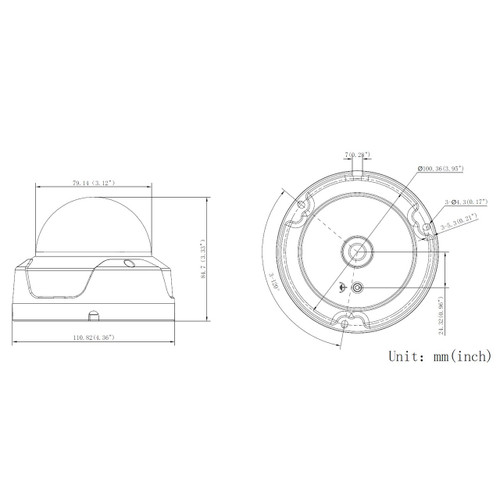
Power input for the A76 is explicitly stated as DC 12V or PoE Class 3 (IEEE 802.3af), delivered via RJ-45 pigtail connector. The Z813 specs list a 1×Ethernet 10/100 Base-T RJ-45 connector but do not specify PoE class or DC input voltage in the provided data. The A76 dimensions are 110.82mm × 84.7mm (Ø × H); Z813 dimensions are not listed in the provided specs. The A76 explicitly supports wall, pole, pendant, and corner mounts; the Z813 spec notes board-mount with pole, wall, and ceiling compatibility.
Which fits your VMS and analytics better?
The A76 is ONVIF Profile S, G, T, and M compliant, explicitly listed. The Z813 is described as ONVIF-compliant with named VMS compatibility (Milestone, Genetec, exacqVISION), but specific ONVIF profiles are not enumerated in the provided specifications. Both cameras support H.265 and H.264 compression; the Z813 spec explicitly labels these as 'Adaptive Stream' variants, while the A76 adds MJPEG as a third codec option. Neither camera's on-board edge storage capability (SD card slot) is confirmed or denied in the provided specifications for either model.
The A76 includes Deep Learning analytics — specifically Face Detection and People Detection — plus VMD, all stated in the supplied specs. No edge analytics are listed for the Z813 in the provided data. Both cameras offer 2-way audio with line-in and line-out; the Z813 additionally includes a built-in microphone, which the A76 spec does not mention. The A76 carries a stated 3-year warranty; no warranty term is provided for the Z813 in the supplied specifications.
Which should you choose: the A76 or the Z813?
Our take: The A76 is the stronger choice when site conditions demand maximum physical ruggedness, long IR throw, and on-camera analytics. Its IP68 + IK10 ratings outclass the Z813's IP67 and unspecified impact resistance; its 65m IR range exceeds the Z813's 40m by 63%; and its 150 dB Extreme WDR rating versus the Z813's unquantified WDR figure is a concrete imaging advantage in high-contrast scenes. The A76 also adds Deep Learning Face and People Detection, MJPEG, four named ONVIF profiles, and a stated 3-year warranty — none of which appear in the Z813's provided specs. The Z813 is the stronger choice when operators need remote focal-length adjustment: its 4.3× motorized zoom (2.8–12mm at f/1.6) lets a single installed unit cover scenes that would require a fixed-lens camera swap, making it better suited for staging areas, entry lanes, or any deployment where coverage geometry may change after installation.
Side-by-Side Comparison
Spec-for-spec, from manufacturer data.
| Specification | ACTi A76 | ACTi Z813 |
|---|---|---|
| Resolution | 4MP (2688×1520) | 4MP |
| Image Sensor | 1/2.7" | 1/3" Progressive Scan CMOS |
| Lens / Focal Length | 2.8mm fixed, board mount | 2.8–12mm motorized zoom (4.3× optical), f/1.6 |
| Min Illumination (Color) | 0.003 lux | 0.003 lux @ F1.6 (AGC on) |
| Min Illumination (B/W) | 0 lux (IR on) | 0 lux (IR on) |
| IR Range | 65m | 40m |
| IR Wavelength | 850nm | 850nm |
| WDR | Extreme WDR (150 dB) | WDR (no dB rating provided) |
| Max Frame Rate | 30 fps @ 2688×1520 | Not specified in provided data |
| Video Compression | H.265; H.264; MJPEG | H.265 Adaptive Stream; H.264 Adaptive Stream |
| IP Rating | IP68 | IP67 |
| IK / Impact Rating | IK10 | Not specified |
| Operating Temperature | -40°C to 60°C | -40°C to 60°C |
| Power Input / PoE Class | DC 12V; PoE Class 3 (IEEE 802.3af) | Not specified in provided data |
| ONVIF Profiles | Profile S, G, T, M | Compliant (specific profiles not listed) |
| Edge Analytics | Deep Learning: Face Detection, People Detection; VMD | Not specified in provided data |
| Audio | 2-way; Line-in; Line-out | 2-way; Built-in microphone; Line-in; Line-out |
| Warranty | 3 years | Not specified in provided data |
Frequently Asked Questions
Which should you choose: the A76 or the Z813?
The A76 is the stronger choice when site conditions demand maximum physical ruggedness, long IR throw, and on-camera analytics. Its IP68 + IK10 ratings outclass the Z813's IP67 and unspecified impact resistance; its 65m IR range exceeds the Z813's 40m by 63%; and its 150 dB Extreme WDR rating versus the Z813's unquantified WDR figure is a concrete imaging advantage in high-contrast scenes. The A76 also adds Deep Learning Face and People Detection, MJPEG, four named ONVIF profiles, and a stated 3-year warranty — none of which appear in the Z813's provided specs. The Z813 is the stronger choice when operators need remote focal-length adjustment: its 4.3× motorized zoom (2.8–12mm at f/1.6) lets a single installed unit cover scenes that would require a fixed-lens camera swap, making it better suited for staging areas, entry lanes, or any deployment where coverage geometry may change after installation.
Is the A76 or Z813 better for low-light performance?
Both cameras reach an identical minimum illumination of 0.003 lux in color mode and 0 lux in B/W with IR active. However, the A76 has a larger 1/2.7" sensor (versus the Z813's 1/3" chip) and a rated IR range of 65m compared to the Z813's 40m, giving the A76 a measurable advantage in pitch-dark, long-distance scenes. The Z813's f/1.6 fixed iris is noted in the specs, but no iris value is provided for the A76, so a direct aperture comparison cannot be made from the available data.
Which camera is more vandal- and weather-resistant?
The A76 holds both IP68 (continuous submersion) and IK10 (20-joule impact) ratings. The Z813 is rated IP67 (temporary immersion, up to 1m for 30 minutes), and no IK impact rating is listed in its provided specifications. For installations exposed to deliberate tampering, flooding, or repeated washdown, the A76's ratings are objectively higher based on the supplied specs.
Can I adjust the field of view after the camera is mounted?
Only the Z813 supports post-installation field-of-view adjustment. Its 4.3× motorized zoom lens (2.8–12mm) can be remotely adjusted from wide-angle to telephoto without physically accessing or swapping the camera. The A76 uses a fixed 2.8mm lens with no zoom capability; its field of view is set at installation and cannot be changed without replacing the lens or the camera.
Get a Second Opinion on Your Camera Choice
Share your site layout, coverage goals, and budget. Our team will validate the camera selection, flag anything we would change, and recommend products that match the use case.