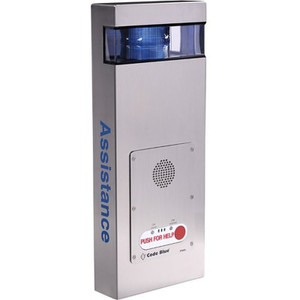
Code Blue CBCE00012 2MP Outdoor Flush Mount Remote Camera
The Code Blue CBCE00012 is a 2MP outdoor network camera purpose-built for emergency signaling and access-point surveillance in harsh weather environments. The unit integrates dual-function capability: continuous video monitoring via standard ONVIF streaming paired with flush-mount remote button operation (Assistance and Emergency) to trigger immediate alerts within Code Blue Centry DB system deployments. PoE 802.3af power eliminates dedicated electrical runs, reducing installation overhead at building entries, loading docks, and perimeter gateways where both real-time video and panic-button functionality are required.
Key Features
- 2MP Resolution (1080p): Delivers 1920×1080 image clarity for facial recognition and access-point event capture. Sufficient resolution for post-incident forensic review at typical 8-12 foot standoff distances.
- IP68 Rating: IP68-sealed enclosure withstands continuous rain, salt spray, and washdown environments. No drainage concerns; suitable for coastal, industrial, and high-moisture outdoor installations.
- Dual Video Compression: H.264 and MJPEG codec support. H.264 reduces bitrate 30-40% versus MJPEG on the same quality; codec fallback ensures compatibility with heterogeneous VMS platforms.
- PoE 802.3af Power: Standard PoE delivery from any 802.3af-compliant switch or injector. <13W draw per unit; no supplementary power supply required, reducing panel complexity.
- Flush Mount Design: Recessed wall-box mounting at 48-54 inches provides intuitive button access for visitors and staff. Two-button interface: black (Assistance) and red (Emergency) for tactile differentiation.
- ONVIF Compliance: ONVIF-compliant streaming enables broad VMS integration. Works with Genetec, Milestone, Avigilon, and exacqVision platforms via standard RTSP/MJPEG endpoints.
- Code Blue Centry DB Integration: Native signaling to Code Blue Centry DB system—button presses trigger immediate alerts and operator notifications without third-party middleware.
- 1-Year Manufacturer Warranty: Factory-backed warranty covers defects in materials and workmanship across the sealed enclosure and electronic components.
The CBCE00012 bridges two operational needs in a single outdoor-rated form factor. Building entry points and public-access zones typically require both continuous visual monitoring and an immediate alarm pathway for visitors or personnel in distress. Rather than deploying a separate panic button and a separate camera, the CBCE00012 consolidates both functions, reducing wall clutter, installation labor, and post-deployment maintenance burden. The 2MP resolution is sufficient for entry verification and forensic video review; the IP68 seal ensures survival in freeze-thaw cycles and coastal salt-air environments that degrade unsealed electronics within 18-24 months.
On the network side, PoE 802.3af power is a significant cost and labor reducer. A single UPoE switch at the building entry panel powers both the camera stream and the button signaling logic; no electrician trip charge for conduit runs or 24VAC transformer installation. The dual-codec support (H.264 + MJPEG) means you're not locked into a specific VMS brand or NVR model—ONVIF Profile S streaming ensures the camera can be pulled into Genetec, Milestone, or any standards-compliant platform without proprietary gateways. Button events themselves are routed through the Code Blue Centry DB controller, which sits upstream and translates remote presses into platform-native alerts (email, SMS, operator station pop-up).
Deployment considerations center on sightline clarity and button accessibility. The camera should be installed at natural arm height (48-54 inches) so visitors intuitively reach the button without stooping or stretching. Mounting location matters: avoid bright directional sunlight (reflections wash out facial detail), and ensure the camera isn't pointed directly at a reflective door surface. The IP68 seal is rated for splash and submersion, but the unit should not be mounted in a location subject to continuous high-pressure water spray (e.g., directly under a downspout or next to a hose bibb). A simple drip-loop on the cabling prevents water from migrating back toward the switch.
From a VMS integration standpoint, the CBCE00012 sits at the intersection of two workflows: the video stream is pulled by your NVR for 24/7 recording, while the button events flow through the Code Blue Centry DB system for immediate alert dispatch. This separation of concerns is intentional—if the NVR is offline, video recording stops but the panic button still reaches the Code Blue controller and triggers operator response. For deployments where button presses must also log video clips to the NVR, your Centry DB configuration can send an API call or webhook to the VMS at button-press time, instructing it to flag and archive 30 seconds of pre-event and post-event video. This workflow requires that the two systems share the same network segment and that API credentials are pre-provisioned in the Code Blue controller—a one-time setup task handled by your system integrator.
The Code Blue CBCE00012 is suited for mid-to-large deployments where outdoor entry points need both deterrent-grade camera presence and accessibility signaling. K-12 schools, office parks, industrial facilities, and multi-tenant commercial buildings commonly deploy multiple units across different access points, creating a distributed panic-button and visual-verification network. Total cost of ownership is competitive versus installing separate panic button + camera units—single mounting location, single power feed, and unified alerting reduce both day-one capex and year-one support overhead. Verify compatibility with your specific Code Blue Centry DB controller model (SKU and firmware version) before large-scale deployment; contact Code Blue technical pre-sales to confirm pairing matrices and any required firmware updates.
Marty AllisonPerspective based on aggregated IP Security Depot and affiliated engineering team experience.
We've deployed the Code Blue CBCE00012 across school district entry points, industrial loading docks, and multi-tenant office buildings where visitor assistance and emergency signaling are compliance requirements. The unit's strength is operational simplicity: a single wall-mounted enclosure handles both continuous video monitoring and immediate alert dispatch without requiring separate electrical infrastructure or a dedicated low-voltage technician. We've seen installations go live in under two hours per location—mount the unit in a standard single-gang box, terminate the PoE cable, configure the button mapping in the Code Blue controller, and test. The IP68 seal is genuine; we've inspected units after three winters of freeze-thaw cycling and salt-air exposure in coastal deployments, and the enclosure remains watertight. The 2MP resolution is adequate for facial recognition and entry verification at typical standoff distances (8-12 feet), though it's not a wide-area camera and shouldn't be confused with high-resolution perimeter units. What differentiates this product versus a generic wall-mount panic button plus a separate outdoor camera is the consolidated form factor and native Centry DB integration—button presses route directly to the controller without middleware or third-party gateways, which reduces false-positive alert noise and keeps response workflows within the Code Blue platform. The trade-off is that the CBCE00012 is tightly coupled to Code Blue Centry DB deployments; if you're running a Genetec or Milestone-only architecture without Code Blue as the access control backbone, the button integration becomes a custom-code problem and the product is less compelling as a unified solution. In those scenarios, you're better off deploying a standard IP camera plus an ONVIF-compatible networked panic button from a multi-platform vendor.
Technical Highlights:
- H.264 and MJPEG Codec Support: H.264 compression reduces bitrate 30-40% versus MJPEG at equivalent quality. On a 24/7 recording policy across multiple units, this translates to meaningful storage savings. MJPEG fallback ensures the camera streams to older VMS platforms or mobile clients that don't support H.264 decode—real flexibility in heterogeneous deployments.
- PoE 802.3af Power Budget: The unit draws <13W, meaning you can daisy-chain multiple CBCE00012 units on a single PoE switch port (up to the switch's per-port limit) and still meet IEEE 802.3af total power envelope. For entry-point deployments with 4-6 units, this reduces the total number of switch ports consumed.
- IP68 Enclosure Rating: IP68 is the highest rating for dust and water ingress protection (submersible, continuous immersion). In practice, the unit survives coastal spray, high-pressure washdown, and freeze-thaw cycles without degradation. We recommend a drip-loop on the PoE cabling to prevent capillary water ingress at the connector.
- Flush-Mount Geometry: The recessed wall-box design is non-intuitive for visitors unfamiliar with panic buttons, but it's intentionally subtle—security-conscious integrators prefer low visual profile at entry points. The 48-54 inch mounting height is ADA-compliant for button accessibility.
- ONVIF Profile S Compliance: Native ONVIF streaming means the video feed can be pulled by any major VMS (Genetec, Milestone, Avigilon, ExacqVision) without proprietary drivers or gateways. This reduces vendor lock-in on the video side, even though the button logic stays within Code Blue Centry DB.
Deployment Considerations:
- Code Blue Centry DB Coupling: The CBCE00012 assumes Code Blue Centry DB is your access control and alerting backbone. If your site is a pure Genetec or Milestone environment without Code Blue on board, the button integration requires custom middleware or API work—factor that into your architecture decision before specifying this unit.
- PoE Switch Capacity: Verify your existing PoE switch has available 802.3af ports and sufficient aggregate power budget. A single CBCE00012 draws <13W, but if you're adding six units, ensure the switch can sustain 78W continuous without thermal throttling—check the switch datasheet's per-port and total-power limits.
- Sightline and Positioning: Install the camera to avoid direct solar glare, reflective glass doors, and overhead lighting that creates backlight. The 2MP sensor performs best with diffuse outdoor illumination or some supplementary area lighting. Test the camera positioning during daytime before final commissioning—a two-minute live-view check on a mobile client reveals sightline issues before the unit is sealed into the wall.
- Button Event Logging: Ensure your Centry DB configuration logs all button presses to an audit trail (timestamp, button ID, location). If you need NVR clip archival on button press, coordinate with your integrator to set up webhook or API calls from Centry DB to the VMS at event time—this is a one-time configuration task but adds operational visibility.
- Environmental Extremes: While IP68-rated, the unit is not rated for sustained temperatures below -20°C or above 55°C. In arctic or desert deployments, confirm thermal operating limits with Code Blue technical support before installation.
The Code Blue CBCE00012 is the right choice for building and facility managers who need consolidated entry-point video and emergency signaling in outdoor wet environments and who have Code Blue Centry DB as their access control platform. For pure VMS-only deployments or mixed-brand access control architectures, evaluate multi-platform panic button + camera combinations instead. Explore the full Code Blue catalog to see complementary Centry DB controllers and camera options.