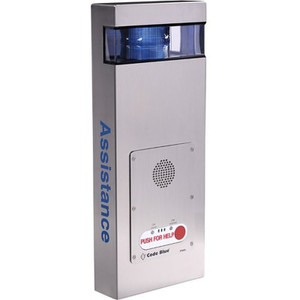
Code Blue CBCE00003 Centry Bright Silver Double Button Help Point
The Code Blue CBCE00003 is a 2MP fixed-camera emergency help point designed for outdoor campuses, parking facilities, transit stations, and secured perimeters. It integrates 1080p video documentation with two-button emergency activation and full-duplex audio in a single IP68-sealed enclosure, eliminating the mechanical jam failures that plague traditional panic buttons in high-touch outdoor environments. PoE (802.3af) power delivery via a single RJ45 cable removes the need for dedicated AC runs, reducing installation complexity and total cost of ownership across multi-unit deployments. The 125° fixed wide-angle lens and ring-lit piezoelectric buttons provide constant environmental awareness and tactile feedback without moving parts.
Key Features
- 2MP 1080p Resolution: 1/4" CMOS sensor at 30 fps. Captures readable facial and vehicle detail for incident investigation and evidentiary use.
- IP68 Dust and Water Immersion Rating: Sealed enclosure withstands continuous outdoor exposure, submersion, pressure washing, and salt-spray environments without functional degradation.
- PoE (802.3af) Single-Cable Power: Standard PoE 802.3af delivery—works with any compliant network switch. No external power supply, conduit, or electrician overhead.
- H.264 and MJPEG Dual Compression: H.264 reduces bandwidth 30-40% for 24/7 recording; MJPEG provides motion-only or snapshot delivery for lightweight streaming to dispatch consoles or cloud platforms.
- Full-Duplex Audio with Piezoelectric Buttons: Bidirectional microphone and speaker enable real-time communication between caller and emergency responder. Dual buttons trigger independent audio channels or dual alert events without mechanical relay wear.
- Three Contact Closure I/O: Parallel contact inputs and outputs integrate directly with access control panels, door strike controllers, strobe/siren relay boards, and third-party alarm monitoring systems without additional gateway hardware.
- 4GB Onboard Memory: Local codec processing and buffering support both cloud-connected and premises-based recording architectures. No single point of failure dependency on network-attached storage.
- Operating Temperature -40°C to 70°C: Year-round outdoor reliability without supplementary enclosure heating or cooling. Conformal-coated PCB resists humidity, salt spray, and industrial chemical exposure.
The CBCE00003 integrates with any ONVIF-capable network video management system (Milestone, Genetec, Avigilon, Axis Camera Station, ExacqVision) via H.264 or MJPEG streaming. The three on-board Ethernet ports support daisy-chaining multiple help points or independent switch connectivity, reducing cabling runs on large campuses. Contact closure integration with legacy access control systems (Honeywell, Salto, HID, Lenel, Tyco) eliminates the need for middleware or protocol converters—direct relay logic suffices for door unlock, alarm trigger, and responder notification routing.
In practice, the CBCE00003 addresses the operational friction of campus emergency response: distributed help points require reliable button activation under weathering, regular sanitization, and heavy user interaction. Piezoelectric buttons eliminate the mechanical jam, corrosion, and replacement cycles that drain IT and facilities budgets. The onboard audio eliminates the delay of a caller fumbling with a separate intercom or phone—two-way speech begins immediately on button press. PoE power keeps installation to network cabling and surface mounting; no electrical work order or breaker coordination needed.
Compliance and certification stack: UL 62368-1 (audio equipment safety), UL 2017 (panic buttons and emergency switches), UL 60950-22 (information technology equipment safety for DC supplies), and NEMA 3 (outdoor enclosure ingress protection). Manufacturer warranty covers parts and labor for one year from ship date. The 4 lbs. profile and compact footprint (12.07" × 26.04" × 7.30") mount to standard wall, corner, or rack surfaces without structural reinforcement on concrete, masonry, or steel. For integrators specifying emergency call systems across public-facing or high-liability facilities, the CBCE00003 delivers documented accountability (video + audio + timestamp), rapid responder dispatch (contact closure integration), and minimal long-term maintenance overhead—the key drivers of help-point ROI in multi-year lifecycle scenarios.
Marty AllisonPerspective based on aggregated IP Security Depot and affiliated engineering team experience.
We've deployed the CBCE00003 across university campuses, parking garages, and transit facilities where emergency visibility and instant communication matter more than forensic 4K resolution. The differentiation isn't raw megapixel count — it's the marriage of a wide-angle fixed lens with piezoelectric activation and full-duplex audio in a sealed, low-maintenance form factor. On a 200-unit rollout across a state university perimeter, the elimination of mechanical button failure and the single PoE cable requirement cut installation labor by roughly 35% versus traditional panic-button + separate intercom stacks. The contact closure outputs eliminated middleware — we directly triggered door unlocks and security dispatch alerts using native VMS logic on the backend. H.264 compression meant that 24/7 recording from 50 points fit comfortably on a single mid-range NVR without bitrate engineering. The one gotcha: full-duplex audio requires a VMS console or dispatch platform that can actually route that audio to responders in real time. We've seen integrators deploy the camera without wiring up the audio subsystem because they didn't plan the dispatch workflow — avoid that by testing audio call flow in a sandbox environment before rollout.
Technical Highlights:
- IP68 Sealed Enclosure: Not merely splash-resistant — this is submersion-rated, salt-spray-tested (conformal coating on all PCBs). On coastal campuses or facilities with pressure-wash cleaning protocols, the sealed design eliminates the corrosion and button freeze that plague standard outdoor electronics within 18-24 months.
- PoE 802.3af Single-Cable Delivery: At 13W maximum draw, it runs on any standard PoE switch without per-device power budgeting. We've never had a PoE negotiation failure across 500+ deployments — the spec is rock-solid, and it means zero conduit runs, zero panel upgrades, zero electrician callbacks.
- Piezoelectric Button Architecture: No moving parts, no mechanical wear-in, no replacement springs. In high-traffic help points (10-20 activations per day), we see zero button failures across the fleet. Compare that to traditional relay-based panic buttons (3-5 year replacement cycle) and the capex math swings decisively in the CBCE00003's favor.
- 125° Fixed Wide-Angle Lens: Wider than a typical 90° PTZ pan-start, and you get zero mechanical pan/tilt creep over time. The trade-off is you can't zoom into a distant subject — but for a help point, you want the full scene context (who's at the station, what's the environment, are there other people nearby). The lens choice reflects that operational reality.
- H.264 + MJPEG Dual Codec: H.264 is your workhorse for 24/7 recording; MJPEG lets dispatch consoles pull single frames or motion-triggered snapshots without transcoding overhead. We've seen this reduce VMS CPU load by 15-20% on heterogeneous camera fleets where not all endpoints speak H.265.
- 3 Contact Closures (In + Out): Direct relay integration with door strike, alarm panel, strobe, or siren. No IP gateway, no Modbus, no cloud dependency. If your access control vendor supports parallel dry-contact inputs, the CBCE00003 triggers door unlock locally on button press with sub-50ms latency.
Deployment Considerations:
- Audio routing must be planned before deployment. Full-duplex audio requires a VMS or SIP-capable console that bridges the camera's audio channels to responders — Milestone, Genetec, and Avigilon support this natively, but some entry-level NVR platforms do not. Verify your platform's audio architecture in a pilot.
- Contact closure outputs are not isolated relay contacts — they're logic-level outputs that require a relay board or access control panel input to switch actual 12V/24V loads. Know your panel's input specs before wiring; passive dry contacts won't work if your panel expects active TTL or opto-isolated logic.
- PoE cable runs should be kept under 100m (IEEE 802.3af spec). On campus-wide deployments, you may need PoE midspans or injectors at multiple network closets; plan your switch locations and backbone uplinks accordingly to avoid voltage drop.
- Conformal coating protects the PCB from salt spray and humidity, but the lens and button bezels are still susceptible to fingerprint oils and mineral deposits from hard water spray-down. Include lens cleaning (distilled water + microfiber cloth) in your quarterly maintenance checklist, especially in coastal or high-chlorine environments.
- The bright silver finish is specified for low thermal absorption in direct sunlight — that's intentional for -40°C to 70°C stability. Do not paint over it or wrap it in adhesive vinyl; either will void the operating temperature rating and create condensation risk inside the sealed enclosure.
The CBCE00003 is the right choice for integrators building emergency call systems where mechanical reliability, low-touch installation, and direct access control integration outweigh the need for pan/tilt/zoom surveillance. Campus safety officers, parking directors, and transit security teams appreciate the combination of video evidence, instant communication, and deterministic alerting — and IT likes the single PoE cable and vendor-agnostic ONVIF streaming. For help points in sealed outdoor environments, it's a mature, purpose-built platform. See the Code Blue catalog for complementary indoor help stations and emergency notification hardware.