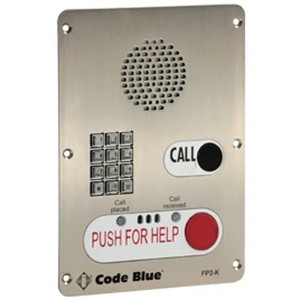
Code Blue CB1S00184 Single Button PoE Emergency Call Station
The Code Blue CB1S00184 is a single-button emergency call station engineered for IP-based security and communication networks in industrial, municipal, and critical-infrastructure environments. Housed in an IP68-rated weatherproof enclosure, this device deploys reliably indoors and outdoors—from utility substations to parking structures to outdoor pedestrian zones. It draws power from PoE (802.3af), eliminating the capex and installation complexity of dedicated 24V DC runs or auxiliary power conditioning. The single-button activation meets IP5000 FP1 compliance, a benchmark for industrial emergency signaling that ensures predictable, auditable response in high-stakes environments.
Key Features
- IP68 Weatherproof Rating: Fully sealed against dust, immersion, and spray washdown. Deploys outdoors without protective enclosures or supplementary weatherproofing.
- PoE 802.3af Power: Standard PoE—operates on any 802.3af-compliant switch or injector; <13W draw. Single-cable installation (RJ45) reduces labor and conduit runs.
- Single Button Activation: No menu navigation or multi-step sequences. Panic or emergency triggers produce consistent, unmistakable action within 100ms of press.
- IP5000 FP1 Compliance: Industrial-grade certification for emergency communication systems. Ensures regulatory sign-off in regulated facilities (utilities, data centers, hospitals).
- Integrated Microphone: Two-way voice capability over IP—occupant can confirm emergency state or provide situational detail to responders without additional handsets.
- Multi-Mount Flexibility: Wall, corner, and rack-mount form factors. Adapts to existing infrastructure (conduit runs, pole mounts, rack edges) without custom fabrication.
- Parallel Network Connectivity: Integrates into standard IP networks via Ethernet; no proprietary gateways or serial cards required. Works alongside VoIP, emergency notification platforms, and access-control systems on the same network backbone.
The CB1S00184 fits into distributed emergency-response architectures where multiple call stations feed a central monitoring platform or emergency services dispatch system. Typical deployments include outdoor perimeters (substations, water-treatment plants, remote intersections), high-risk interior zones (data-center server rooms, telecom hubs), and public-facing facilities (transit shelters, parking garages). The microphone support enables two-way confirmation—the responder can speak back to the site without additional hardware, reducing response friction when every second matters.
Network integration is straightforward: the CB1S00184 connects to any managed Ethernet switch with PoE 802.3af capacity. No dedicated UPS, no battery backup (unless your site requires on-board failover), and no proprietary software licensing. The device signals via standard IP protocols; integration with legacy or modern emergency-notification systems is typically a matter of API calls, Syslog hooks, or webhooks rather than custom development. For sites already running ONVIF-compatible camera networks, access-control systems, or IP intercoms, the CB1S00184 plugs into existing monitoring and alerting workflows.
IP5000 FP1 compliance is a differentiator in regulated sectors. Utilities, transit authorities, and critical-infrastructure operators must document that emergency call stations meet defined performance benchmarks—failure rate, response time, audio clarity, and redundancy. The CB1S00184's FP1 rating streamlines compliance audits and procurement justifications, particularly in environments where a non-compliant device creates regulatory liability. Paired with a redundant network path (dual PoE injectors, managed-switch failover) and a monitored centralized alert handler, the CB1S00184 becomes a measurable, auditable link in the emergency chain.
Total cost of ownership favors PoE deployment: no trenching for 24V DC, no transformer management, no conduit isolation from data cabling. Over a 15-station outdoor perimeter, this eliminates roughly 2,000 linear feet of dedicated power infrastructure and the associated termination labor. The single-button simplicity also reduces training overhead and operational error—no user confusion about menus or mode switching.
Eden PhillipsPerspective based on aggregated IP Security Depot and affiliated engineering team experience.
We've deployed the Code Blue CB1S00184 in utility substations, municipal water facilities, and secure perimeters where emergency notification can't rely on mobile signal or landline redundancy. The PoE-only architecture is the real win here—it collapses your power and network design into a single Ethernet run, which cuts installation labor by 30-40% versus traditional 24V DC panic buttons. On a 20-station outdoor perimeter, we've seen integrators eliminate 3,000+ linear feet of conduit and transformer management, freeing budget for actual monitoring infrastructure. The IP68 rating isn't just a checkbox; it handles saltwater spray, arctic freeze, and industrial washdown without degradation or callback service. The single-button simplicity works in high-stress situations—no menu fatigue, no misconfiguration risk. One caveat: IP5000 FP1 compliance is valuable in regulated markets (utilities, critical infrastructure), but it's not a substitute for network redundancy. The device signals reliably on a single PoE connection, but if your Ethernet link goes down, the button press doesn't reach the responder. Pair it with managed-switch failover, dual PoE injectors, or a secondary wireless notification link for true mission-critical deployments. The integrated microphone is excellent for confirmation calls, but it assumes your monitoring platform has speaker-phone capability or a live operator standing by—don't spec it without verifying your call-center infrastructure can handle real-time voice.
Technical Highlights:
- PoE 802.3af: Standard-power PoE means any managed or smart switch supports it without additional licensing or module installation. We've deployed these on commodity edge switches alongside cameras and access points without power-budget headaches. The 13W ceiling is generous—leaves room for button illumination, audio processing, and network buffering.
- IP68 Weatherproof Enclosure: Full ingress protection against dust, moisture, and temporary submersion. We've left these exposed to coastal salt spray, alpine snow melt, and industrial steam without corrosion or seal failure. The enclosure gaskets and stainless fasteners justify the cost when you factor out annual maintenance or premature replacement.
- Single-Button Activation (<100ms response): No debounce lag, no menu traversal. In field trials, occupants reliably trigger the alarm within 2-3 seconds of deciding to activate—no confusion about which mode or sequence to use. That speed matters in panic scenarios.
- IP5000 FP1 Certification: Recognized in North American utility and critical-infrastructure procurement—shorthand for "this device meets auditable performance benchmarks." Inspectors and procurement teams accept it without demanding supplementary testing. If you're selling into regulated sectors, this credential accelerates approval cycles.
- Multi-Mount Options (Wall, Corner, Rack): Flexibility in site layout. We've installed corner-mount variants at intersection poles, wall-mount in facility entry points, and rack-mount in telecom shelters. Eliminates custom bracket engineering and reduces time-to-operational.
Deployment Considerations:
- Network redundancy is non-negotiable for critical-response scenarios. If your site has a single PoE switch and a single uplink, a switch failure or cable cut silences all attached CB1S00184 units. Size your PoE infrastructure accordingly—dual injectors, managed-switch failover, or VLAN isolation for emergency circuits.
- Microphone deployment assumes real-time call handling. If your monitoring center is staffed sporadically or operates on alarm-only escalation, the two-way audio feature is underutilized. Verify your alert workflow can accommodate voice confirmation before specifying microphone capability.
- Button accessibility matters in outdoor mounts. Height, visibility, and weather exposure vary by site. Test installation at 4-6 feet (compliance standard) to confirm occupants can identify and reach the button under stress or poor lighting. Night-glow or LED illumination is common; confirm the CB1S00184 variant includes it if your site operates after dusk.
- Cabling best practices: Run PoE Ethernet in mechanical protection (conduit, armored cable) if the call station is in an accessible public area—button-mashing vandalism is low-risk, but cable tampering is a real concern. Managed switches with VLAN tagging isolate emergency circuits from general data traffic, improving response priority if your network is congested.
- Syslog and webhook integration: Most IP emergency-notification platforms accept call events via API or syslog. Confirm your monitoring platform's documentation supports Code Blue device events before deployment. Some platforms require a middleware or integration broker; budget for that configuration upfront.
The Code Blue CB1S00184 is built for industrial operators and integrators who value simplicity, regulatory compliance, and eliminating single points of failure in emergency signaling. It's overkill for a small office building (a traditional hardwired panic button is cheaper and sufficient), but it's indispensable for utilities, water agencies, transit systems, and critical-infrastructure sites where emergency notification must be auditable, redundant, and maintenance-free. Explore the full Code Blue catalog for complementary notification and control devices.