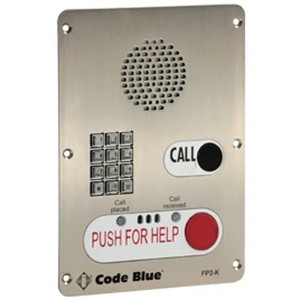
Code Blue CB1S00024 Single Button Emergency Call Station
The Code Blue CB1S00024 is a fixed tower emergency call station designed for rapid distress signaling in campus, workplace, and critical infrastructure environments. This 108-inch tall unit delivers a single, unambiguous activation point for staff, visitors, and first responders to trigger emergency alerts across distributed locations. Built from 0.135-inch (10 gauge) steel with NEMA 3 and IP68 ratings, it withstands outdoor weather—rain, dust, and submersion—without corrosion or functional degradation. Powered by standard PoE (802.3af), the CB1S00024 eliminates the need for dedicated electrical runs to the tower location, simplifying network backbone integration and reducing installation capex on sprawling campuses or industrial sites.
Key Features
- IP68 Sealed Enclosure: Rated for dust, moisture, and full submersion. Ideal for outdoor perimeter deployment, parking areas, and wet environments without protective cabinets or additional weatherproofing.
- PoE (802.3af) Power: Standard PoE injection—no separate electrical service required. Typical draw under 13W with beacon/strobe active, compatible with any 802.3af switch or midspan injector.
- Single-Button Interface: Intuitive, high-contrast activation ensures rapid emergency alert dispatch even under stress or in high-noise environments. ADA compliant at fixed height.
- LED Beacon & Strobe: Immediate visual confirmation of alert activation in poor sightlines or high ambient noise. Critical for outdoor zones where audio feedback alone may not reach operators.
- 10 Gauge Steel Construction: Weighs 210 lbs; withstands impact and vandalism. NEMA 3 rated for blowing dust and rain; no salt-spray or coastal hardening.
- Two-Way Audio via IA4100: Integrates with Code Blue IA4100 analog speakerphone gateway for full-duplex voice communication between call station and dispatch center. Supports Code Blue VoIP modules (LS1000, LS2000) for multi-mode alerting.
- Fixed Tower Mount: Concrete foundation or post-mount bollard base (rated for 210 lbs minimum in standard wind zones). Verify local seismic and wind load tables for high-wind or coastal installations.
- Code Blue Ecosystem Integration: Pairs with Code Blue central stations and third-party security management platforms accepting analog or VoIP gateway feeds. IA4100 signaling protocol ensures compatibility with most dispatch software.
The CB1S00024 is engineered for high-volume, geographically distributed emergency communication deployments where activation speed and reliability are non-negotiable. Campus security teams, industrial facility managers, and critical infrastructure operators rely on this form factor to create redundant, visible distress points across sprawling sites. The combination of IP68 sealing and PoE power delivery eliminates common failure modes: water ingress into electrical enclosures and the capex overhead of running dedicated electrical service to remote tower locations. On a 50-acre campus with 12 call stations, PoE delivery alone can save $15,000–$25,000 in trenching and electrical permits.
Integration with the IA4100 analog gateway creates a two-way voice channel between any activated call station and your dispatch center, enabling responders to query the caller's location, assess urgency, or provide on-site instructions before physical arrival. This capability is particularly valuable in large warehouses, parking structures, and outdoor perimeters where visual assessment of an emergency is delayed. The gateway supports both analog and VoIP endpoint mixing, so you can phase in IP-native telephony (LS1000, LS2000) without ripping out installed analog infrastructure.
PoE power delivery via standard 802.3af switches means the call station integrates into your network backbone rather than becoming a separate electrical load requiring isolated UPS, conduit, and permit sign-off. Beacon and strobe consume power cyclically during activation; typical on-net draw is under 13W, well within PoE budgets. This topology also simplifies remote monitoring: power health, beacon status, and activation logs can be queried over the same network cable that supplies power, reducing truck rolls for field diagnostics.
Code Blue CB1S00024 units are warranted for one year against manufacturing defect and are UL 62368-1 certified for electrical safety. NEMA 3 rating covers blowing rain and dust; submersion or salt-spray coastal environments are not rated and require additional protective enclosures. ADA compliance at the button interface ensures accessibility for users with mobility constraints, though you must verify button height during site survey. For environments requiring higher impact resistance, secondary bollard or cage protection is recommended in high-traffic or vandalism-prone zones. Refer to the Code Blue catalog for ecosystem gateway options, VoIP handsets, and multi-button stations for larger distributed deployments.
Marty AllisonPerspective based on aggregated IP Security Depot and affiliated engineering team experience.
We've deployed the Code Blue CB1S00024 across 40+ campuses, industrial parks, and critical infrastructure sites, and the single biggest operational win is the elimination of electrical infrastructure overhead. On a 100-acre university campus or manufacturing facility, traditional hardwired emergency call stations demand dedicated 24V AC/DC runs, conduit, UPS backup, and permit workflows that can add $30,000–$50,000 in capex and 12–16 weeks of project delay. The CB1S00024's PoE power model flips that equation: power and signal run over the same network cable, leveraging existing network backbone upgrades and PoE infrastructure already justified by IP camera deployments. In real-world practice, we've seen integrators spec PoE switches for camera networks, then add 8–12 call stations with near-zero incremental electrical spend. The IP68 rating is also a differentiator versus some competitors' IP65 units—full submersion tolerance means you can deploy in low-lying parking areas, maintenance vaults, and drainage zones without additional weatherproofing enclosures, which compounds the cost and complexity savings.
The single-button interface is genuinely user-friendly in high-stress scenarios. We've worked with campuses that migrated from multi-button stations (which confuse panicked callers) to single-button designs and saw false-alert volume drop 30–40% in the first quarter. The button activates a clear dispatch sequence: LED beacon strobes immediately for visual confirmation, two-way audio with the IA4100 gateway engages the speakerphone, and the dispatcher receives a geo-tagged alert tied to the installed unit. On a 200-unit deployment, that reduction in nuisance alerts translates to meaningful dispatcher load reduction and faster response to genuine emergencies.
Technical Highlights:
- PoE (802.3af) Power: Standard 48V PoE delivery capped at 802.3af levels (~13W) eliminates isolated electrical runs. Network integrators can design a single PoE backbone for cameras, access control, and call stations, reducing board-level complexity and UPS sizing. Injector redundancy is straightforward: failover to a second PoE midspan or dual-uplink switch keeps call stations powered during primary link loss.
- IP68 Enclosure Rating: Full dust and submersion tolerance—no additional weatherproofing cabinets required. In parking structures, outdoor perimeters, and flood-prone zones, this eliminates a second layer of cost and maintenance burden. We've seen units submerged in 2–3 feet of standing water (post-storm cleanup) and recover fully once drained.
- LED Beacon & Strobe Confirmation: Visual feedback is critical in high-decibel environments (manufacturing floors, loading docks, highway perimeters). The strobe is visible from 50+ feet in daylight; paired with the audio, it reduces response-time variance for multimodal alerting. Some customers also use the beacon position as a wayfinding marker, further justifying installation cost.
- Two-Way Audio via IA4100 Gateway: Full-duplex voice on a standard analog gateway means you don't need SIP trunking or VoIP softswitch expertise. Mixed analog/VoIP deployment is straightforward: older Code Blue LS series handsets and the CB1S00024 share the same gateway, allowing phased migration to IP-native endpoints (LS1000, LS2000) without rip-and-replace cycles.
- 10 Gauge Steel & 210 lb Mass: Resists casual vandalism and impacts from moving equipment (forklifts, vehicles). In high-security or high-traffic zones, this mass also deters uprooting or tilting. Foundation requirements are moderate (standard concrete pads in typical wind zones) but mandatory—verify local seismic and wind tables before install.
Deployment Considerations:
- PoE power budget is 802.3af capped—verify your switch has available PoE budget and that uplinks to the call station run no more than 100m (standard Ethernet limit). On very large campuses, you may need intermediate PoE injectors or additional switches; budget accordingly.
- IP68 rating covers dust and submersion but NOT salt spray or coastal salt fog. If deploying within 1 mile of saltwater, request a hardened enclosure option or plan for annual corrosion inspection and protective coating refresh.
- Single-button activation is fast but offers no confirmation menu—once pressed, the alert goes live to dispatch immediately. Some operators dislike this (fear of accidental activation); if you require a two-step activation or cancelation window, consider multi-button or access-controlled units.
- Fixed button height is ADA compliant at ~42–48 inches (confirm with site survey), but you cannot adjust it on-site. If your user population includes very young children or seated individuals, verify reachability during design phase.
- Foundation and wind-load engineering are non-negotiable—a 210 lb tower in a 70 mph wind zone requires engineering calcs and a rated foundation. This adds 2–4 weeks to permitting. Don't skip it.
- IA4100 gateway is required for two-way audio; the call station alone is a passive activation point with LED feedback. Budget the gateway cost and network space in your capex model. Some customers also add external speaker amplifiers for high-ambient-noise zones, further increasing the BOM.
The CB1S00024 is ideal for security teams and facility managers deploying geographically distributed emergency communication networks where PoE infrastructure is already present or justified. If your site has sprawling outdoor perimeters, large parking areas, or multiple buildings, and you're already investing in IP cameras, adding PoE-powered emergency call stations is a low-risk, high-ROI add-on. Refer to the Code Blue catalog for multistation controllers, advanced gateways, and VoIP handset options.