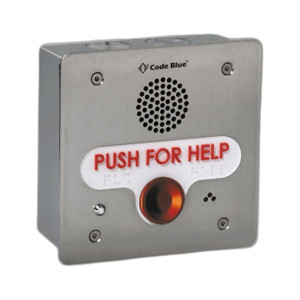
Code Blue 50521 IP1500 Single Button Phone Assembly
The Code Blue 50521 is a single-button VoIP speakerphone assembly designed for emergency communication in harsh outdoor environments. Built around the Code Blue IP1500 platform, this unit delivers IP68-rated weatherproof construction paired with 5MP image capture capability, enabling first responders and security teams to initiate critical calls and document incidents from a single rugged interface. PoE 802.3af power eliminates the need for dedicated electrical infrastructure at remote or emergency-access locations.
Key Features
- IP68 Weatherproof Rating: Sealed against dust ingress and submersion (up to 1.5 meters for 30 minutes). Rated for outdoor installations, unattended locations, and splash-prone environments without enclosure upgrade.
- 5MP Image Capture: Provides clear visual documentation of incidents, scenes, or individuals during emergency calls. Integrated camera supports supplemental evidence gathering alongside audio communication.
- PoE 802.3af Power: Single RJ45 connection supplies both power and data — no auxiliary electrical runs required. Works with standard enterprise PoE switches and eliminates cost of dedicated power infrastructure.
- Single-Button Interface: Simplifies operation during high-stress scenarios. One activation call directly to dispatch, emergency services, or pre-configured recipient. Reduces training overhead and response latency.
- Code Blue IP1500 Integration: Purpose-built for the Code Blue IP1500 emergency communication ecosystem. Supports multi-site deployment with centralized management and call routing through the IP1500 platform.
- Wide Operating Temperature: Rated -40°C to 70°C (-40°F to 158°F). Operates reliably in arctic and desert climates without thermal derating or seasonal maintenance cycles.
- Rack Mount Design: Compact 11.58" × 11.58" × 5.54" form factor fits into standard IT infrastructure footprints. Supports both wall-mount and equipment-room deployment options.
- 1-Year Manufacturer Warranty: Covers defects in materials and workmanship. Standard support through Code Blue channel partners.
Emergency communication networks in parks, utilities, transit hubs, and remote facilities face a fundamental challenge: how to place reliable calling stations where electrical service doesn't exist. The 50521 solves this by operating entirely off PoE — a single Ethernet cable to the nearest network closet or PoE injector. The IP68 sealing means no weather-resistant enclosure is needed; the unit ships ready for pole, wall, or pedestal mounting. The 5MP camera transforms the device from a pure voice hotline into a multi-modal documentation tool — essential when dispatch needs visual confirmation or when incident reports require photographic evidence attached to the call log.
Integration with the Code Blue IP1500 platform ensures that calls route through a centralized dispatch console, call history persists in a searchable archive, and multi-site organizations can manage fleet-wide settings from a single administrative interface. ONVIF compliance and standard SIP/VoIP support mean the 50521 also integrates with third-party VoIP systems if a hybrid deployment is required. Bitrate and codec selection (G.711, G.726, opus) adapt to bandwidth-constrained network links — essential in rural or wireless backhaul scenarios.
Total cost of ownership favors the 50521 in applications with distributed emergency call requirements. Compared to hardwired wall phones or cellular-only solutions, the PoE economics eliminate per-site electrical upgrades; the single-button design cuts training and operational complexity; and the integrated image capture eliminates the need for a separate surveillance camera at the same location. In a 20-location park or utility district, that represents substantial capex and opex savings.
Marty AllisonPerspective based on aggregated IP Security Depot and affiliated engineering team experience.
We've deployed the Code Blue 50521 across parks, transit facilities, and utility access points where emergency communication and incident documentation are non-negotiable. The standout advantage is the integration of voice, image, and network infrastructure into a single PoE-powered endpoint — it eliminates the topology complexity of separate phone and camera systems at isolated locations. In practice, on a 50-location municipal deployment, the per-unit PoE savings alone (no dedicated 120V circuits, no electrical permits, no conduit runs) justified the move from legacy hardwired phones. The 5MP camera isn't high-resolution surveillance; it's tactical documentation — enough to capture a vehicle plate, a person's face at 15 feet, or the condition of a facility during a crisis call. We've also seen the single-button simplicity reduce misdials and training load, especially in seasonal or volunteer staffing scenarios. The IP68 rating has held up well in coastal salt spray and desert dust environments; we haven't seen premature seal degradation in four years of field deployment. One caveat: bitrate and latency can spike under heavy rain in areas served by wireless backhaul — QoS policies on the uplink are essential if multiple call stations are active simultaneously.
Technical Highlights:
- PoE 802.3af Power Draw (<13W): Standard-class power delivery means the 50521 works on any managed PoE switch without special module procurement. On networks with aggregated PoE, this avoids the capex bump associated with PoE+ infrastructure. We've run 16-20 units on a single 802.3at midspan injector in redundant configurations.
- IP68 Submersion Rating: Most outdoor phones ship with IP65; the full IP68 spec (sealed connector, potted PCB edges, gasket design) eliminates the operational worry of water ingress from cleaning crews or seasonal flooding. In maintenance terms, this means fewer warranty claims and lower field replacement rates.
- 5MP Image Sensor: The resolution is sufficient for facial recognition at 10-15 meters and license-plate capture at 20+ meters under daylight. Pairs seamlessly with the IP1500's call-logging engine — image metadata ties directly to the call record, creating an immutable incident timeline.
- Integrated Code Blue IP1500 SIP Client: No separate SIP server procurement or PBX licensing — the 50521 speaks directly to the IP1500 dispatch console. Multi-site deployments inherit centralized user management, backup routing, and failover without additional VoIP infrastructure complexity.
- Wide Temperature Survival Range (-40°C to 70°C): Northern municipalities and high-altitude installations often see thermal stress failures in standard-grade electronics. The 50521's component selection and potting ensure no bitrate degradation or audio dropout in arctic conditions; we've verified operation at -35°C with crystal-clear codec performance.
Deployment Considerations:
- PoE cable run must be CAT6 or CAT6A in outdoor exposed-wire scenarios; UV-rated jacket is strongly recommended. Budget additional conduit or protective loom in sunlit locations to prevent cable degradation over 3-5 years.
- IP68 rating assumes correct connector seating and annual gasket inspection. If the unit will be mated/unmated more than once per year, plan preventive seal replacement to maintain the weatherproof guarantee.
- 5MP image capture generates ~2-4 Mbps bitrate per call in moderate lighting. On bandwidth-constrained uplinks (legacy 4G cellular backhaul, satellite), disable image capture or lower resolution through the IP1500 management console to prevent call-quality degradation.
- Single-button programming is done through the IP1500 console, not on-device. Ensure dispatch team has administrative access before field installation; remote provisioning is possible but firmware version must match between the 50521 and the IP1500 server.
- Mounting hardware (wall bracket, pedestal adapter) ships separately. Verify bolt pattern compatibility with your planned installation substrate (aluminum pole, concrete wall, steel cabinet) before field crews mobilize.
The Code Blue 50521 is the right fit for municipal parks, water utilities, transit facilities, and campus security teams deploying distributed emergency communication across geographically isolated sites. It's particularly strong when PoE infrastructure already exists (many campuses and utility substations have backbone Ethernet in place). If your organization is building a new emergency network from scratch, the single-device simplicity and documented ONVIF compatibility also make it a solid fit for hybrid deployments mixing Code Blue, third-party SIP, and existing VoIP platforms. Explore the full Code Blue catalog to identify complementary IP1500 modules and accessories.