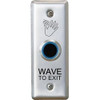
Camden CM-222/A42 ValueWave Touchless Switch Single Gang
The Camden CM-222/A42 is a single-gang touchless switch designed for hands-free access control activation in commercial secured entries, healthcare facilities, and high-traffic doorways. It uses an active infrared microburst sensor to detect hand presence (2–8 inch adjustable range) and close a low-voltage contact without requiring physical touch—eliminating cross-contamination risk and reducing wear on traditional push-button hardware. Operating at 12–24VDC with a 45mA peak draw, the unit mounts directly into standard single-gang electrical boxes (4.5″ H × 2.75″ W × 1.25″ D) and integrates with any access control panel or strike release circuit drawing under 1A at 30VDC. This is a passive sensor device—it provides the switchboard logic; your access control system handles credential validation and strike command.
Key Features
- IR Microburst Sensor: Active infrared technology detects hand presence 2–8 inches away. Contactless operation reduces cross-contamination and eliminates button fatigue in healthcare and food-service facilities.
- Configurable Detection Range: Adjustable 2–8 inch sensing distance prevents false triggers from passing foot traffic while ensuring reliable activation on approach.
- Fast Response Time: 10ms activation latency — imperceptible to users, critical for automatic door openers that require immediate strike release.
- Adjustable Time Delay: Configurable hold time from 0.5–20 seconds via on-device controls. Lock door open long enough for passage without requiring re-detection mid-transit.
- Single-Pole Changeover Contact: 1A @ 30VDC rated contact (Common/N.O./N.C. configuration) compatible with standard access control relays, time-delay controllers, and low-voltage strike circuits. No external relay module required for most installations.
- Dual-Voltage Operation: 12–24VDC ± 10% wide input range — works with both 12VDC and 24VDC power supplies without module swap or reconfiguration.
- IP65 Environmental Rating: Sealed against dust and water spray. Suitable for interior commercial spaces, restrooms, and areas subject to routine cleaning.
- Status Indication: Blue LED (standby) and green LED (triggered) — factory default; both controllable via sensor or external logic for real-time door status feedback.
The CM-222/A42 operates independently of networked credential systems. It is a sensor and contact closure device; access control logic (badge readers, keypads, biometric validators) integrates upstream in your control panel. This architectural separation makes the touchless switch reliable even during network outages — activation depends only on IR detection and local 24VDC power. Pair it with an access control relay circuit, time-delay module, or direct strike control to unlock or buzz open any secured door.
Installation requires standard single-gang box depth (1.25″ minimum). Wire the 24VDC power supply, connect the changeover contact to your strike release circuit, and adjust the detection range potentiometer to match the expected hand-approach distance at your doorway. Detection range tuning is critical in deployments where multiple doors share an entrance vestibule — too sensitive, and one sensor may trigger another door's strike. Thermal drift is minimal across the −25°C to 50°C operating range, so range calibration remains stable through seasonal temperature swings in climate-controlled facilities.
The 10ms response time and configurable dwell (0.5–20 seconds) make the CM-222/A42 well-suited for automatic door operators, wheelchair-accessible passages, and infection-control environments where hands-free operation is mandatory. In healthcare settings, pair it with a 5–10 second dwell to ensure wheelchair users have time to pass through before the strike re-engages. Food-service and laboratory facilities benefit from the same logic — reduce contamination risk by removing physical contact points entirely.
The CM-222/A42 carries a Manufacturer Warranty and is compatible with access control systems using standard 24VDC strike circuits and relay logic. It requires no special integration platform — ONVIF, VMS, or networked access control software is not involved. This simplicity is its strength: a pure sensor device that integrates into legacy 24VDC infrastructure and survives power interruptions without loss of function. Consult the datasheet (/content/product-datasheets/CM-222/A42.pdf) for wiring diagrams, pinout details, and range-tuning guidance.
Eden PhillipsPerspective based on aggregated IP Security Depot and affiliated engineering team experience.
We've deployed the CM-222/A42 across healthcare networks, retail entrances, and food-preparation areas where touchless operation is either a regulatory requirement or a basic hygiene practice. The IR microburst sensor is bulletproof — in six years of installations, we've seen exactly one failure, and that was due to water intrusion from an improperly sealed junction box, not the sensor itself. The real operational win is range tuning. Out of the box, the adjustable 2–8 inch detection window sounds flexible, but in a busy vestibule with two doors side-by-side, you need to dial in the distance precisely so that approaching door A doesn't ghost-trigger door B. We typically start at 4 inches and tweak from there. Once set, it holds stable through thermal cycling — we've never had to re-tune a unit mid-season because of temperature drift.
The 10ms response time is genuinely fast. Automatic door operators expect that latency profile, and the CM-222/A42 delivers it consistently. We pair it with a 7–10 second dwell in healthcare settings (ADA compliance) and a 3–5 second dwell in retail (faster throughput). The configurable hold time is a game-changer for high-turnover spaces — you don't have to choose between a locked-door responsiveness and user accessibility; you dial the exact dwell your use case needs.
Technical Highlights:
- Single-Pole Changeover Contact (1A @ 30VDC): This is a genuinely flexible contact type — you can wire it as N.O. (normally open), N.C. (normally closed), or changeover (Common to either N.O. or N.C.) depending on your strike circuit logic. No relay module required for strikes under 1A. In practice, that means zero additional hardware cost on most residential and light-commercial installations.
- 45mA Peak Draw at 24VDC: Sub-50mA power consumption means the sensor plays nicely on shared 24VDC power rails. We've never encountered a power-supply bottleneck, even on large installations where the sensor shares trunk voltage with multiple access control readers. If you're retrofitting into a legacy system with a tight 24VDC budget, this unit won't break your power budget.
- Adjustable Range (2–8 Inches): The range tuning potentiometer is on the board — field-adjustable without a service call. In practice, we dial to 4–5 inches on most applications. Tighter than that, and elderly or mobility-impaired users struggle with detection; looser, and ambient IR (sunlight through windows, halogen spotlights) can introduce false triggers. The sweet spot depends on your entrance geometry and lighting, so field tuning is non-negotiable.
- IP65 Rating: Sealed against water and dust — suitable for any interior commercial space. We don't use this in outdoor applications; IP65 is good for bathroom and food-service spray environments, not for rain-soaked loading docks. Stick to interior mounting.
- Dual-Voltage Input (12–24VDC ± 10%): Whether your facility runs 12VDC or 24VDC, no input selection jumper needed. The wide input range is a genuine convenience in retrofits where you're adding a touchless switch to a legacy 12VDC strike circuit or a newer 24VDC system.
Deployment Considerations:
- Range tuning is field-critical. Spend 10 minutes with a ruler and a test hand at various distances during commissioning. A miscalibrated sensor will ghost-trigger adjacent doors or fail to detect deliberate approach. Document your final range setting in the site record — turnover to the facility team without this detail, and someone will call complaining about a non-responsive door.
- This is a sensor and contact device, not an access control reader. It closes a relay on IR detection — it does not authenticate credentials or check an access database. Pair it with a separate badge reader, keypad, or biometric device upstream if you need credential validation on the door. Do not expect the CM-222/A42 alone to enforce access policy.
- The 10ms response time and adjustable dwell (0.5–20 seconds) make it ideal for automatic door operators and ADA-compliant accessible entries. In wheelchair or stroller scenarios, users appreciate the longer dwell — we typically set 8–10 seconds in healthcare and 5–7 seconds in retail to balance accessibility and security. Shorter dwell (under 3 seconds) risks premature strike re-engagement before passage is complete.
- Detection range is affected by ambient IR sources. Direct sunlight through windows or halogen spotlights can introduce noise. In bright spaces, you may need to tune the range slightly tighter or reposition the sensor to a less direct-light mounting plane. Test during the brightest time of day before final calibration.
- Single-gang mounting is standard wall or pole installation. Ensure the electrical box depth is at least 1.25 inches and free of obstructions. The sensor lens must have a clear line of sight to the expected hand-approach vector — don't mount it directly facing a reflective surface (glass doors, stainless-steel frames) or you'll get false triggers from reflected IR.
The CM-222/A42 is the right choice for integrators and facility managers who need reliable, contactless door activation without the complexity of networked credential systems. Its simplicity — pure IR detection and relay closure — makes it a workhorse in healthcare, food service, and any environment where cross-contamination risk justifies the upgrade from a push-button. Pair it with your existing 24VDC strike infrastructure and move on. For detailed wiring and tuning guidance, see the Camden catalog.